

Enhanced Yield Strategies & Rising Rates
Published April 26, 2018

U.S. Head of Research

Director, Research
Just shy of three years ago, WisdomTree launched the WisdomTree Barclays Yield Enhanced U.S. Aggregate Bond Fund (AGGY), an exchange-traded fund (ETF) that seeks to track the yield and performance of the Bloomberg Barclays U.S. Aggregate Enhanced Yield Index (Enhanced Yield). While our strategy draws from the same investable universe as the Bloomberg Barclays U.S. Aggregate Index (Agg), it seeks to boost income by reweighting exposures across 20 buckets. In order to maintain a comparable risk profile to the Agg, a series of qualitative and quantitative constraints are run to keep credit and duration over-weights in check. Since interest rates started to rise in 2016, investors have questioned whether a strategy that is one year longer in duration than the benchmark is prudent. As we highlight below, we believe our approach continues to deliver value in the core of investor bond portfolios.
The Trade-Offs of Higher Yield
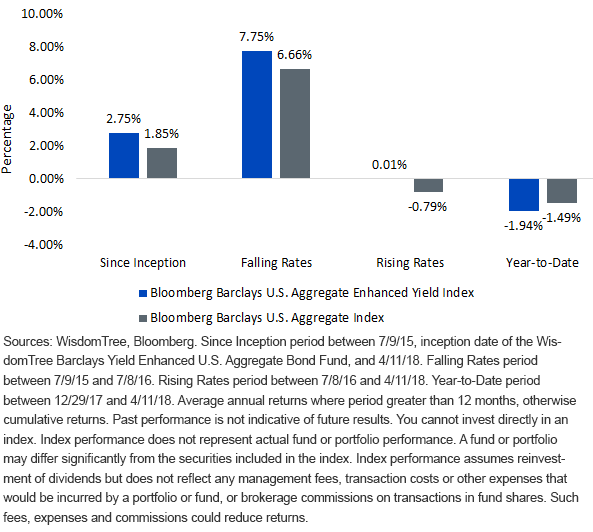
The two main levers that investors can pull to enhance yield are incremental credit and interest rate risk. Since inception, the strategy has been over-weight credit and has generally been over-weight duration by one year. On average, our approach maintained a yield advantage of 60 basis point (bps). As we show below, the strategy has outperformed the Agg by 90 bps per year since inception. While 5-year and 10-year interest rates rose over this period, credit spreads tightened and the yield curve flattened. Put another way, our strategy was not dependent on falling rates to generate excess returns versus the Agg. Below, we quantify performance during rising and falling rate periods.
Yield Enhanced: Greater Income and Total Return Outperformance
Average Annual Returns for Enhanced Yield vs. the Agg
Falling Rates
As one would expect, an index with increased duration during a falling rate environment was rewarded. Over the falling rate period, the Index outperformed the Agg by more than 100 basis points. However, what happens to credit spreads in a falling rate environment is also important. Falling rates are often associated with investor fears over slower economic growth. In this instance, credit spread volatility ticked up in the second half of 2015 and early 2016 as fears of a China slowdown weighed on risky assets and commodities. Despite those short-term concerns, credit spreads generally tightened over the period.
Rising Rates
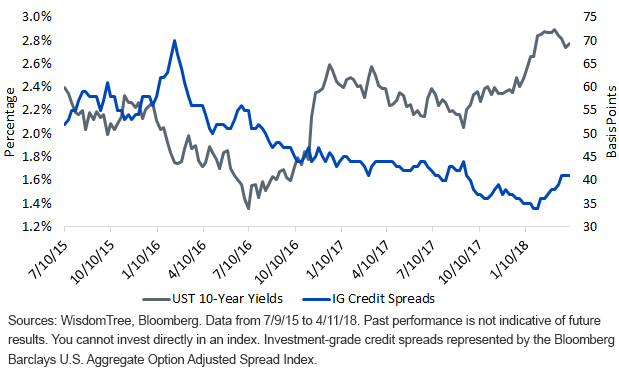
In our view, one of the primary takeaways that investors overlook in our Enhanced Yield Index is the concept of diversification. While our approach is generally over-weight interest rate risk versus the benchmark, it is also generally over-weight credit risk. With few exceptions, periods of rising rates generally coincide with faster economic growth, increases in inflation expectations and a healthier U.S. economy. As a result, credit spreads tend to tighten as the risk of ratings downgrades recedes. In reviewing the performance over the past seven quarters, a period in which 10-Year Treasury yields rose by more than 140 basis points,1 the yield-enhanced Index outperformed the Agg by 80 basis points annualized.
- Bottom Line: A credit over-weight resulted in higher income and the ability to benefit from tighter spreads despite the headwinds of increased duration during a rising rate environment. The Index may have a tough time over short periods, such as the year-to-date performance, but over market cycles, the Enhanced Yield approach adds value.
UST 10-Year Yields and Investment-Grade Credit Spreads
Current Performance
While diversification can add value in the long run, there is no guarantee that rates and credit will always move in opposite directions. Year-to-date has been a negative for both: wider credit spreads and higher rates. Over this narrow period, the Index has underperformed the Agg by 45 basis points. Much of the rate rise this year occurred in January and early February, and rates have since been range-bound. As for credit, a host of factors unrelated to economic fundamentals have been floated as to credit widening, largely due to fleeting supply-and-demand factors. In our view, it seems unlikely that this trend will continue indefinitely. As a result, we believe the income advantage has the ability to narrow the performance gap over time. As of April 11, 2018, the additional income advantage over the Agg was 47 basis points.2
Conclusion
It’s impossible for this Index, or any index, to outperform in all environments. With the Federal Reserve (Fed) hiking interest rates at a measured pace, it seems to us that the central bank views economic conditions as strong. This gives us conviction in being over-weight credit. As a result, our income advantage should help investors generate returns during a period of rising rates, provided they do not rise rapidly. Later in the cycle, credit spreads will inevitably widen. As a result, nominal interest rates should fall as the Fed shifts its bias from tightening to easing. In our view, our Enhanced Yield strategy has the ability to add value across market cycles.
1Source: Bloomberg, as of 4/11/18.
2Source: Bloomberg, as of 4/11/18.
Important Risks Related to this Article
There are risks associated with investing, including possible loss of principal. Fixed income investments are subject to interest rate risk; their value will normally decline as interest rates rise. Fixed income investments are also subject to credit risk, the risk that the issuer of a bond will fail to pay interest and principal in a timely manner or that negative perceptions of the issuer’s ability to make such payments will cause the price of that bond to decline. Investing in mortgage- and asset-backed securities involves interest rate, credit, valuation, extension and liquidity risks and the risk that payments on the underlying assets are delayed, prepaid, subordinated or defaulted on. Due to the investment strategy of the Fund, it may make higher capital gain distributions than other ETFs. Please read the Fund’s prospectus for specific details regarding the Fund’s risk profile.
Categories
About the contributors

U.S. Head of Research
Bradley Krom joined WisdomTree as a member of the research team in December 2010. He is involved in creating and communicating WisdomTree’s thoughts on global markets, as well as analyzing existing and new fund strategies. Prior to joining WisdomTree, Bradley served as a senior trader on a proprietary trading desk at TransMarket Group. Bradley is a graduate of the Wharton School, University of Pennsylvania.

Director, Research
Matt Wagner joined WisdomTree in May 2017 as an Analyst on the Research team. He currently serves as a Director, where he supports the creation, maintenance, and reconstitution of WisdomTree’s indexes and actively managed ETFs. Matt began his career at Morgan Stanley, working as an analyst in Treasury Capital Markets from 2015 to 2017, focusing on unsecured funding planning, execution, and risk management. He graduated magna cum laude from Boston College in 2015 with a B.A. in International Studies, concentrating in Economics. In 2020, he earned a Certificate in Advanced Valuation from NYU Stern. He is also a Chartered Financial Analyst (CFA) charterholder.