

Small-Cap Investors: Time to Listen More Closely
Published June 3, 2019

Director, Research
Last year, we touched on a Federal Reserve (Fed) financial stability report that highlighted elevated corporate leverage as a vulnerability to the financial system. Following that report, the Fed hiked rates in December and signaled further rate hikes for 2019.
You can be excused for shrugging this off. If the economy were in trouble, why would the Fed be raising rates?
But with the Fed officially putting further rate hikes on hold for 2019 and publicly acknowledging some softness in the global economy, it may be time asset allocators listen more closely to such misgivings.
Take, for instance, a statement on March 20 by Fed Chairman Jerome Powell at a conference on financial markets in Fernandina Beach, Florida: “Business debt has clearly reached a level that should give businesses and investors reason to pause and reflect.”1
This statement does not reveal some new finding by Chairman Powell and the Fed. They have been expressing this sentiment for some time now.
But perhaps the judgment may carry more weight now than it did just six or seven months ago.
Greater Leverage, Greater Down Capture
Small caps are one of the market segments we have been highlighting as the most at threat to potentially increasing debt loads. To be clear, increasing debt is a normal business-cycle process that takes place as borrowers and lenders get more confident in their ability to repay and get repaid on loans. And corporate treasurers may have been capitalizing on this era of low interest rates to readjust capital structures.
We also know that typically companies that have the highest debt burdens are more acutely exposed to a deceleration in the economy. To measure this, we dissected the interest-paying Russell 2000 Index constituents by their interest coverage ratios (earnings before interest and taxes over interest expense).
Between August 31 and the bottom of last year’s sell-off on December 24—a period when the Russell 2000 Index was down over 20%—the most indebted quintile of companies based on interest coverage ratios plus companies with negative coverage ratios were down 27.81% and 31.78%, respectively.
That performance compares to those companies in the top quintile of coverage ratios that returned -23.24%.
Russell 2000 Performance by Interest Coverage Ratio Categories
Cumulative Returns During 2018 Drawdown (8/31/18–12/24/18)
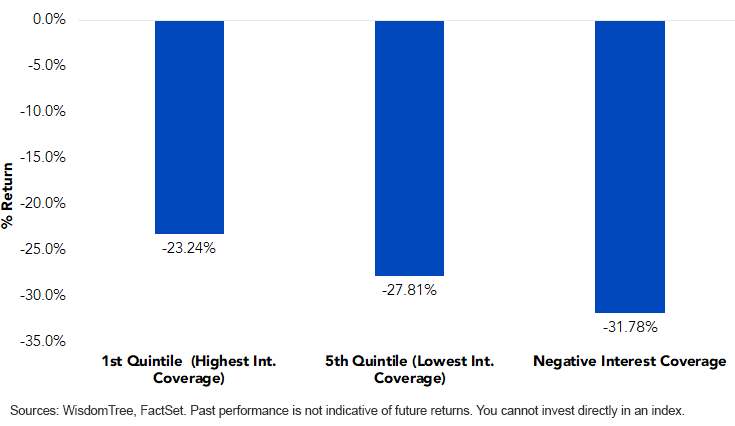
It appears that during the sell-off—when global macro conditions were signaling a slowdown—investors responded by more aggressively dumping the shares of companies with the greatest debt burdens relative to their higher-quality peers.
What could this performance mean for investors going forward?
While the Russell 2000 Index has about 13% of its weight in companies with negative interest coverage ratios (sometimes referred to as “zombie companies”), we also think small caps broadly can profit from a still-growing domestic economy with reduced exposure to the headline risks of a trade war (think China targeting mega-caps like Apple2).
In sum, for investors looking for a way to reduce volatility within small-cap allocations, we think now is the time to move up the quality spectrum.
Higher-leverage peers are likely to offer better returns during a strong market climb, like the rebound to start this year, but we think the present later stage of the cycle favors a tilt away from such companies.
WisdomTree Small-Cap Exposures
WisdomTree offers three domestic small-cap Funds: the WisdomTree U.S. SmallCap Quality Dividend Growth Fund (DGRS), the WisdomTree U.S. SmallCap Dividend Fund (DES) and the WisdomTree U.S. SmallCap Fund (EES).
Each Fund offers higher interest coverage ratios than the Russell 2000 Index, mainly by reducing exposure to negative earners through a fundamental screening process, and each provided relative downside protection during last year’s sell-off.
Cumulative Returns During 2018 Drawdown (8/31/18–12/24/18)
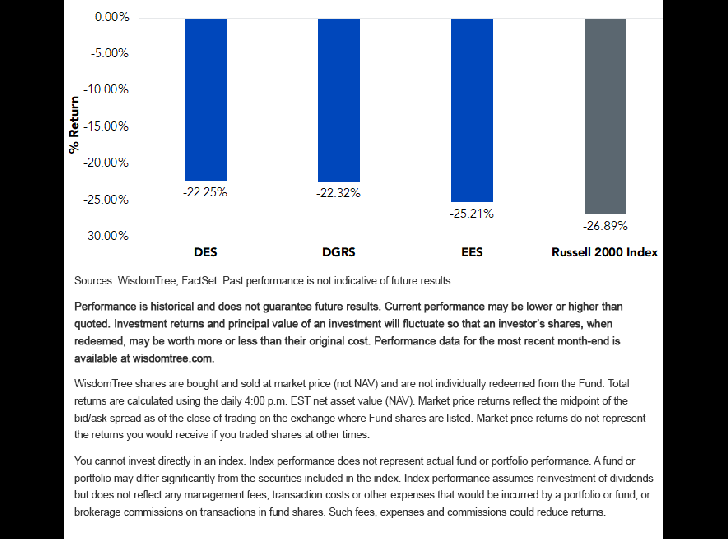
For standardized performance of DES, DGRS and EES, please click the respective ticker.
1Andrew Ackerman and Nick Timiraos, “Fed Chairman Powell Warns of Economic Risks from Rising Business Debt,” The Wall Street Journal, 5/20/19.
2As of 5/31/19, DES, DGRS and EES hold 0% of APPL
Important Risks Related to this Article
There are risks associated with investing, including possible loss of principal. Funds focusing their investments on certain sectors and/or smaller companies increase their vulnerability to any single economic or regulatory development. This may result in greater share price volatility. Please read each Fund’s prospectus for specific details regarding the Fund’s risk profile.
Categories
About the contributor

Director, Research
Matt Wagner joined WisdomTree in May 2017 as an Analyst on the Research team. He currently serves as a Director, where he supports the creation, maintenance, and reconstitution of WisdomTree’s indexes and actively managed ETFs. Matt began his career at Morgan Stanley, working as an analyst in Treasury Capital Markets from 2015 to 2017, focusing on unsecured funding planning, execution, and risk management. He graduated magna cum laude from Boston College in 2015 with a B.A. in International Studies, concentrating in Economics. In 2020, he earned a Certificate in Advanced Valuation from NYU Stern. He is also a Chartered Financial Analyst (CFA) charterholder.