

Reconciling the Chinese Economy with Chinese Equities
Published January 22, 2018

U.S. Head of Research
While many investors understand the important role that China plays in the global economy, this generally doesn’t translate into significant portions in their equity portfolios. In our view, this will likely change over the course of the next several years. After a series of financial market reforms, President Xi Jinping could be on track to oversee the most significant shift in Chinese policy since Deng Xiaoping. However, getting exposure to Chinese stocks today is not necessarily as straightforward as in the U.S. market. American companies list on U.S. exchanges, while Chinese companies may list in the U.S., Singapore, Hong Kong or mainland China. As a result, the common notion of beta for the Chinese market is ill defined. In this piece we provide an introduction to the variety of options available to investors who seek exposure to Chinese stocks and how the market may evolve over time.
In the table below, we highlight the key differences between the seven varieties of Chinese shares. Until recently, shares listed on mainland China exchanges were generally available only to institutional investors. After a series of pilot programs, global investors are starting to take note. Although MSCI’s June 2017 A-shares announcement captured attention, we estimate that the immediate impact on the market will be limited. However, Goldman Sachs released a note proclaiming that A-shares had moved from a nice-to-have market to an essential one. As global access to Chinese markets evolve, subjective decisions for indexes can have a dramatic impact on the breadth of exposure as well as portfolio risk.
Overview of Chinese Share Classes
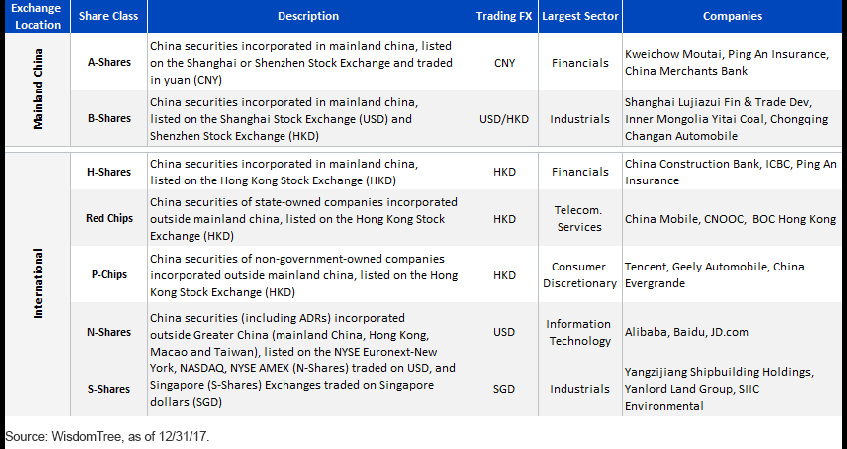
The primary rationale for why investors are excited about the A-shares market is that it’s underowned in global portfolios, it’s largely held by Chinese retail investors and it provides exposure to certain “New China” sectors of the economy that investors lack. In the middle of 2017, Goldman Sachs estimated that approximately 1.4% of the China A-share market was held by foreign investors. This signals opportunity for returns and diversification. On the final point, the economic model in China must evolve, which means increasing exposure to consumer-oriented sectors. The promise of A-shares is that they can dramatically increase opportunities in many of these industries.
International Exposures
For most China investors, H shares are probably the most familiar flavor given that they currently account for 35% of the MSCI China Index.1 While Hong Kong historically has served as the nexus to mainland China, its role as financial hub ensures that it will continue to be a big part of Chinese allocations. The one challenge is that this segment of the market is dominated by the Financials sector (70%). While Financials can certainly thrive as markets liberalize, they are also viewed with the greatest skepticism from China bears.
In terms of Chinese red chips vs. P chips, we find that significant state ownership may not always convey advantages for shareholders in the long run. However, state-owned firms make up a large percentage of the Chinese economy and should thus be a part of any beta-focused index. Finally, N shares and S shares, dominated by technology firms, represent some of the most dynamic and compelling opportunities in Chinese markets today. While some investors are cautious about Alibaba’s and Tencent’s massive returns in 2017, we find that a significant portion of their performance has come from dramatic revenue and profit growth as opposed to multiple expansions.
Tying It All Together
In sum, we believe that financial market reform in China will prove to be a positive catalyst for emerging markets generally and China specifically. As access grows, the prominence of China will continue to increase in emerging market indexes as well as global investor portfolios. While some benchmarks currently provide exposure to most flavors of Chinese equities, very few provide complete coverage. This is why we sought to partner with S&P to license the S&P China 500 Index. While it provides exposure to all flavors of Chinese equities, it also seeks to maintain broad-based exposure across sectors. In our view, if investors are interested in overweighting China relative to existing benchmarks, we believe this comprehensive approach offers one of the best approaches to owning beta in Chinese equities.
1Source: MSCI, as of 11/30/17.
Important Risks Related to this Article
Investments focused in China increase the impact of events and developments associated with the region, which can adversely affect performance.
Categories
About the contributor

U.S. Head of Research
Bradley Krom joined WisdomTree as a member of the research team in December 2010. He is involved in creating and communicating WisdomTree’s thoughts on global markets, as well as analyzing existing and new fund strategies. Prior to joining WisdomTree, Bradley served as a senior trader on a proprietary trading desk at TransMarket Group. Bradley is a graduate of the Wharton School, University of Pennsylvania.