
DHS: Bucking ‘18 Street Consensus
Published January 18, 2018

Head of Equity Strategy
Ask the market what fate awaits stocks with high dividends, and the answer often lies in the outlook for interest rates. This is logical. When bond yields rise, the incentive to own stocks that offer higher dividends wanes, and vice versa. Fortunately for the WisdomTree U.S. High Dividend Fund (DHS), a rising rate environment hasn’t hit the market in recent years, right? Actually, wrong.
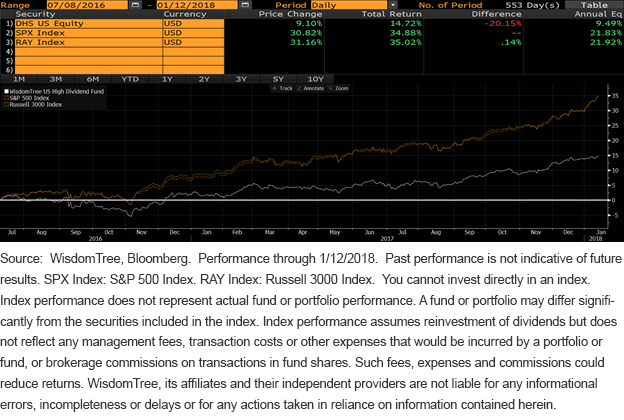
In the summer of 2016, U.S. 10-Year Treasury note yields collapsed to 1.359%, and they have subsequently risen more than a full point, to 2.55%.1 The pain in yield-oriented DHS has been palpable (figure 1).
Figure 1: Performance Since 2016 Low in 10-Year T-Note Yield
Click here for DHS standardized performance.
The thing is that right now there is a remarkably crowded Wall Street consensus that U.S. 10-Year T-note yields will continue to rise in 2018, so much so that predictions by 54 out of 61 economists compiled by Bloomberg in January see them going higher. In fact, not one economics team put a “1” as the first digit on the yield for the end of 2018. This is a crowded consensus.
If they are right, more trouble is probably in store for DHS compared to broad U.S. equity indexes. However, if they are proved wrong, which happens too often for comfort when the consensus is lopsided, we could be looking at a value play for the few who entered 2018 with a contrarian view on rates. And rates may not even have to move lower to aid DHS; it could be as simple as a situation in which rates do not move much higher, or that they chop sideways, disappointing the economists’ collective forecasts and surprising the masses.
The “Siegel Chart”: Put It Under the Pillow, Rip Van Winkle
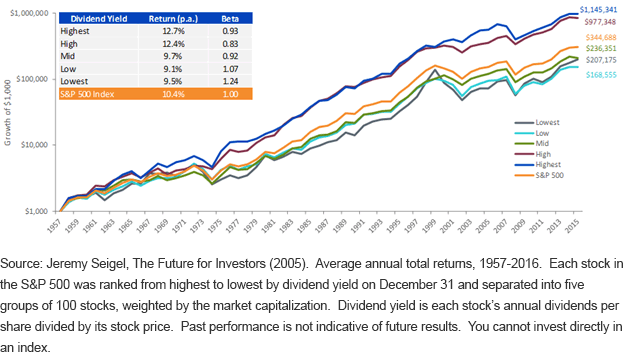
Outside of the macro case for yield-oriented securities to have a bout of relative performance in 2018, we have the supporting half century of fundamental data in the form of what WisdomTree affectionately refers to as “the Siegel chart.” After watching DHS underperform the S&P 500 by double-digit percentage points in 2017, the Siegel chart in figure 2 may provide solace for those who take greater comfort in six decades of data than in the action of just a few recent years.
That data shows that a strategy that divided the S&P 500 into five groups of 100 based on each company’s dividend yield, with an annual rebalance, would have resulted in 230 basis points (bps) of annual outperformance for the highest-yielding group over 59 years. In retrospect, it would have been wise to enter a high-dividend strategy back in 1957 and take a multidecade Rip Van Winkle nap, waking to a very pleasant result today.
Figure 2: “The Siegel Chart”
Siegel + Consensus Bucking for 2018
What Professor Jeremy Siegelfound, quite plainly and clearly—and what we have all heard, read and talked about for years—is that companies that send money back to shareholders are less likely to squander it on bad ideas and bad ventures.
Companies that pay dividends, and pay handsomely, are usually the ones that are serving their stockholders. With time, that consideration can pay off.
Because DHS screens for the 30% of companies in our dividend-paying universe that have the highest yields, these modern alpha ETFs reincarnate the Siegel study for those who realize that sometimes investing boils down to the use of logic and reason.
Tie in this modern alpha concept with the nearer-term crowding of Wall Street consensus and the result looks like a nice recipe for 2018.
1Source: Bloomberg. Data as of 1/15/2018.
Important Risks Related to this Article
There are risks associated with investing, including possible loss of principal. Funds focusing their investments on certain sectors increase their vulnerability to any single economic or regulatory development. This may result in greater share price volatility. Please read the Fund’s prospectus for specific details regarding the Fund’s risk profile.
Dividends are not guaranteed, and a company currently paying dividends may cease paying dividends at any time. An investment’s value may decline due to an increase in interest rates. When interest rates fall, income may decline.
About the contributor

Head of Equity Strategy
Jeff Weniger, CFA, has been with WisdomTree since 2017 and serves as the Head of Equities. He shapes the firm’s market outlook through a combination of macroeconomic and fundamental analysis. With more than two decades in investment strategy, Jeff is known for his work on market cycles and valuations. Before joining WisdomTree, Jeff was with BMO Private Bank and BMO Global Asset Management for 11 years. At BMO, he sat on the firm’s Asset Allocation Committee and co-managed ETF model portfolios across the U.S. and Canada. In 2013, at age 32, he became the youngest member of BMO’s Global Investment Forum. When he left BMO to come to WisdomTree, his final role was Director, Senior Strategist in the Office of the CIO in 2017.
Jeff is a frequent television guest on networks such as CNBC, Bloomberg, and Schwab, with regular print appearances in The Wall Street Journal, Barron’s and Reuters. He also appears weekly on the Behind the Markets podcast and is a regular on SiriusXM’s The Business Briefing. On X, Jeff has developed one of the larger followings in financial media. He earned a B.S. in Finance from the University of Florida and an MBA from the University of Notre Dame. He has held the CFA charter since 2006.