

Money Market Reform: The Shot Clock Is Ticking
Published August 24, 2016

Head of Investment and Fixed Income Strategy
On October 14, 2016, money market reform here in the U.S. is slated to be implemented. And the potential repercussions are already being witnessed, as investors do not seem to want to wait until implementation day to begin making adjustments to their money market portfolios. The upcoming money market reform had its genesis in the financial crisis. During the height of that crisis, a money market fund “broke the buck” and repriced its shares below the $1.00 threshold. As a result, prime institutional money market funds experienced heavy redemptions, as investors withdrew “approximately $300 billion (14% of their assets),” according to the U.S. Securities and Exchange Commission (SEC). These redemptions continued until the U.S. Treasury provided another one of its government guarantees, and they ultimately led to the reform measures that will become activated in mid-October. For the record, there are a variety of different money market funds (MMFs), and they can invest primarily in government securities, tax-exempt securities or corporate debt securities. Prime funds are money market funds that invest mainly in corporate debt. The most noteworthy change is that institutional prime MMFs will be required to have a floating net asset value (NAV) and can impose liquidity fees and redemption gates during periods of stress. (A floating NAV utilizes market-based factors to value securities within the portfolio. Redemption gates are the ability to suspend withdrawals temporarily if a fund’s level of weekly assets falls below a certain threshold.) These rules will also apply to institutional municipal money market funds. Retail MMFs will not be required to use a floating NAV but will have the ability to impose liquidity fees and redemption gates in periods of stress as well. Government MMFs (funds that invests at least 99.5% of their total assets in cash, government securities and/or repurchase agreements collateralized by government debt or cash) will also not be required to have a floating NAV and would not be subject to the liquidity fees/redemption gate rules. Recent Trends in Three-Month LIBOR and Financial Commercial Paper Markets
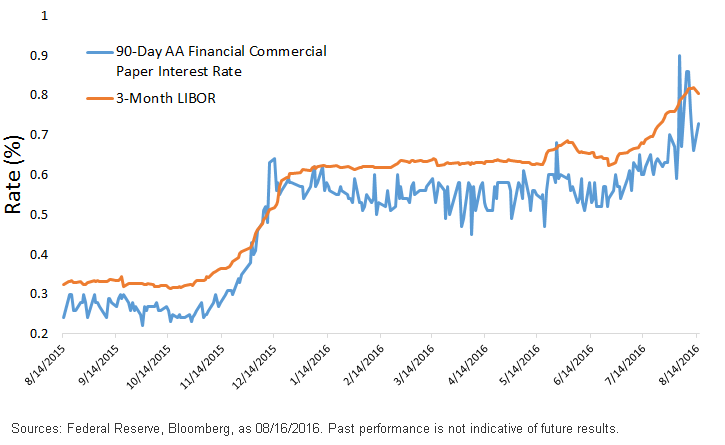
As mentioned, there are clear signs that investors have already begun the process of adjusting to these new rules, as cash has been leaving prime MMFs and moving into government funds. As a result, the markets have been witnessing lower demand for short-term corporate debt, such as financial commercial paper (CP). In order to compensate for this reduced demand, CP issued by financials has seen a rather visible rise in rates just over the last four to six weeks. Since adjusting to the Fed’s first rate hike in December, 90-day financial CP rates climbed another 36 basis points (bps) to a high of 0.90% in early August. There has been some retreat from this high watermark, but as of this writing, the increase was still in the 25-bps vicinity. These elevated CP rates have spilled over into the LIBOR arena, pushing three-month LIBOR up by roughly 15 bps since the end of June. Conclusion As investors continue the process of reallocating funds from prime MMFs to government funds, further dislocations, and potentially higher CP and LIBOR rates, could ensue. Why does this matter? With many borrowing arrangements tied to LIBOR, any sustained increase can actually serve as a non-Fed-related “stealth” tightening. Thus far, Fed officials have not publicly stated any concerns on this front, but it is certainly a situation that will bear continued monitoring.
Important Risks Related to this Article
Fixed income investments are subject to interest rate risk; their value will normally decline as interest rates rise. In addition, when interest rates fall, income may decline. Fixed income investments are also subject to credit risk, the risk that the issuer of a bond will fail to pay interest and principal in a timely manner or that negative perceptions of the issuer’s ability to make such payments will cause the price of that bond to decline.
About the contributor

Head of Investment and Fixed Income Strategy
Kevin serves as the Head of Investment and Fixed Income Strategy. In this role, he writes macro and fixed income-related content and works closely with the sales, research and marketing teams. In addition, Kevin conducts client-facing webinars and meetings, providing expertise on WisdomTree’s existing and future bond ETFs. Prior to joining WisdomTree, Kevin spent 30 years at Morgan Stanley, where he was Managing Director and Chief Fixed Income Strategist for Wealth Management. He was responsible for tactical and strategic recommendations and created asset allocation models for fixed income securities. He was a contributor to the Morgan Stanley Wealth Management Global Investment Committee, primary author of Morgan Stanley Wealth Management’s monthly and weekly fixed income publications, and collaborated with the firm’s Research and Consulting Group Divisions to build ETF and fund manager asset allocation models. Kevin has an MBA from Pace University’s Lubin Graduate School of Business, and a B.S. in Finance from Fairfield University.