
DXJ
Japan Hedged Equity Fund

Published November 26, 2024

Director, Research
Japan continues to capture foreign investor attention.
The market sell-off in late July/early August caused the wrong kind of attention for market bulls. But for opportunistic investors, the sell-off has so far proved to be a tremendous buying opportunity.
The market's blend of low valuations, corporate reforms and global economic positioning is just one of the reasons investors who turned away from Japan this summer may want to reconsider allocations.
Recent developments in the nation's political and financial landscapes highlight both challenges and opportunities, creating a unique investment narrative.
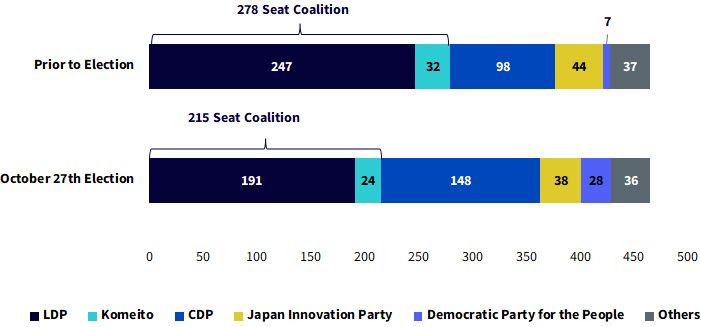
A recent lower house election in Japan on October 27 served as a de facto referendum on the administration of the new prime minister, Shigeru Ishiba. Concerns about cronyism and the rising cost of living led to a surprise defeat for the ruling coalition of the Liberal Democratic Party (LDP) and Komeito.
The result puts into question more than a decade of political stability in Japan. On November 11, PM Ishiba survived a parliamentary vote to remain in office, but he will have to walk a tightrope while ruling from a minority government. Figure 1 highlights the results of the recent lower house election.
Figure 1: Lower House Election Results—465 Seats Total (233 Majority)
Source: The Economist.
Despite this potential political headwind, the broader structural drivers of Japan's economic appeal remain firmly intact. Monetary policy is still broadly accommodative, and the government may have a greater incentive now to favor expansionary fiscal policy over budget discipline. On November 22nd, Japan's cabinet approved a fiscal stimulus package worth more than $140 billion to boost growth. Meanwhile, reforms initiated by the Tokyo Stock Exchange (TSE) continue to focus on improving corporate governance.
These changes represent critical steps in positioning Japan as a globally competitive market. Governance reforms, particularly those encouraging transparency and shareholder value creation, have been instrumental in fostering investor confidence.
One concrete way Japanese companies have been illustrating governance reforms is through generous dividend growth programs. The growth in cumulative dividends by region from 2019 to 2024 demonstrates Japan's strong performance in dividend expansion compared to other regions, as seen in figure 2.
Figure 2: Cumulative Dividend Growth by Region
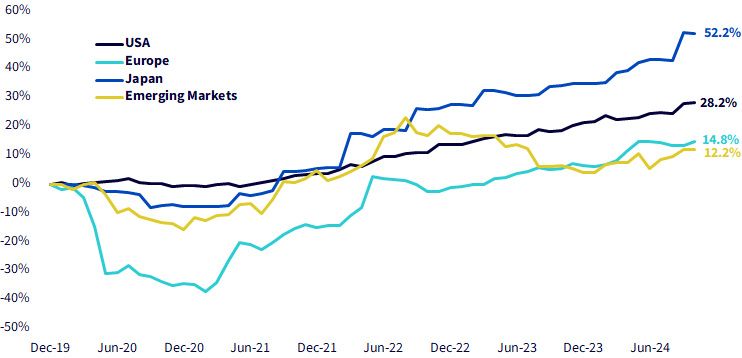
Sources: WisdomTree, MSCI, 12/31/19–10/31/24. Dividends are trailing 12 months. Regions represented by respective MSCI Indexes. Dividends measured in local currency. You cannot invest directly in an index.
Japan's market is increasingly appealing to foreign investors, with recent high-profile activity underscoring this trend.
Warren Buffett's incremental stake increases in Japanese trading houses (or Sogo Shuga) highlight the value proposition these companies offer. Often referred to as Japan's version of Berkshire Hathaway, these firms provide diversified exposure to the nation's economic engine.
Beyond Buffett, cross-border deals like the potential acquisition of 7-Eleven's parent company (Seven and I) by a Canadian firm (Circle K's parent company) signal that Japan is becoming more appealing for—if not open to—global investors. Such moves reflect a (potential) shift in attitude toward foreign ownership and signal broader opportunities for global capital to access Japanese assets.
Foreign investment flows into Japanese stocks have grown but are still at relatively modest levels compared to the beginning of Shinzo Abe's last tenure as PM in late 2012. Figure 3 illustrates net foreign investment flows into Japanese stocks from 2013 to 2024, reflecting trends in foreign investor activity over this period.
Figure 3: Net Foreign Investment Flows into Japan Stocks
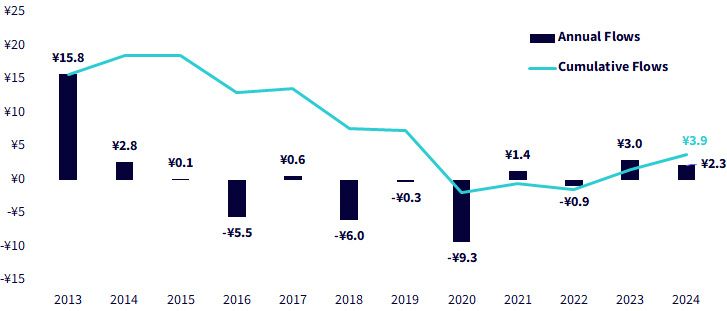
Source: Japan Ministry of Finance, 1/1/13–11/1/24.
Japan's export-oriented economy continues to thrive amid global trade reconfigurations. The combination of undervalued assets and the ability to capitalize on shifting supply chains positions Japan favorably for long-term growth.
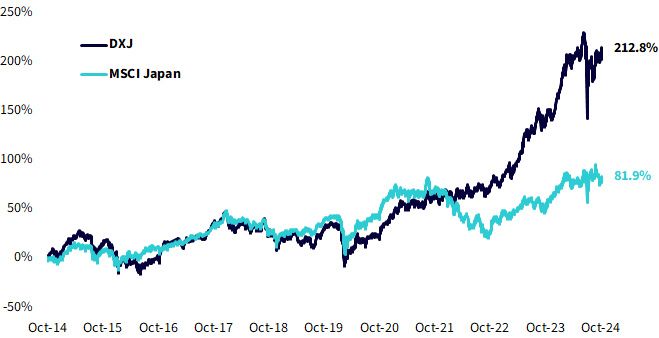
Exporters play a critical role in the composition of the WisdomTree Japan Hedged Equity Fund (DXJ), which provides investors with exposure to Japan's global reach while hedging against currency fluctuations.
As evidenced by figure 4, this approach ensures that yen volatility does not erode the returns from the underlying stocks, particularly in the context of a strong-dollar environment, which some foresee from a second Trump presidency.
Figure 4: Cumulative Returns
Sources: WisdomTree, MSCI, 10/31/14–11/11/24. You cannot invest directly in an index. Past performance is not indicative of future results. Investment return and principal value of an investment will fluctuate so that an investor's shares, when redeemed, may be worth more or less than their original cost. Current performance may be lower or higher than the performance data quoted. For the most recent month-end and standardized performance, click here.
Japan's aging population presents a demographic challenge, particularly as birth rates decline and the country grapples with immigration policies. However, these concerns are not unique to Japan; many developed economies face similar dynamics. Investors should take note that Japan's equity markets often price in these long-term headwinds, creating opportunities to acquire high-quality, undervalued assets.
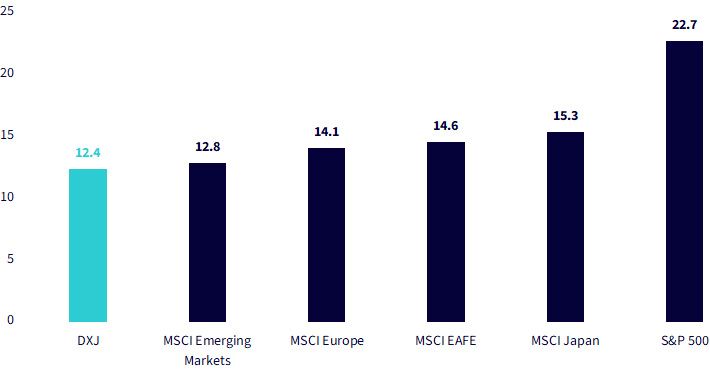
With price-to-earnings multiples hovering around 12x–13x for many Japanese companies, the market offers an attractive entry point. Paired with corporate reforms aimed at increasing operational efficiency and shareholder returns, this valuation backdrop underscores the long-term appeal of Japanese equities. Japan's attractive valuation levels compared to other markets are evident in the global forward price-to-earnings ratios presented in figure 5.
Figure 5: Global Forward Price-to-Earnings Ratios
Sources: WisdomTree, FactSet, MSCI, S&P, as of 10/31/24. You cannot invest directly in an index.
For investors navigating currency risks, DXJ offers an efficient solution by hedging yen exposure and mitigating currency volatility. Additionally, the liquidity of the yen market ensures cost-effective hedging, with slippage costs amounting to an estimated 1–2 basis points annually.
This emphasis on minimizing currency risk allows investors to focus on Japan's corporate growth and global competitiveness without the distraction of exchange rate fluctuations.
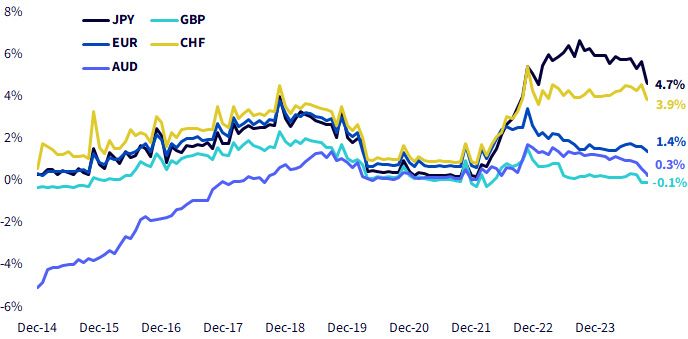
Additionally, based on current interest rate dynamics, investors are actually "paid" about 4.7% on an annualized basis to hedge yen currency exposure. Figure 6 highlights the annualized carry by currency, demonstrating the financial advantage of hedging yen exposure due to the interest rate differential between the U.S. dollar and foreign currencies.
Figure 6: Annualized Carry by Currency
Sources: WisdomTree, MSCI, 12/31/14–11/7/24. Carry measures the interest rate differential between the U.S. dollar and foreign currencies embedded in the difference in spot and forward FX rates. You cannot invest directly in an index.
Warren Buffett's deepening interest in Japanese trading houses offers a roadmap for investors seeking exposure to Japan's evolving market. By investing in these diversified entities, Buffett gains access to a broad spectrum of Japan's economic activity, mirroring the approach he has taken in the U.S.
For investors, ETFs like DXJ offer a streamlined, tax-efficient way to gain similar exposure to Japan's corporate ecosystem without the complexity of managing individual holdings or applying their own currency hedging in a manner resembling the currency-neutral investments that Buffett has made.
As Japan navigates political shifts, demographic challenges and evolving trade dynamics, its market remains a compelling opportunity for long-term investors. The nation's low valuations, corporate reforms and export strength form the foundation of an investment thesis.
At WisdomTree, we continue to see Japan as a vital component of global portfolios, offering investors unique opportunities to capitalize on structural reforms and economic resilience.
For current holdings of DXJ, please click here. Holdings are subject to risk and change.
There are risks associated with investing, including possible loss of principal. Foreign investing involves special risks, such as risk of loss from currency fluctuation or political or economic uncertainty. The Fund focuses its investments in Japan, thereby increasing the impact of events and developments in Japan that can adversely affect performance. Investments in currency involve additional special risks, such as credit risk and interest rate fluctuations. Derivative investments can be volatile and may be less liquid than other securities and more sensitive to the effect of varied economic conditions. As this Fund can have a high concentration in some issuers, the Fund can be adversely impacted by changes affecting those issuers. Due to the investment strategy of this Fund, it may make higher capital gain distributions than other ETFs. Dividends are not guaranteed, and a company currently paying dividends may cease paying dividends at any time. Please read the Fund’s prospectus for specific details regarding the Fund’s risk profile.
Japan Hedged Equity Fund

Director, Research
Matt Wagner joined WisdomTree in May 2017 as an Analyst on the Research team. He currently serves as a Director, where he supports the creation, maintenance, and reconstitution of WisdomTree’s indexes and actively managed ETFs. Matt began his career at Morgan Stanley, working as an analyst in Treasury Capital Markets from 2015 to 2017, focusing on unsecured funding planning, execution, and risk management. He graduated magna cum laude from Boston College in 2015 with a B.A. in International Studies, concentrating in Economics. In 2020, he earned a Certificate in Advanced Valuation from NYU Stern. He is also a Chartered Financial Analyst (CFA) charterholder.

