
DXJ
Japan Hedged Equity Fund

Published November 22, 2024

Research Analyst
After its July meeting, the Bank of Japan unexpectedly hiked interest rates to 0.25%—the highest since 2008. The response was dramatic, as the MSCI Japan Index dropped 13.6% between August 1 and August 5. However, markets soon recovered, and the Index returned 12.4% for the year to September 30, 2024, as shown in figure 1.
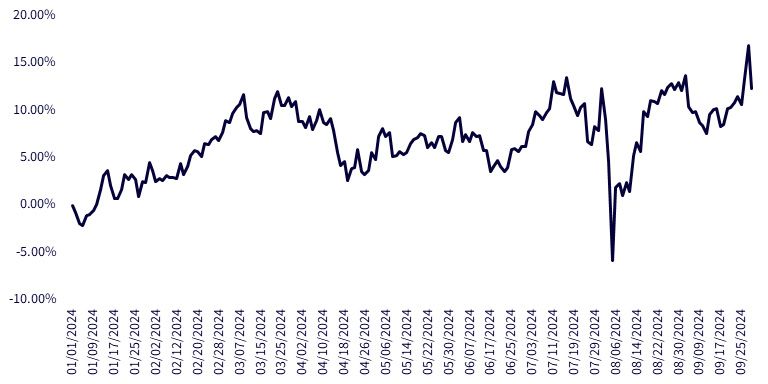
Sources WisdomTree, MSCI. Data, 12/31/23–9/30/24. Past performance is not indicative of future results. You cannot invest directly in an index.
The WisdomTree Japan family of Indexes underwent their annual reconstitutions in October. These Indexes are tracked by:
Figure 2 shows us that these Indexes have historically had greater dividend yields compared to their respective benchmarks.
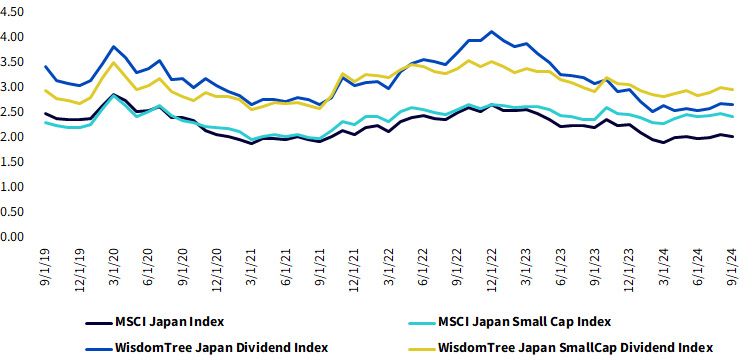
Sources: WisdomTree, MSCI, FactSet. Data, 9/30/19–9/30/24. Past performance is not indicative of future results. You cannot invest directly in an index.
The WisdomTree Japan Hedged Equity Index, the WisdomTree Japan Hedged SmallCap Equity Index and the WisdomTree Japan SmallCap Dividend Index, tracked by DXJ, DXJS and DFJ, respectively, have also outperformed their respective benchmarks over the past five years as seen in figures 3 and 4.
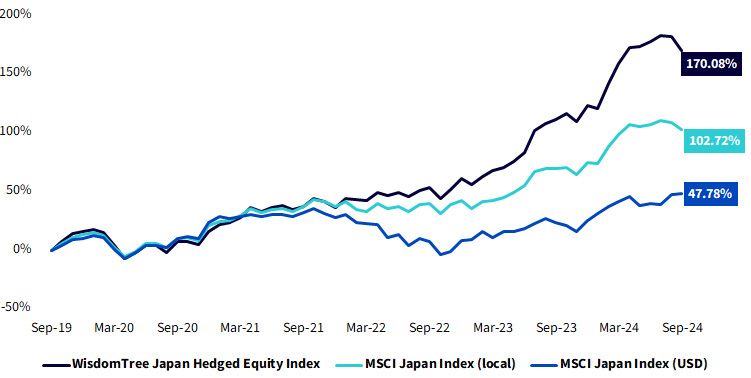
Sources: WisdomTree, MSCI, FactSet. Data, 9/30/19–9/30/24. Past performance is not indicative of future results. You cannot invest directly in an index.
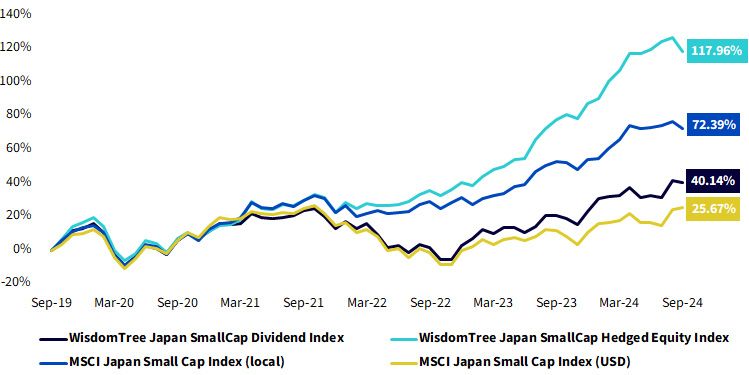
Sources: WisdomTree, MSCI, FactSet. Data, 9/30/19–9/30/24. Past performance is not indicative of future results. You cannot invest directly in an index.
Though the rate hike caused a sharp spike in the JPY/USD exchange rate, the yen eventually weakened, and Japanese exporters benefitted again from rates settling down. DXJ's Index, which tracks only companies that generate less than 80% of their revenues domestically, captured these gains year-to-date.
As we can see in figure 5, export-focused companies saw greater returns than did companies that generate more revenues domestically. DXJ's Index has a 100% allocation to export-focused companies and outperformed the broad MSCI Japan Index during this period.
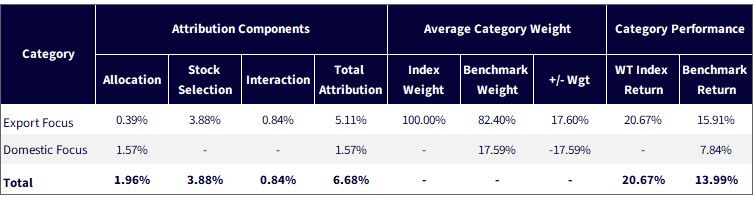
Sources: WisdomTree, MSCI, FactSet. Data, 12/31/23–9/30/24. Past performance is not indicative of future results. You cannot invest directly in an index.
Following its rebalance, DXJ's Index slightly increased its allocations to the Consumer Discretionary, Health Care and Information Technology sectors, which is shown in figure 6. It decreased its allocations to other sectors except for Real Estate, in which it maintained a zero weight.
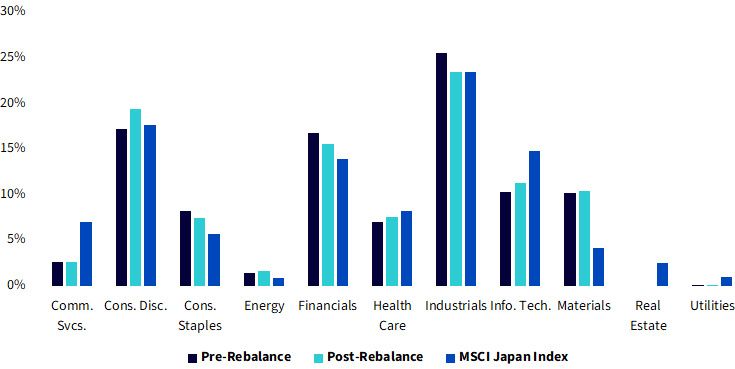
Sources: WisdomTree, MSCI, FactSet, as of 9/30/24. You cannot invest directly in an index.
In the case of DFJ's and DXJS's Indexes, which have identical compositions, allocations to the Consumer Discretionary and Consumer Staples sectors increased, while allocations to the Industrials and Information Technology sectors decreased. We see this illustrated in figure 7.
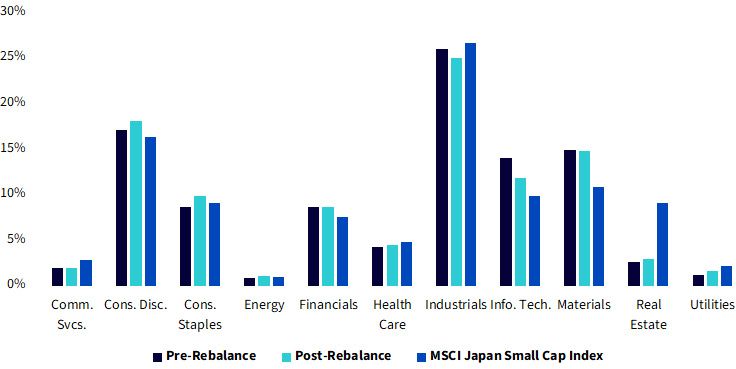
Sources: WisdomTree, MSCI, FactSet, as of 9/30/24. You cannot invest directly in an index.
Following their rebalances, each Index saw improvements in its price-to-earnings ratio, dividend yield, return on assets and return on equities as indicated in figure 8.
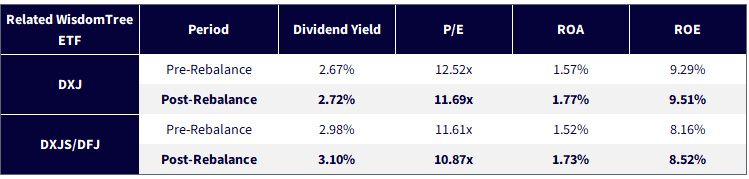
Sources: WisdomTree, FactSet, as of 9/30/24. Past performance is not indicative of future results. You cannot invest directly in an index.
Figure 9: Performance
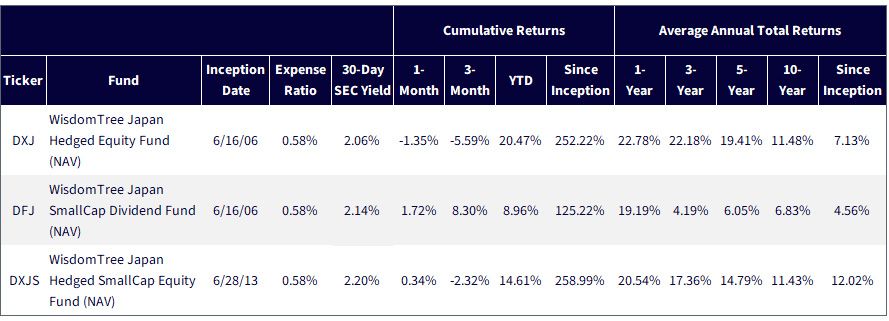
Source: WisdomTree, as of 9/30/24. NAV denotes total return performance at net asset value. 30-Day SEC Yield = The yield figure reflects the dividends and interest earned during the period, after deduction of the Fund’s expenses. This is also referred to as the “standardized yield". Past performance is not indicative of future results. Investment return and principal value of an investment will fluctuate so that an investor’s shares, when redeemed, may be worth more or less than their original cost. Current performance may be lower or higher than the performance data quoted. For the most recent month-end and standardized performances and to download the Fund’s prospectus, click the ticker: DXJ, DFJ, DXJS.
There are risks associated with investing, including the possible loss of principal. Foreign investing involves special risks, such as risk of loss from currency fluctuation or political or economic uncertainty. Please read the Fund’s prospectus for specific details regarding the Fund’s risk profile.
DXJ: The Fund focuses its investments in Japan, thereby increasing the impact of events and developments in Japan that can adversely affect performance. Investments in currency involve additional special risks, such as credit risk, interest rate fluctuations, derivative investments which can be volatile and may be less liquid than other securities, and more sensitive to the effect of varied economic conditions. As this Fund can have a high concentration in some issuers, the Fund can be adversely impacted by changes affecting those issuers. Due to the investment strategy of this Fund it may make higher capital gain distributions than other ETFs. Dividends are not guaranteed, and a company currently paying dividends may cease paying dividends at any time.
DFJ: Funds focusing their investments on smaller companies or certain sectors increase their vulnerability to any single economic or regulatory development. The Fund focuses its investments in Japan, thereby increasing the impact of events and developments in Japan that can adversely affect performance. This may result in greater share price volatility.
DXJS: Funds focusing their investments on certain sectors and/or smaller companies increase their vulnerability to any single economic or regulatory development. This may result in greater share price volatility. The Fund focuses its investments in Japan, thereby increasing the impact of events and developments in Japan that can adversely affect performance. Investments in currency involve additional special risks, such as credit risk, interest rate fluctuations, derivative investments which can be volatile and may be less liquid than other securities, and more sensitive to the effect of varied economic conditions. As this Fund can have a high concentration in some issuers, the Fund can be adversely impacted by changes affecting those issuers. Due to the investment strategy of this Fund it may make higher capital gain distributions than other ETFs.

Research Analyst
Hyun Kang joined WisdomTree in July 2022 as a Research Analyst. As a part of the Index team, he assists with the creation and maintenance of the firm’s indexes and supports the group’s research initiatives across various strategies. Hyun graduated from Carnegie Mellon University, with a B.S. in Business Administration and an additional major in Statistics and Machine Learning.