

Is WisdomTree’s Five-Tool Multifactor Strategy Living Up to Its Promise?
Published April 9, 2018

Chief Investment Strategist

Vice President of Strategic Research at Venn by Two Sigma
Many investors familiar with the exchange-traded fund (ETF) landscape will agree that multifactor strategies have become a central part of the investment conversation. WisdomTree pioneered this effort over a decade ago with a fundamental approach to indexing, but only recently did we launch the WisdomTree U.S. Multifactor Index, which directly seeks exposure to value, quality, momentum and low correlation, and indirectly provides size and low volatility exposure in a sector-neutral fashion. While investors still try to wrap their heads around these different multifactor strategies, we wanted to take advantage of the recent break from the bull market to compare and contrast real-time performance—in both up and down markets.
Since we launched our Index in June 2017, we have had sneak peaks into an up market, characterized by impressive stock returns and new market highs. We have recently also experienced vicious downdrafts in the market, accompanied by higher volatility. Below we display returns for a few of the multifactor indexes that serve as the underlying index for some of the largest multifactor ETFs. We also show returns for the WisdomTree U.S. Multifactor Index, which serves as the underlying Index for the WisdomTree U.S. Multifactor Fund (USMF). For context, we also include returns for the MSCI USA Minimum Volatility, S&P 500 Equal Weight, and S&P 500 indexes, during this roller-coaster period in U.S. equity markets.
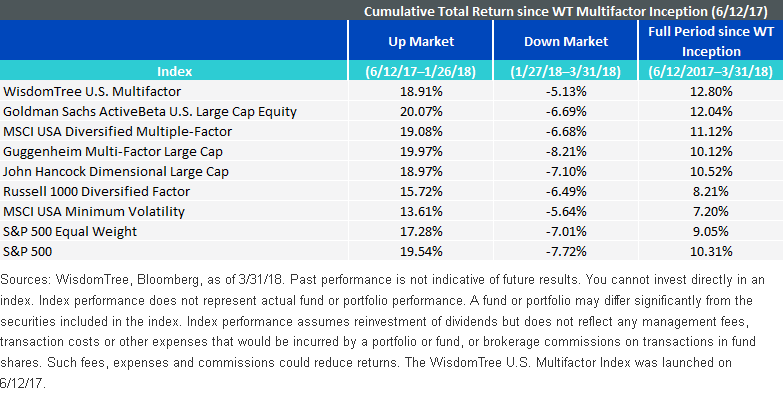
Please see our glossary for definitions of indexes contained in the chart.
A Closer Look at Multifactor Index Performance
During the up-market trend, we were quite pleased with the ability of WisdomTree’s Index to keep pace with the S&P 500 Index. We say this because the latest up trend was characterized by some of the S&P 500’s largest names posting stellar returns. Our strategy, which contains a concentrated basket of 200 stocks, with about 45% of the Index’s weight distributed to mid-cap stocks,1 was nevertheless able to keep pace with the S&P 500 despite natural under-weights in these larger names. However, as the down market came over the last two months or so, and the large-cap beta trade broke down, stock selection again became advantageous. The 10-Year U.S Treasury yield over this period rose from 2.66% to 2.73%,2 providing meaningful headwinds for strategies like the MSCI USA Minimum Volatility Index, which tend to seek lower volatility by undertaking relative over-weights in defensive sectors such as Utilities and Consumer Staples. This is where the WisdomTree U.S. Multifactor Index truly shined, providing more downside protection than every other strategy shown here. Relative to the MSCI USA Minimum Volatility Index and the S&P 500 Index, respectively, this downside protection amounted to 51 and 259 basis points of outperformance over the two-month period.
Because of this balance—capturing most of the upside and providing more downside protection—not only did the WisdomTree U.S. Multifactor Index outperform the S&P 500 by approximately 250 basis points since its inception in June 2017, it beat all the other smart beta strategies above over this time period.
We believe multifactor exposure, as well as innovative single factors such as low correlation, can provide lower volatility through diversification, while also being less sensitive to interest rate risk than a strictly low- or minimum-volatility approach. Additionally, weighting by half low volatility while focusing the other half of the weighting based on a stock’s composite factor score provides a risk and return framework that at its core, we believe, is more structurally sound for a variety of market environments.
Conclusion: WisdomTree U.S. Multifactor Index Offers Balanced and Efficient Multifactor Exposure
Compared to the indexes shown above, the WisdomTree Multifactor Index has been the best and most balanced smart beta strategy investors could have adopted over the past nine months. We believe that as market volatility continues, whether it be via up or down days, stock selection will again play a vital role in investors’ considerations. We believe the WisdomTree U.S. Multifactor Index provides pointed stock selection via value, quality, momentum and low correlation, giving investors a way to seek alpha when buying the biggest stocks by market-cap stops working. While we believe the right way to view multifactor exposure is through the lens of a long-term time horizon, once the large-cap beta trade starts to break down is when we believe thoughtful and rules-based stock selection can truly shine. And as a reminder, outside of bubbles, it is not the norm to have the biggest names by market cap consistently driving the market forward. In other words, with a large-cap beta run potentially behind us, now may be as good as time as any to introduce efficient multifactor exposure into the core of your portfolio for the long-term.
1Source: WisdomTree, as of 3/31/18.
2Source: Bloomberg. Period from the close of 1/26/18 through 3/29/2018
Important Risks Related to this Article
Diversification does not eliminate the risk of experiencing investment losses.
There are risks associated with investing, including possible loss of principal. Investing in a Fund exposed to particular sectors increases the vulnerability to any single economic, political or regulatory development. This may result in greater share price volatility. Due to the investment strategy of the Fund, it may make higher capital gain distributions than other ETFs. Please read the Fund’s prospectus for specific details regarding the Fund’s risk profile.
Categories
About the contributors

