
EPI
India Earnings Fund

Published April 30, 2025

Global Head of Research
There's something counterintuitive about watching a country lower its GDP forecast while simultaneously launching the most ambitious infrastructure campaign in its modern history.
Most investors focus on the revision. Fewer ask: what kind of country continues to build at full throttle while others are pulling back?
India is doing something rare in 2025—it's acting like a nation that knows where it's going.
At a time when much of the world is gripped by defensive posturing—reacting to geopolitical shocks and trimming growth expectations—India is mapping out expressways, ports, hydrogen rail systems and digital logistics networks with a kind of purposeful calm. 1
Prime Minister Modi's third-term blueprint isn't cautious. It's clarifying. Public and private capital of ₹100 trillion (that's $1.2 trillion USD) is being mobilized to build the physical scaffolding of a very different India. One where 100 km is the furthest any citizen lives from a high-speed highway. One where mega ports rival the world's top 50. One where railways run clean, fast and efficient. One where the air network doesn't just link global hubs but connects the smallest cities to economic opportunity.2
India's growth is being architected on domestic resilience, not export dependence. Only 2.7% of India's exports go to the U.S.—a fraction compared to China's 14% or Mexico's 15%.3 In a moment of global contraction, India isn't fighting to preserve yesterday's flows. It's setting the terms for tomorrow's.
That's not a story of managing today's growth. That's a story of reshaping what growth means.
Resilience is not the same as immunity. Some estimate that India's GDP will grow just 6.1% in FY26, a figure that does reflect a lowering. The reason? Tariffs, trade friction, global weakness—the familiar headwinds that leave business sentiment damp and capex cycles hesitant.
But, when you look closer, India isn't reacting to global turbulence—it's ignoring it. Not recklessly, but deliberately. Public capex is moving forward. Inflation is gliding below 4%. The Reserve Bank is easing, not tightening. And fiscal policy, while cautious, remains on track.4
This is how compounding works at the country level: steady inputs, applied during moments of uncertainty, accelerating once the fog lifts.
You can see this quiet resilience in the market too. It doesn't roar—it holds. Equity beta to the global cycle is falling. Retail investor flows haven't wavered. India-specific catalysts are starting to matter more than U.S. rate policy or oil volatility.
Domestic investors have poured in $25 billion year-to-date, cushioning volatility with conviction.5
This isn't a market built on hype. It's a market built on internal durability.
And perhaps the most underappreciated shift? The architecture of India's geopolitical strategy. Underneath the macro data is a structural alignment—with the U.S.—that's quietly altering India's role in the global economy.
Through bilateral frameworks like the U.S.-India COMPACT and TRUST, India is now embedded in conversations about defense manufacturing, semiconductors, artificial intelligence, quantum and critical supply chains. The defense deals are real. The trade target—$500 billion by 2030—is not marketing. It's intent.6
The U.S. is already India's largest export destination for smartphones, with a 54% YoY surge in shipments through March 20, a data point that reflects not just decoupling from China, but intentional rerouting of industrial relevance.7
And when those intentions begin to show up in trade data, tech investment and security alignment, they'll matter far more than any one quarter's growth revision.
The temptation right now is to look elsewhere. To say "not yet" on India. To wait until the data looks better or the global picture clears. But that's not how the best long-term investments reveal themselves.
They show up dressed in doubt, built on plans that take time, in countries that aren't waiting for perfect conditions to start building.
India in 2025 isn't chasing a moment. It's constructing momentum.
And for the investors willing to look beyond the noise, that may be the single most investable quality of all.
Short-term numbers are noisy. Year-to-date, the WisdomTree India Earnings Fund (EPI)8 is down 7.0%. The MSCI India Index is close behind at −6.7%, and the broader MSCI Emerging Markets Index is off 4.4%.
To many investors, these red numbers flash warning signs. But seasoned allocators know: the moments when sentiment retreats often sow the seeds of outperformance. What the market "feels" in the short term often contradicts what companies are doing underneath.
And that's where EPI tells a different story.
Over the last five years, EPI has delivered a 22.1% annualized return. It beat the MSCI India Index (+18.6%) and absolutely crushed the EM benchmark (+6.0%).
This didn't happen by accident. It happened by design.
Unlike traditional indexes, EPI doesn't just count a company's size—it counts its profits. It weights by earnings, not hype. That means companies have to actually make money to earn more space in the portfolio.
If you believe in capitalism working—profits attracting capital—then EPI is simply more aligned with how the world works.
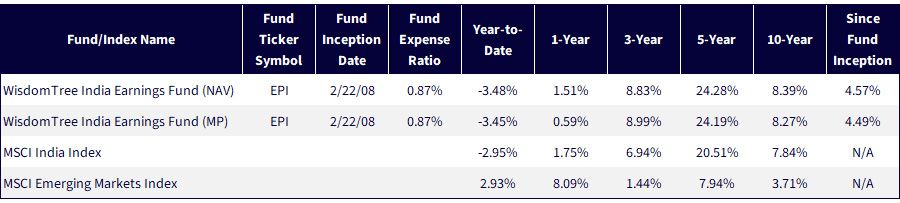
Sources: Morningstar, FactSet and WisdomTree, specifically data from the PATH Fund Comparison Tool, accessed as of 4/15/25, but showing returns for the period ended 3/31/25. NAV denotes total return performance at net asset value. MP denotes market price performance. The performance data quoted represents past performance. Past performance is not indicative of future results. Investment return and principal value of an investment will fluctuate so that an investor's shares, when redeemed, may be worth more or less than their original cost. Current performance may be lower or higher than the performance data quoted. For the most recent month-end and standardized performance and to download the respective Fund prospectuses, click here.
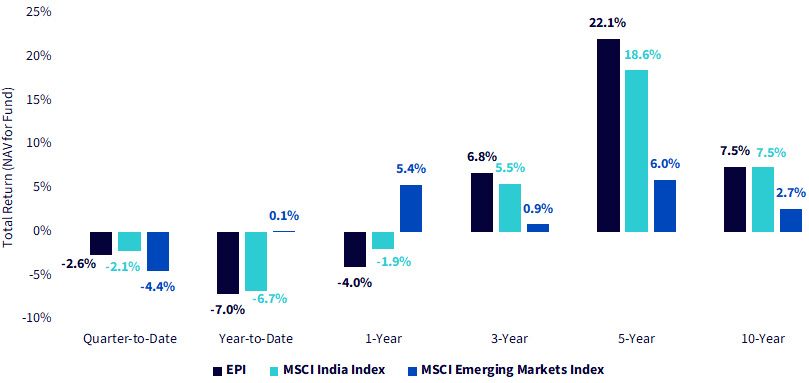
Sources: Morningstar, FactSet and WisdomTree, specifically data from the PATH Fund Comparison Tool, accessed as of 4/15/25, but showing returns for the period ended 4/14/25. NAV denotes total return performance at net asset value. MP denotes market price performance. Past performance is not indicative of future results. Investment return and principal value of an investment will fluctuate so that an investor's shares, when redeemed, may be worth more or less than their original cost. Current performance may be lower or higher than the performance data quoted. For the most recent month-end and standardized performance and to download the respective Fund prospectuses, click here.
Valuation matters most when it's least fashionable. In 2025, with markets leaning back into momentum and multiple expansion, it's easy to forget that compounding loves discipline more than drama.
EPI's valuation is a quiet signal: you're not buying hype. You're buying earnings, at a reasonable price, in one of the world's most exciting economies.
And that's exactly what long-term investing should feel like.
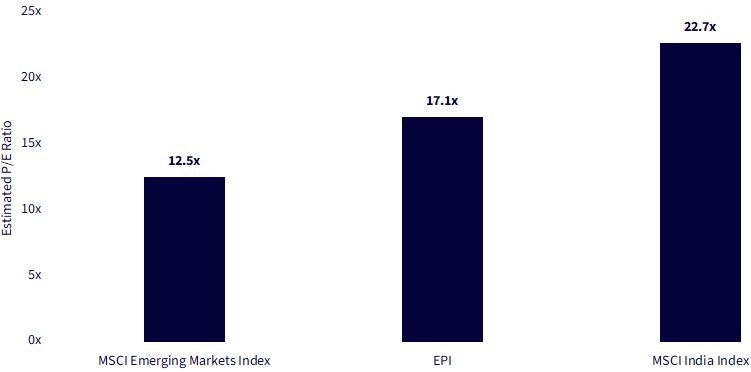
Sources: Morningstar, FactSet and WisdomTree, specifically data from the PATH Fund Comparison Tool, accessed as of 4/15/25, but showing fundamentals for the period ended 3/31/25. Subject to change.
India is rapidly digitizing, urbanizing and industrializing. That's the macro backdrop.
But EPI aligns to that future at the company level, where compounding happens. This is what makes it structurally different from other vehicles: it doesn't just allocate to India, it aligns with India's economic engine.
And with a projected 20.17% earnings growth rate, it offers a runway that few global strategies can match.
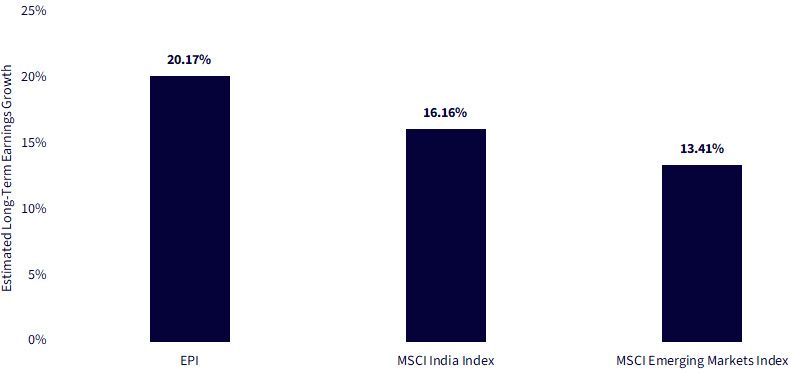
Sources: Morningstar, FactSet and WisdomTree, specifically data from the PATH Fund Comparison Tool, accessed as of 4/15/25, but showing fundamentals for the period ended 3/31/25. Subject to change.
Let's say it plainly: EPI is giving you more future per unit of present cost. Here, we take the measure of estimated growth (figure 3) and divide by the estimated P/E ratio (figure 2) to get a ratio of growth to price. We find this important because one cannot say that only growth or only valuation is important—both are important.
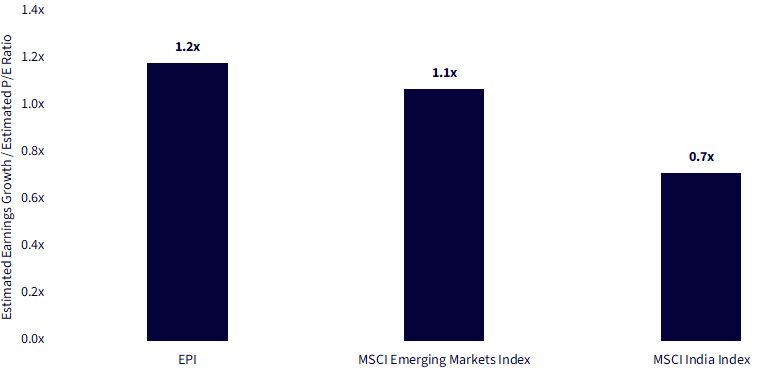
Sources: Morningstar, FactSet and WisdomTree, specifically data from the PATH Fund Comparison Tool, accessed as of 4/15/25, but showing fundamentals for the period ended 3/31/25. Subject to change.
1 Source: Mint, "Inside India's ₹100 Trillion Infrastructure Revolution: Roads, Railways, Ports & More!" YouTube. (https://www.youtube.com/watch?v=7hGep3HA2mU)
2 Source: Mint, YouTube.
3 Source: Abhishek Vishnoi & Ashutosh Joshi, "Global Funds Tout India as Haven in Trump Tariff Crisis," Bloomberg, 4/13/25.
4 Source: Chachra et al., "EcoView: Lower GDP Growth, Earnings Estimates, Index Target," Morgan Stanley Research, 4/14/25.
5 Source: Vishnoi, 4/13/25.
6 Source: Chachra et al., 4/14/25.
7 Source: Vishnoi, 4/13/25.
8 The WisdomTree India Earnings Fund (EPI) is designed to track the total return performance, before fees and expenses, of the WisdomTree India Earnings Index. This Index is focused on profitable companies within India, and it weights those companies on the basis of their earnings.
There are risks associated with investing, including the possible loss of principal. Foreign investing involves special risks, such as risk of loss from currency fluctuation or political or economic uncertainty. This Fund focuses its investments in India, thereby increasing the impact of events and developments associated with the region which can adversely affect performance. Investments in emerging, offshore or frontier markets such as India are generally less liquid and less efficient than investments in developed markets and are subject to additional risks, such as risks of adverse governmental regulation and intervention or political developments. As this Fund has a high concentration in some sectors, the Fund can be adversely affected by changes in those sectors. Due to the investment strategy of this Fund it may make higher capital gain distributions than other ETFs. Please read the Fund’s prospectus for specific details regarding the Fund’s risk profile.
India Earnings Fund

Global Head of Research
Christopher Gannatti began at WisdomTree as a Research Analyst in December 2010, working directly with Jeremy Schwartz, CFA®, Director of Research. In January of 2014, he was promoted to Associate Director of Research where he was responsible to lead different groups of analysts and strategists within the broader Research team at WisdomTree. In February of 2018, Christopher was promoted to Head of Research, Europe, where he was based out of WisdomTree’s London office and was responsible for the full WisdomTree research effort within the European market, as well as supporting the UCITs platform globally. In November 2021, Christopher was promoted to Global Head of Research, now responsible for numerous communications on investment strategy globally, particularly in the thematic equity space. Christopher came to WisdomTree from Lord Abbett, where he worked for four and a half years as a Regional Consultant. He received his MBA in Quantitative Finance, Accounting, and Economics from NYU’s Stern School of Business in 2010, and he received his bachelor’s degree from Colgate University in Economics in 2006. Christopher is a holder of the Chartered Financial Analyst Designation.

