
EPI
India Earnings Fund

Published February 6, 2025

Global Chief Investment Officer

Director, Quantitative Research
India stands at a pivotal moment in its economic evolution, bolstered by forward-looking policy initiatives and structural reforms that seek to sustain high growth while ensuring fiscal prudence. The Union Budget for Financial Year 2025–26 underscores India’s long-term commitment to macroeconomic stability, infrastructure expansion and industrial resurgence, making it an increasingly attractive investment destination for global and domestic stakeholders.
As the global economy grapples with geopolitical shifts and financial uncertainties, India’s demographic dividend, robust policy framework and economic resilience position it as a beacon of sustainable growth.
India’s long-term investment landscape remains compelling, underpinned by structural reforms, fiscal prudence and dynamic policy measures. The combination of strong domestic consumption, rapid urbanization, robust digital transformation and a resilient financial sector sets the stage for sustainable economic expansion. As the global economic axis increasingly tilts toward emerging markets, India continues to lead the charge, presenting investors with unparalleled opportunities for wealth creation and capital appreciation.
WisdomTree’s offerings, in the form of the WisdomTree India Earnings ETF (EPI) and the WisdomTree India Hedged Equity ETF, offer investors differentiated India exposures, with the former providing a broad-based exposure that’s weighted by earnings to tackle the comparatively expensive Indian markets and the latter providing exposure to large-cap Indian stocks while hedging the currency exposure, leading to a lower volatility exposure to India, with reduced currency risks.
It is notable that the WisdomTree India Earnings ETF has delivered strong outperformance over the common history of the Fund versus the iShares MSCI India ETF (INDA), which continues to be the largest ETF by AUM providing exposure to Indian markets. In the last five years to January 31, 2025, EPI delivered a strong 4.67% annualized outperformance versus INDA.
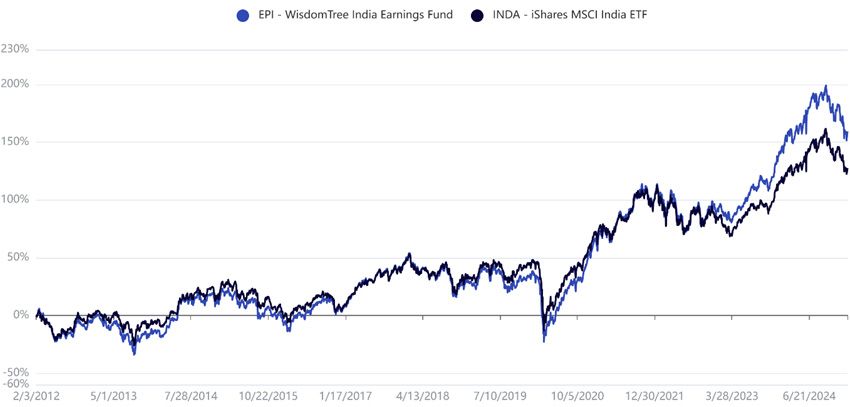
Source: WisdomTree PATH tool. Performance from 2/3/12–1/31/25 – Cumulative Total Return. Performance is historical and does not guarantee future results. Current performance may be lower or higher than quoted. Investment returns and principal value of an investment may be worth more or less than their original cost.
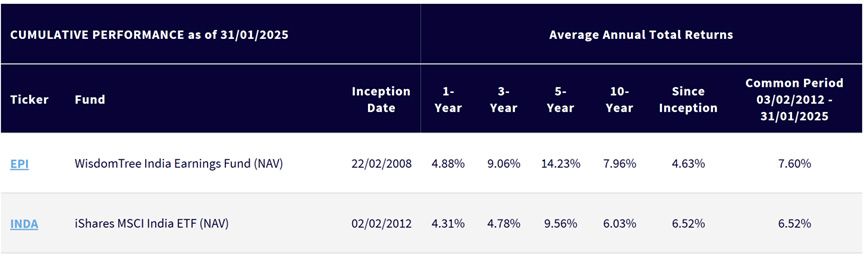
Source: WisdomTree PATH tool. Performance from 2/3/12–1/31/25 – Cumulative Total Return. Performance is historical and does not guarantee future results. Current performance may be lower or higher than quoted. Investment returns and principal value of an investment may be worth more or less than their original cost. For standardized performance, please click the respective ticker: EPI, INDA.
Important Information
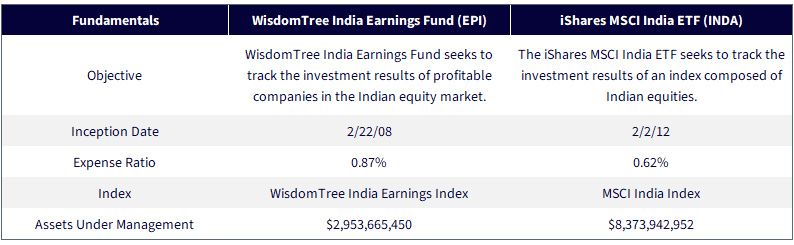
Sources: WisdomTree, iShares, as of 3/10/25. Current performance may be lower or higher than quoted. Investment returns and principal value of an investment may be worth more or less than their original cost. Past performance is not indicative of future results. Investment return and principal value of an investment will fluctuate so that an investor's shares, when redeemed, may be worth more or less than their original cost. Current performance may be lower or higher than the performance data quoted. For the most recent month-end and standardized performances, please click the respective ticker: EPI, INDA.
EPI: There are risks associated with investing, including the possible loss of principal. Foreign investing involves special risks, such as risk of loss from currency fluctuation or political or economic uncertainty. This Fund focuses its investments in India, thereby increasing the impact of events and developments associated with the region, which can adversely affect performance. Investments in emerging, offshore or frontier markets such as India are generally less liquid and less efficient than investments in developed markets and are subject to additional risks, such as risks of adverse governmental regulation and intervention or political developments. As this Fund has a high concentration in some sectors, the Fund can be adversely affected by changes in those sectors. Due to the investment strategy of this Fund, it may make higher capital gain distributions than other ETFs. Please read the Fund’s prospectus for specific details regarding the Fund’s risk profile.
INDA: Carefully consider the Fund’s investment objectives, risk factors, and charges and expenses before investing. This and other information can be found in the Fund’s prospectus and, if available, summary prospectus, which may be obtained by calling 1-800-iShares (1-800-474-2737) or by visiting www.iShares.com or www.blackrock.com. Read the prospectus carefully before investing.
Investing involves risk, including the possible loss of principal.
International investing involves risks, including risks related to foreign currency, limited liquidity, less government regulation and the possibility of substantial volatility due to adverse political, economic, or other developments. These risks are often heightened for investments in emerging/developing markets or in concentrations of single countries.
Diversification may not protect against market risk or loss of principal. Shares of ETFs are bought and sold at market price (not NAV) and are not individually redeemed from the Fund. Any applicable brokerage commissions will reduce returns.
India Earnings Fund

Global Chief Investment Officer
Jeremy Schwartz has served as Global Chief Investment Officer since November 2021 and leads WisdomTree’s investment strategy team in the construction of WisdomTree’s equity Indexes, quantitative active strategies and multi-asset Model Portfolios. Jeremy joined WisdomTree in May 2005 as a Senior Analyst, adding Deputy Director of Research to his responsibilities in February 2007. He served as Director of Research from October 2008 to October 2018 and as Global Head of Research from November 2018 to November 2021. Before joining WisdomTree, he was a head research assistant for Professor Jeremy Siegel and, in 2022, became his co-author on the sixth edition of the book Stocks for the Long Run. Jeremy is also co-author of the Financial Analysts Journal paper “What Happened to the Original Stocks in the S&P 500?” He received his B.S. in economics from The Wharton School of the University of Pennsylvania and hosts the Behind the Markets podcast. Jeremy is a member of the CFA Society of Philadelphia.

Director, Quantitative Research
Ayush Babel is the Director of Quantitative Research in WisdomTree's multi-asset quantitative research and index teams. In this role, he focuses on developing innovative quantitative strategies across various asset classes while supporting WisdomTree's diverse range of products. His expertise spans factor exploration, portfolio construction and optimization, quantitative investment research, and product development.
With over a decade of experience in the financial services industry, Ayush has held investment research roles at J.P. Morgan and Franklin Templeton. At these institutions, he was responsible for developing and managing equity and fixed income smart beta products, as well as cross-asset risk premia solutions for global institutional and retail clients. His experience covers a broad spectrum of asset classes and investment styles.
Ayush holds a bachelor's in Engineering Physics and a master’s degree in Nanoscience from the Indian Institute of Technology, Bombay.