
QHY
U.S. High Yield Corporate Bond Fund

Published August 13, 2026

Director, Fixed Income
2026 has served up a familiar mix of market anxiety and fleeting relief. The first quarter brought a sharp selloff across riskier assets, driven by the escalation of the Middle East conflict, rising energy prices, and a renewed bout of inflation fears that put a potential Fed rate hike back on the table. Big tech companies and hyperscalers compounded the pressure with a debt-issuance spree that weighed on the broader corporate credit market. Those concerns have not fully disappeared. They have moderated enough to give markets some breathing room, but not enough to call it settled.
Below, we walk through what has been driving high yield (HY) credit markets this year, how fundamentals are holding up, and how two WisdomTree HY products, the WisdomTree US High Yield Corporate Bond Fund (QHY) and the WisdomTree Interest Rate Hedged High Yield Bond Fund (HYZD), have performed through these conditions.
We started the year with market expectations of continued easing by the Federal Reserve, albeit at a slower pace. Those expectations quickly gave way to heightened geopolitical risk and the resulting inflation concerns. The repricing was sharp: by the end of Q2, markets were pricing in one to two rate hikes for 2026.
The past month layered on additional complexity. Markets absorbed a stream of solid economic data alongside elevated oil prices and rising doubts about the Fed's credibility. The decision to hold rates was widely expected. What caught the market off guard was the absence of a clear recommitment to the inflation mandate. That ambiguity lifted long-term inflation expectations and drove meaningful bear steepening of the yield curve. Longer-dated bonds sold off harder than short-dated ones, a sign the market is pricing in stickier inflation for longer.
Worth noting: breakevens, the market's implied inflation forecast baked into bond prices, remain well below their May peaks. The renewed inflation concerns are not a reaction to fresh geopolitical supply shocks. They reflect a more structural worry about what loose financial conditions mean for growth and inflation over the next few years.
Despite the volatility, the underlying picture for HY credit remains solid. Default rates sit at 1.9%, leverage is broadly stable at 4.5x, and interest coverage remains above 4x. Companies across the ratings spectrum continue to access capital markets, though lenders have grown more selective with lower-quality issuers.
With all-in yields still attractive and mid-single-digit return expectations as our base case, we are still constructive on high yield as a sector.
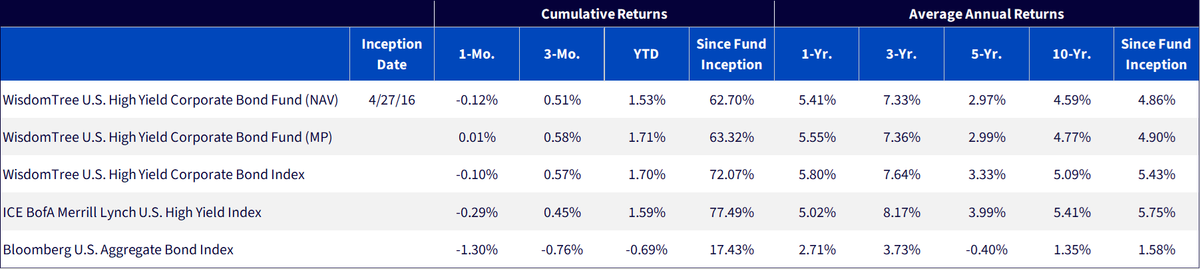
QHY is up 1.53% net of fees and 1.75% gross of fees year-to-date, outperforming the Bloomberg US Corporate High Yield Bond Index on a gross-of-fees basis. Add back transaction costs and the results look even better.
Source: WisdomTree, as of 7/31/26. You cannot invest directly in an index. For definitions of terms in the table above, please visit the glossary. Past performance is not indicative of future results. Investment return and principal value of an investment will fluctuate so that an investor’s shares, when redeemed, may be worth more or less than their original cost. Current performance may be lower or higher than the performance data quoted. For the most recent month-end and standardized performance, click here.
That outperformance has roots in a deliberate strategy update we made at the end of 2024. As noted in one of our previous blog posts, alongside our long-term free cash flow signals, we added equity return momentum as a complementary tool. Together, these signals give us a timelier read on each issuer's financial health, helping us identify weaker credits well before their problems register in ratings downgrades or default filings. The goal is to sideline potential trouble before it becomes the market's problem. This refinement has already added value, and we expect it to matter even more as issuer selection becomes the main differentiating factor in HY performance going forward.
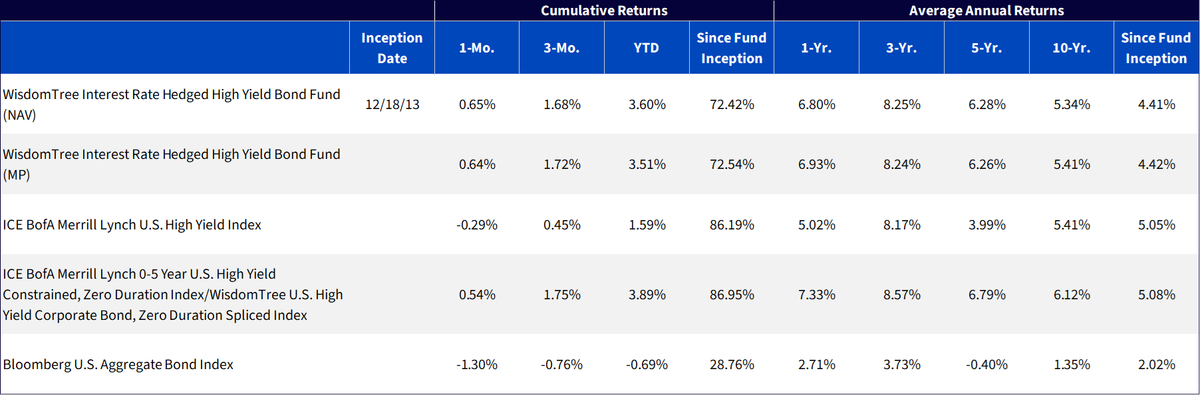
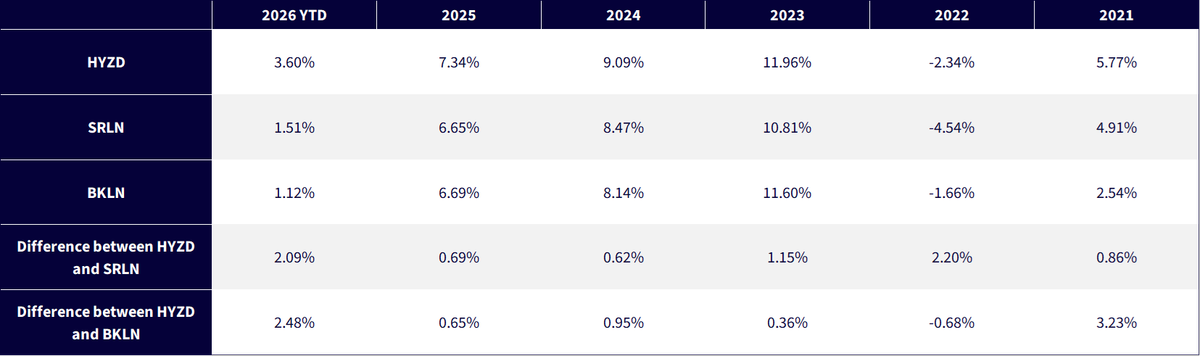
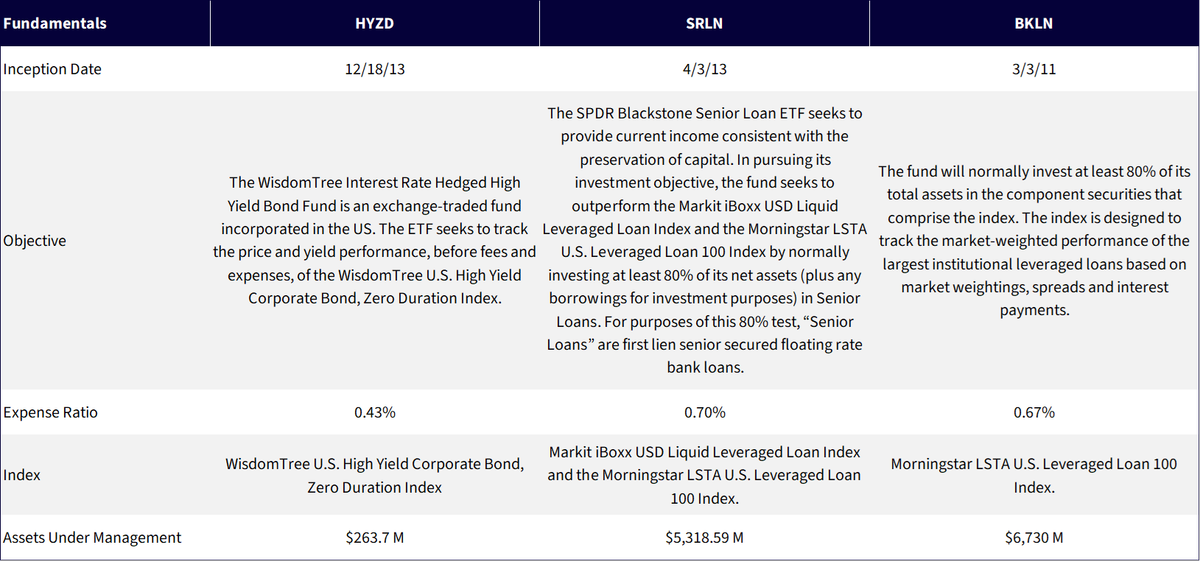
For investors who want sector exposure with interest rate risk neutralized, HYZD has been the stronger performer of the two. The fund is up 3.60% net of fees and 3.85% gross of fees year-to-date. We wrote last September that HYZD could serve as a compelling replacement for senior loan exposure. That thesis has continued to play out this year, with HYZD maintaining its outperformance against that segment of the market.
Source: WisdomTree, as of 7/31/26. You cannot invest directly in an index. For definitions of terms in the table above, please visit the glossary. Past performance is not indicative of future results. Investment return and principal value of an investment will fluctuate so that an investor’s shares, when redeemed, may be worth more or less than their original cost. Current performance may be lower or higher than the performance data quoted. For the most recent month-end and standardized performance, click here.
Sources: WisdomTree, Bloomberg, as of 7/31/26. Performance is historical and does not guarantee future results. Current performance may be lower or higher than quoted. Investment returns and principal value of an investment will fluctuate so that an investor’s shares, when redeemed, may be worth more or less than their original cost. For the most recent month-end and standardized performance, click the respective ticker: HYZD, SRLN, BKLN.
We believe the message for HY investors in 2026 is clear. Broad, passive exposure to the asset class is no longer sufficient. With the Fed's path uncertain and lenders growing more selective at the lower end of the credit quality spectrum, the ability to identify the strong issuers matters more now than it did a year ago. WisdomTree's HY suite is built on exactly that premise: quality-biased security selection, disciplined fundamental analysis, and a strategy refined to catch problems early. QHY and HYZD have both delivered results that reflect that design, and we think the case for this approach only gets stronger as the credit cycle matures.
Sources: WisdomTree, State Street, Invesco, as of 8/4/26. All funds are managed differently and do not react the same to economic or market events. The investment objectives, strategies, policies or restrictions of other funds may differ and more information can be found in their respective prospectuses. Therefore, we generally do not believe it is possible to make direct fund to fund comparisons in an effort to highlight the benefits of a fund versus another similarly managed fund.
You cannot invest directly in an index.
Material must be preceded or accompanied by a prospectus. Click the respective ticker to view the fund prospectus: QHY, HYZD, SRLN, BKLN.
HYZD: There are risks associated with investing, including the possible loss of principal. High-yield or “junk” bonds have lower credit ratings and involve a greater risk to principal. Fixed income investments are subject to interest rate risk; their value will normally decline as interest rates rise. The Fund seeks to mitigate interest rate risk by taking short positions in U.S. Treasuries (or futures providing exposure to U.S. Treasuries), but there is no guarantee this will be achieved. Derivative investments can be volatile and these investments may be less liquid than other securities, and more sensitive to the effects of varied economic conditions.
Fixed income investments are also subject to credit risk, the risk that the issuer of a bond will fail to pay interest and principal in a timely manner, or that negative perceptions of the issuer’s ability to make such payments will cause the price of that bond to decline. The Fund may engage in “short sale” transactions where losses may be exaggerated, potentially losing more money than the actual cost of the investment and the third party to the short sale may fail to honor its contract terms, causing a loss to the Fund. While the Fund attempts to limit credit and counterparty exposure, the value of an investment in the Fund may change quickly and without warning in response to issuer or counterparty defaults and changes in the credit ratings of the Fund’s portfolio investments. Due to the investment strategy of certain Funds, they may make higher capital gain distributions than other ETFs. Please read the Fund’s prospectus for specific details regarding the Fund’s risk profile.
SRLN: Investments in senior loans are subject to credit risk and general investment risk. Credit risk refers to the possibility that the borrower of a senior loan will be unable and/or unwilling to make timely interest payments and/or repay the principal on its obligation. Default in the payment of interest or principal on a senior loan will result in a reduction in the value of the senior loan and consequently a reduction in the value of the portfolio’s investments and a potential decrease in the net asset value (NAV) of the portfolio.
Bonds generally present less short-term risk and volatility than stocks, but contain interest rate risk (as interest rates rise, bond prices usually fall); issuer default risk; issuer credit risk; liquidity risk; and inflation risk. These effects are usually pronounced for longer-term securities. Any fixed income security sold or redeemed prior to maturity may be subject to a substantial gain or loss.
Investing in high yield fixed income securities, otherwise known as “junk bonds,” is considered speculative and involves greater risk of loss of principal and interest than investing in investment grade fixed income securities. These lower-quality debt securities involve greater risk of default or price changes due to potential changes in the credit quality of the issuer.
BKLN: There are risks involved with investing in ETFs, including possible loss of money. Shares are not actively managed and are subject to risks similar to those of stocks, including those regarding short selling and margin maintenance requirements. Ordinary brokerage commissions apply. The fund’s return may not match the return of the underlying index. The fund is subject to certain other risks. Please see the current prospectus for more information regarding the risk associated with an investment in the fund.
Most senior loans are made to corporations with below investment-grade credit ratings and are subject to significant credit, valuation and liquidity risk. The value of the collateral securing a loan may not be sufficient to cover the amount owed, may be found invalid or may be used to pay other outstanding obligations of the borrower under applicable law. There is also the risk that the collateral may be difficult to liquidate, or that a majority of the collateral may be illiquid.
An issuer may be unable to meet interest and/or principal payments, thereby causing its instruments to decrease in value and lowering the issuer’s credit rating.
Interest rate risk refers to the risk that bond prices generally fall as interest rates rise and vice versa.
Non-investment-grade securities may be subject to greater price volatility due to specific corporate developments, interest-rate sensitivity, negative perceptions of the market, adverse economic and competitive industry conditions and decreased market liquidity.
The risks of investing in securities of foreign issuers can include fluctuations in foreign currencies, political and economic instability, and foreign taxation issues.
The fund is non-diversified and may experience greater volatility than a more diversified investment.
Reinvestment risk is the risk that a bond’s cash flows (coupon income and principal repayment) will be reinvested at an interest rate below that on the original bond.
All funds are managed differently and do not react the same to economic or market events. The investment objectives, strategies, policies or restrictions of other funds may differ and more information can be found in their respective prospectuses. Therefore, we generally do not believe it is possible to make direct fund to fund comparisons in an effort to highlight the benefits of a fund versus another similarly managed fund.

Director, Fixed Income
Behnood Noei serves as Director of Fixed Income at WisdomTree Asset Management, where he develops the firm’s suite of fixed income and currency exchange-traded funds and enhances existing investment processes. Behnood has 11 years investment experience in portfolio management and quantitative research. Prior to joining WisdomTree in 2022, Behnood was a portfolio manager and developer of some of the fixed income ETFs at J.P.Morgan Asset Management, where he was directly responsible for managing more than 7 Fixed Income ETFs and multiple SMAs with more than $13Billion in assets. He graduated from The Ohio State University with Master of Science degree in Finance and is a CFA charter holder.

