

From Conservative Outlook to Positive Surprises—Japanese Earnings
Published May 22, 2018

Senior Advisor
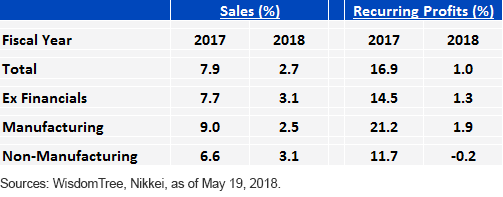
In Japan, the stage is now set for an upturn in earnings revision momentum. As the corporate results season ended last week, the aggregate data reveals very conservative and cautious baseline guidance from listed companies for future profits: after the 16.9% rise in recurring profits in fiscal year 2017 (which ended March 31, 2018), companies are budgeting for a mere 1% rise in profits in FY2018 (which started April 1, 2018). In contrast, we maintain our call for a 15%–20% rise in profits this year.
Importantly, the key reason we expect better-than-forecast earnings is top-line sales growth. Companies are budgeting for a significant slowdown in sales, from 7.9% growth in FY2017 to a mere crawl of 2.7% growth in FY2018. The reason for corporate conservatism may not just be fear of protectionism and worries about a U.S. recession, but, in my personal view, further evidence of better corporate governance and capital stewardship: CEOs have learned that it pays to revise up rather than down. For now, what matters is that top-line sales growth correlates well with global nominal GDP growth, and for all intents and purposes, it appears unlikely that global growth rates are about to plunge by more than half in the coming nine to twelve months.
That said, for every added 1% of top-line growth over the baseline, Japanese profits could rise by an additional 8%; so if sales growth comes to 4% instead of the 2.7% budgeted, profits could rise by about 10% instead of the 1% currently guided by Japanese CEOs and CFOs.
In addition to sales becoming the likely main driver of future upward revisions to profits, foreign exchange assumptions appear equally conservative: the average CFO appears to be budgeting for ¥105/$ for FY2018, after a realized average of ¥110.8/$ for FY2017.1 Bear in mind that every ¥1 of added yen weakness over the baseline basically generates a windfall of 0.8% to profits. So if the current ¥110–¥111/$ were to prevail for the year, that alone would boost profits by almost 5%.2 Add the sales growth assumption of 5% (instead of 2.7%), and you end up with profits growing 15% rather than the 1% growth given in corporate guidance.
In terms of market valuations, the official 1% profit growth would put TOPIX on a one-year forward price-to-earnings (P/E) ratio of about 14.8x.3 If we’re right with our 15% earnings growth assumption, the forward P/E comes to about 13x. Either way, Japan appears attractively valued: the average P/E multiple has been 16.7x since Prime Minister Abe assumed power in December 2012; and every time the P/E dropped below 14x, the market rallied by 20%–30% in the subsequent six to nine months.4
From here, it will be the “E”, the Earnings momentum upturn, that re-energizes Japanese markets, in our view. The stage is set.
Japan Listed Companies Corporate Profit and Sales—FY2017 Results and FY2018 Guidance
Unless otherwise noted, data source is Nikkei, as of May 19, 2018.
1Source: WisdomTree estimate, 5/21/18.
2Source: WisdomTree estimate, 5/21/18.
3Source: Bloomberg, 5/21/18.
4Source: Bloomberg, 5/21/18.
Important Risks Related to this Article
Investments focused in Japan increase the impact of events and developments associated with the region, which can adversely affect performance.
Categories
About the contributor
