

Don’t “Fix”ate within Your Short Duration
Published May 29, 2019

Head of Investment and Fixed Income Strategy
The current landscape for the fixed income arena can be defined by two key factors. The first, of course, is the current, as well as prospective, shape of the yield curve. The second is that, according to Federal Reserve (Fed) data, households have been stashing away large amounts of cash. These two forces have placed a premium on short-term government investments in bond-land, but instead of going into products that are fixed in nature, perhaps investors should look to floating rate strategies instead. Let’s examine why.
When people talk about interest rates, the focus is usually on what the Fed is doing and what the U.S. Treasury (UST) 10-Year yield is doing. As I just mentioned, the flat and/or inverted shape of the UST yield curve (a topic I’ve written quite a lot about) makes investing in short-duration instruments more attractive because investors can potentially capture the same or even better yield levels without taking on the interest rate risk. Although the markets seem to be embracing a rate cut for this year and next, based upon our outlook, the more likely scenario could just place the Fed in a holding pattern on the rate front.
U.S. Treasury 2-Year Note vs. Fed Funds
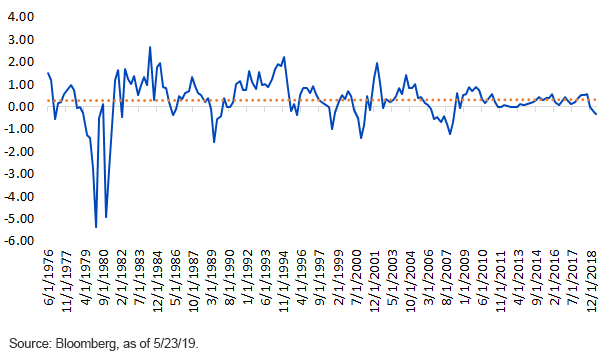
The second focus, a Fed on hold, is a very important factor to consider when looking to put cash to work. I’ve made the case that the UST market has already cut rates for the Fed, and, interestingly, there has been nothing from the Fed to suggest that they are contemplating such a move anytime in the foreseeable future (see the latest FOMC minutes). Against such a backdrop, I would argue that short-term Treasury yields may be vulnerable to some potential upside risk if the economy doesn’t falter and if inflation stops decelerating (our base case).
The accompanying graph highlights the historical spread relationship between the UST 2-Year yield and the Fed Funds rate. As illustrated, the latest downward move in the 2-Year yield puts it into negative territory by a little more than 30 basis points (bps) as of this writing (the UST 2-Year yield is 2.18% and the top end of the Fed Funds target is 2.50%). Conversely, the historical mean spread between these two instruments is around +30 bps.
Conclusion
A 2% to 2.50% growth rate with unemployment at or below 4% (sound familiar?) and an easing of U.S./China trade tensions in any form would seem to be a recipe for the UST 2-Year yield to rise from its current levels, notwithstanding some geopolitical event. Conservatively, if the 2-Year yield moves back toward the top end of the current Fed Funds target, that would place it at 2.50%, where it resided as recently as March. But if there was a mean reversion, then the rate increase would be more like 60 bps from here. Fixed short-term government solutions would be vulnerable in either scenario, while Treasury floating rate strategies would be insulated. Where would you want to put your cash?
Unless otherwise stated, data source is Bloomberg, as of 5/23/2019.
About the contributor

Head of Investment and Fixed Income Strategy
Kevin serves as the Head of Investment and Fixed Income Strategy. In this role, he writes macro and fixed income-related content and works closely with the sales, research and marketing teams. In addition, Kevin conducts client-facing webinars and meetings, providing expertise on WisdomTree’s existing and future bond ETFs. Prior to joining WisdomTree, Kevin spent 30 years at Morgan Stanley, where he was Managing Director and Chief Fixed Income Strategist for Wealth Management. He was responsible for tactical and strategic recommendations and created asset allocation models for fixed income securities. He was a contributor to the Morgan Stanley Wealth Management Global Investment Committee, primary author of Morgan Stanley Wealth Management’s monthly and weekly fixed income publications, and collaborated with the firm’s Research and Consulting Group Divisions to build ETF and fund manager asset allocation models. Kevin has an MBA from Pace University’s Lubin Graduate School of Business, and a B.S. in Finance from Fairfield University.