
WCBR
Cybersecurity Fund

Published August 1, 2024

Global Head of Research

Director, Quantitative Research
In today’s interconnected digital landscape, we believe cybersecurity has emerged as a crucial investment theme that demands attention from savvy investors. The recent global IT outage linked to CrowdStrike, a major player in the cybersecurity industry, serves as a stark reminder of both the importance and the challenges faced by this sector. While such incidents may cause short-term disruptions, they ultimately underscore the growing need for robust cybersecurity solutions, potentially fueling long-term growth in this theme.
On July 19, 2024, a widespread IT outage affected numerous businesses worldwide, including banks, airlines and media outlets. This disruption was reportedly linked to CrowdStrike’s Falcon sensor, a key component of their cybersecurity suite. The incident led to grounded flights, disrupted financial services and even impacted emergency services in some regions.1
While such events can temporarily shake confidence in cybersecurity providers, they also highlight the critical role these companies play in maintaining the smooth operation of our digital infrastructure. The far-reaching impact of this outage demonstrates just how deeply integrated cybersecurity solutions have become in our daily lives and business operations.
Despite short-term setbacks, several factors continue to make cybersecurity an attractive theme for stock pickers:
While incidents like the recent CrowdStrike-related outage may cause short-term volatility, they ultimately reinforce the critical need for robust cybersecurity solutions. As our world becomes increasingly digital, the importance of cybersecurity will only grow. For investors, this presents a compelling long-term opportunity to capitalize on a theme that is not just a trend, but a fundamental necessity in our modern, interconnected world.
It is interesting to remember:
I mention these two companies simply because it is important to keep perspective. We never know the future, but we do know that if we look at history, there are examples of companies that have been hacked in significant ways—making global news—they have come out the other side. For those that can keep a longer-term perspective, sometimes these kinds of events signal interesting points of entry for investors, particularly those investors who have been concerned about valuations in the past.
The WisdomTree Cybersecurity Fund (WCBR) is designed to track, before fees and expenses, the total return performance of the WisdomTree Team8 Cybersecurity Index. In discussing the strategy, we tend to highlight the following:
When I have spoken to investors in 2024, for the most part, they have been unhappy with the cybersecurity theme. In fact, WisdomTree tracks the thematic universe of U.S. ETFs, and we find that, out of roughly 45 distinct thematic topics into which we group hundreds of ETFs, cybersecurity was the second-worst in terms of outflows, seeing investors remove about $1.1 billion during the first six months of 2024.10
We understand that performance of cybersecurity strategies has lagged that of the larger market capitalization technology firms capturing the lion’s share of headlines, but to be the topic with the second-most outflows across all U.S. thematic topics is quite a statement. Even outside of the CrowdStrike incident, it’s possible that sentiment is too bearish for the reality. It’s difficult for us to rationalize the excitement about Nvidia and AI and not think about all the new cybersecurity tools that will ultimately be required.
In setting up for the second half of 2024, we wanted to try to put things into a better context.
First, we must always show the standardized performance as of the most recent quarter-end. In this analysis, we compare WCBR to two growth-oriented performance benchmarks. We look at the Russell MidCap Growth Index because we wanted to show a measure of the performance that was growth-oriented but did not include Nvidia, Microsoft, Alphabet, Amazon, Meta Platforms, Tesla or Apple—the so-called Mag 7. We then also showed the Russell 1000 Growth Index that does include these large companies.
In figure 1, one of the starkest comparisons occurs when looking at WCBR (either NAV or market price) on a year-to-date basis compared to a one-year basis. We will remind people just how strong the WCBR performance was in the second half of 2023 even if it has been very weak in 2024 so far.
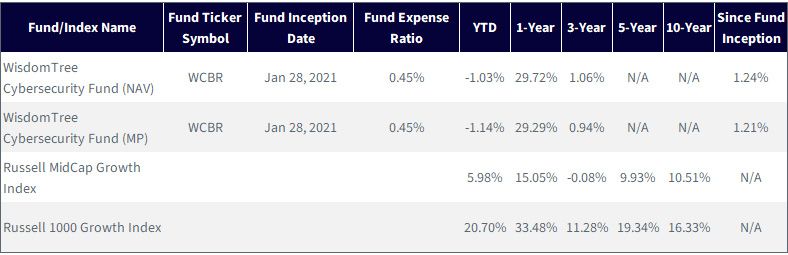
Source: WisdomTree, specifically data from the Fund Comparison Tool in the PATH suite of tools, as of 6/30/24. NAV denotes total return performance
at net asset value. MP denotes market price performance. Past performance is not indicative of future results. Investment return and principal
value of an investment will fluctuate so that an investor’s shares, when redeemed, may be worth more or less than their original cost.
Current performance may be lower or higher than the performance data quoted. For the most recent month-end and standardized
performance and to download the Fund prospectus, click here.
Investor sentiment toward cybersecurity does tend to take the current year into account, so we see how WCBR has underperformed both the Russell MidCap Growth Index (RMIDGR) and the Russell 1000 Growth Index (RU1000G) in figure 2.
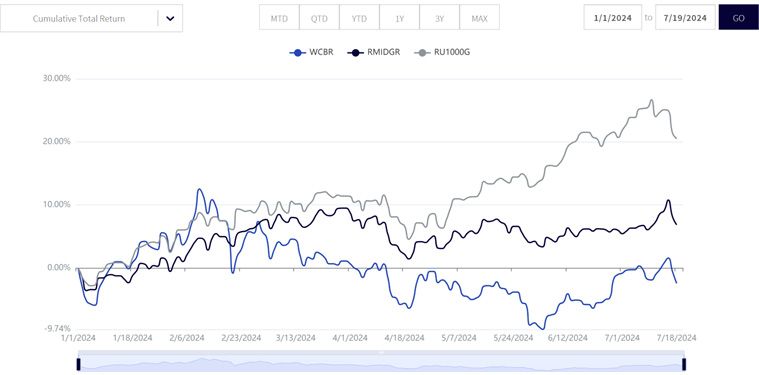
Source: WisdomTree, specifically data from the Fund Comparison Tool in the PATH suite of tools, as of 7/19/24. WCBR represents NAV. NAV
denotes total return performance at net asset value. MP denotes market price performance. Past performance is not indicative of future
results. Investment return and principal value of an investment will fluctuate so that an investor’s shares, when redeemed, may be
worth more or less than their original cost. Current performance may be lower or higher than the performance data quoted. For the
most recent month-end and standardized performance and to download the Fund prospectus, click here.
But, the tough performance of 2024, in our opinion, is at least partly due to the strong performance of 2023. To understand why we say that, look at the roughly 40% rally upward in WCBR from roughly October 31, 2023, to December 31, 2023. This was a strong two-month period, characterized by expectations of falling interest rates in early 2024. This expectation did not manifest itself in actual policy decisions in early 2024—particularly at the U.S. Federal Reserve—so we view a lot of the lackluster 2024 performance of WCBR as a bit of a correction in this misplaced expectation.
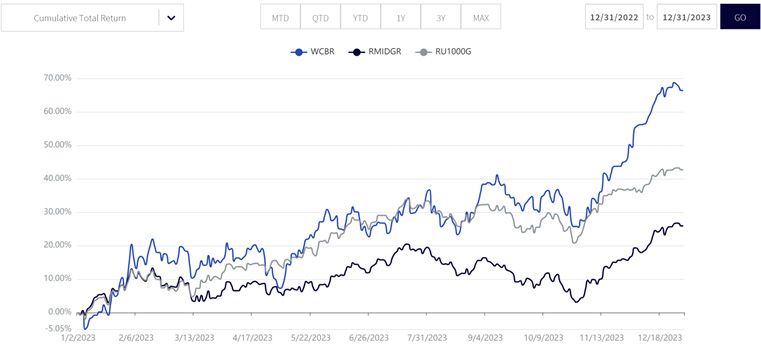
Source: WisdomTree, specifically data from the Fund Comparison Tool in the PATH suite of tools, as of 12/31/23. WCBR represents NAV. NAV
denotes total return performance at net asset value. MP denotes market price performance. Past performance is not indicative of future
results. Investment return and principal value of an investment will fluctuate so that an investor’s shares, when redeemed, may be
worth more or less than their original cost. Current performance may be lower or higher than the performance data quoted. For the
most recent month-end and standardized performance and to download the Fund prospectus, click here.
In our opinion, thematic funds are about growth, in that there needs to be a reasonable expectation that the growth within a theme has a reasonable expectation of being above that of the growth of the broad market. In figure 4, we ignored the most recent year and focused on three- and five-year periods, also looking at the median as opposed to the average or weighted average to be less influenced by outliers. We see that WCBR's sales growth does look compelling relative to both the Russell MidCap Growth and Russell 1000 Growth indexes. This is something we will always monitor, as there are never any guarantees of future growth.
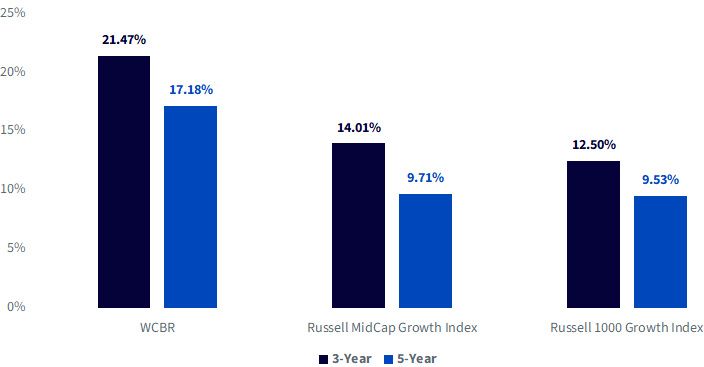
Source: WisdomTree; specifically, data is from the PATH Fund Comparison Tool, as of 6/30/24. Holdings are subject to change. You
cannot invest directly in an index.
If there are investors looking for strategies with a potential to respond to falling interest rates, we can take the 2023 case study and think that WCBR may have the potential to respond favorably to falling interest rates, should they occur, in the second half of 2024.
1 Source: https://www.crowdstrike.com/blog/to-our-customers-and-partners/
4 Source: Wall Street Journal, with market capitalization accessed on 7/22/24.
7 Source: https://www.okta.com/blog/2022/03/updated-okta-statement-on-lapsus/
8 Source: Wall Street Journal, with data accessed as of 7/22/24.
9 Source: https://investor.okta.com/static-files/45a8008e-a185-47a8-a1a7-7e373cfddac5
10 Sources: WisdomTree, Morningstar, Bloomberg. All data as of 6/30/24 and based on WisdomTree's internal classification of thematic Funds. Historical performance is not an indication of future performance, and any investments may go down in value. ETFs are sold by prospectus only. See each individual Fund’s website for its prospectus and other important information.
For current holdings of WDNA, please click here. Holdings are subject to risk and change.
There are risks associated with investing, including the possible loss of principal. The Fund invests in cybersecurity companies, which generate a meaningful part of their revenue from security protocols that prevent intrusion and attacks to systems, networks, applications, computers and mobile devices. Cybersecurity companies are particularly vulnerable to rapid changes in technology, rapid obsolescence of products and services, the loss of patent, copyright and trademark protections, government regulation and competition, both domestically and internationally. Cybersecurity company stocks, especially those which are internet related, have experienced extreme price and volume fluctuations in the past that have often been unrelated to their operating performance. These companies may also be smaller and less experienced companies, with limited product or service lines, markets or financial resources and fewer experienced management or marketing personnel. The Fund invests in the securities included in, or representative of, its Index regardless of their investment merit and the Fund does not attempt to outperform its Index or take defensive positions in declining markets. The composition of the Index is heavily dependent on quantitative and qualitative information and data from one or more third parties, and the Index may not perform as intended. Please read the Fund’s prospectus for specific details regarding the Fund’s risk profile.
Cybersecurity Fund

Global Head of Research
Christopher Gannatti began at WisdomTree as a Research Analyst in December 2010, working directly with Jeremy Schwartz, CFA®, Director of Research. In January of 2014, he was promoted to Associate Director of Research where he was responsible to lead different groups of analysts and strategists within the broader Research team at WisdomTree. In February of 2018, Christopher was promoted to Head of Research, Europe, where he was based out of WisdomTree’s London office and was responsible for the full WisdomTree research effort within the European market, as well as supporting the UCITs platform globally. In November 2021, Christopher was promoted to Global Head of Research, now responsible for numerous communications on investment strategy globally, particularly in the thematic equity space. Christopher came to WisdomTree from Lord Abbett, where he worked for four and a half years as a Regional Consultant. He received his MBA in Quantitative Finance, Accounting, and Economics from NYU’s Stern School of Business in 2010, and he received his bachelor’s degree from Colgate University in Economics in 2006. Christopher is a holder of the Chartered Financial Analyst Designation.

Director, Quantitative Research
Ayush Babel is the Director of Quantitative Research in WisdomTree's multi-asset quantitative research and index teams. In this role, he focuses on developing innovative quantitative strategies across various asset classes while supporting WisdomTree's diverse range of products. His expertise spans factor exploration, portfolio construction and optimization, quantitative investment research, and product development.
With over a decade of experience in the financial services industry, Ayush has held investment research roles at J.P. Morgan and Franklin Templeton. At these institutions, he was responsible for developing and managing equity and fixed income smart beta products, as well as cross-asset risk premia solutions for global institutional and retail clients. His experience covers a broad spectrum of asset classes and investment styles.
Ayush holds a bachelor's in Engineering Physics and a master’s degree in Nanoscience from the Indian Institute of Technology, Bombay.

