
QGRW
U.S. Quality Growth Fund

Published August 2, 2024

Global Head of Research
For the better part of the last two years, the U.S. equity market has been driven by what seems, at least on paper, to be a very simple story:
At WisdomTree, it’s gotten to the point where investors have begun to ask:
The point is that behavioral finance exists for a reason, and the phrase “performance chasing” exists because it is a powerful force that does, in fact, drive decision-making.
However, the thing about “diversification”—simply put, not putting all of one’s eggs in one basket—is that it may seem like it doesn’t matter until a big, unexpected catalyst cautions us about getting too comfortable with the current trend.
People are going to remember July 2024. After the presidential debate on June 28, an unprecedented situation unfolded that led to President Biden pulling out of the 2024 presidential race and endorsing Vice President Kamala Harris. There was also the assassination attempt on former President Trump, the Republican nominee. Even without votes being cast, we have been living political history.
Looking at market history, while there are no hard and fast rules, when historic, unexpected things happen, it makes sense to consider if seemingly embedded trends can change.
Prior to July 2024:
Figure 1 sets up the analysis of July by showing the longer-term standardized periods of returns for the underlying Funds:
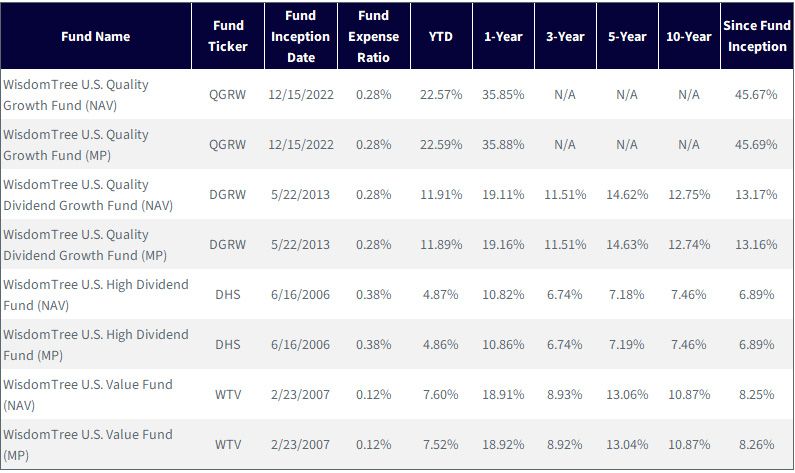
Source: WisdomTree, specifically data from the Fund Comparison Tool in the PATH suite of tools, as of July 28, 2024. NAV denotes total return
performance at net asset value. MP denotes market price performance. WTV’s objective changed effective December 18, 2017. Prior to December 18,
2017, Fund performance reflects the investment objective of the Fund when it tracked the performance, before fees and expenses, of the WisdomTree
U.S. LargeCap Value Index. Past performance is not indicative of future results. Investment return and principal value of an investment will
fluctuate so that an investor’s shares, when redeemed, may be worth more or less than their original cost. Current performance may be
lower or higher than the performance data quoted. For the most recent month-end and standardized performance and to download the
respective Fund prospectuses, click the relevant ticker: QGRW, DGRW, DHS and WTV.
We tend to monitor the performance of different strategies to showcase certain narratives or stories. For most of 2024 so far, there has been one story: QGRW, which emphasizes exposure to the “Magnificent 7” and other large-cap companies with strong quality and growth characteristics, has been the runaway leader. DGRW has been more stable and less prone to bigger runs, either up or down. And then DHS and WTV have been comparatively “out of favor” since they focus on the value side of the ledger and the growth side has been running faster.
But, roughly starting around July 1, 2024, it looks like the picture shifted a bit.
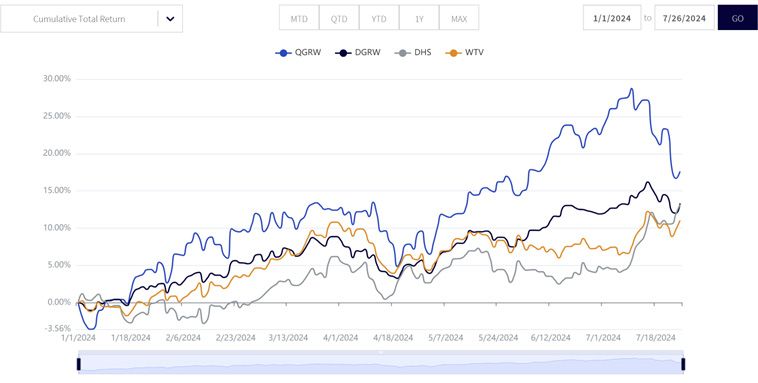
Source: WisdomTree, specifically data from the Fund Comparison Tool in the PATH suite of tools, for the period 1/1/24 to 7/26/24. NAV denotes
total return performance at net asset value. MP denotes market price performance. Past performance is not indicative of future results.
Investment return and principal value of an investment will fluctuate so that an investor’s shares, when redeemed, may be worth
more or less than their original cost. Current performance may be lower or higher than the performance data quoted. For the most
recent month-end and standardized performance and to download the respective Fund prospectuses, click the relevant ticker:
QGRW, DGRW, DHS and WTV.
If we zoom in and only look at July 2024’s performance for these four Funds, we see:
One month of performance is just that—one month. We have to continue to monitor things in order to see if what we are witnessing is just a blip and large growth goes back to leadership OR if it’s actually time for a sustained value rally in U.S. equities—something we haven’t really seen since 2022.
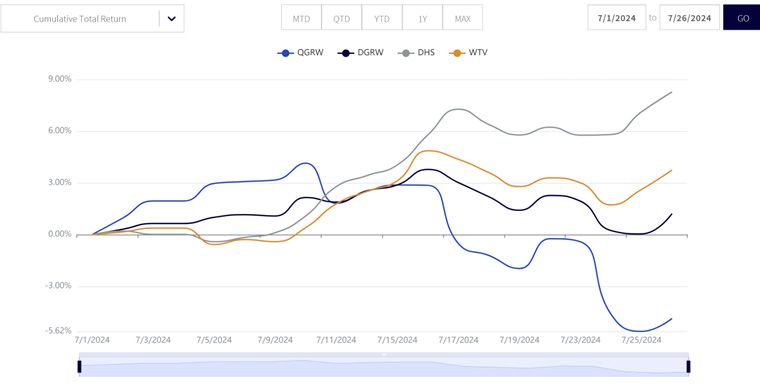
Source: WisdomTree, specifically data from the Fund Comparison Tool in the PATH suite of tools, for the period 7/1/24 to 7/26/24. NAV denotes
total return performance at net asset value. MP denotes market price performance. Past performance is not indicative of future results.
Investment return and principal value of an investment will fluctuate so that an investor’s shares, when redeemed, may be worth
more or less than their original cost. Current performance may be lower or higher than the performance data quoted. For the most
recent month-end and standardized performance and to download the respective Fund prospectuses, click the relevant ticker:
QGRW, DGRW, DHS and WTV.
Because the Magnificent 7 has garnered so much attention over the past two years, we pulled up the top 10 positions in each of these four strategies:
Since we are deluged with headlines and commentary regarding how the Magnificent 7 is doing on a daily basis, those investors looking for “something else” to drive the returns of investment strategies may have at least an initial catalyst to look toward DHS and WTV.
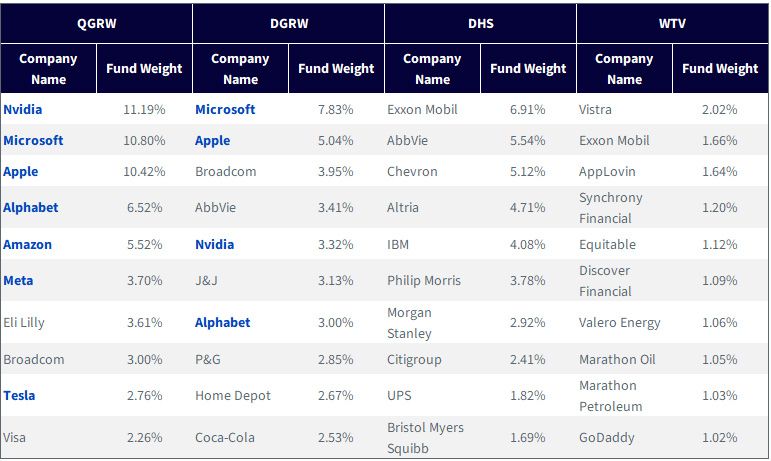
Sources: WisdomTree, FactSet, as of 6/30/24. Holdings subject to change.
Valuation is an often-cited market characteristic, but it’s important to realize that history has not shown that markets crash or rally based on it alone. We tend to think about valuation as a way to consider risk levels—higher valuations could be one way to indicate a market is susceptible to a correction after a strong rally, whereas lower valuations could indicate a potential to move positively in light of new, positive information coming to light.
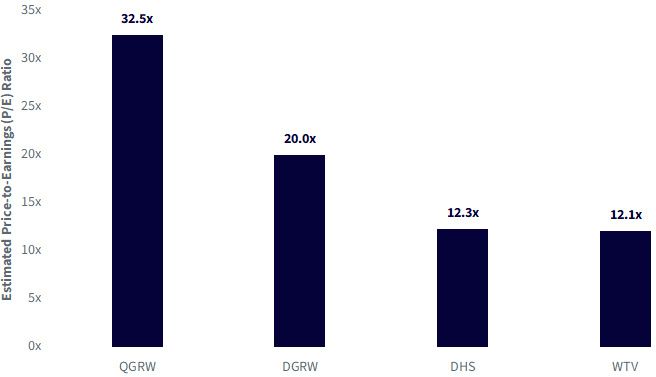
Sources: WisdomTree, FactSet, with data accessed in WisdomTree’s PATH Fund Comparison tool as of 7/28/24.
Finally, our bottom-line discussion regards whether one has to sacrifice earnings growth to gain exposure to value.
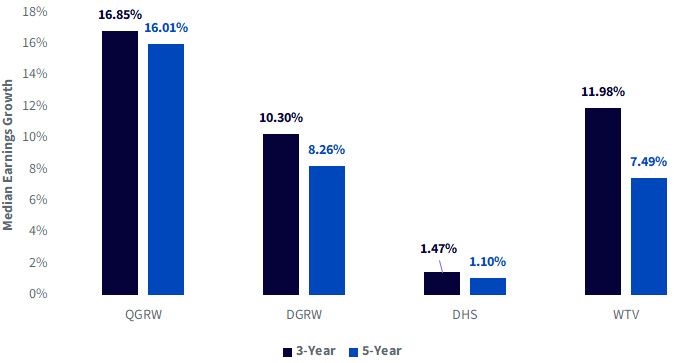
Sources: WisdomTree, FactSet, with data accessed in WisdomTree’s PATH Fund Comparison tool as of 7/28/24.
For those investors thinking that the trend of the largest, growth-oriented companies leading markets is ripe for a change, WTV may be an interesting way to think about something driven by a very different mix of companies. And, to be fair, the relative steadiness of DGRW has been notable to us in the face of these bigger growth-oriented positions seeming to fall out of favor in July 2024.
There are risks associated with investing, including the possible loss of principal. Growth stocks, as a group, may be out of favor with the market and underperform value stocks or the overall equity market. Growth stocks are generally more sensitive to market movements than other types of stocks. The Fund is non-diversified; as a result, changes in the market value of a single security could cause greater fluctuations in the value of Fund shares than would occur in a diversified fund. The Fund invests in the securities included in, or representative of, its Index regardless of their investment merit. The Fund does not attempt to outperform its Index or take defensive positions in declining markets, and the Index may not perform as intended.
Funds focusing their investments on certain sectors increase their vulnerability to any single economic or regulatory development. This may result in greater share price volatility. Dividends are not guaranteed, and a company currently paying dividends may cease paying dividends at any time. While the Fund is actively managed, the Fund’s investment process is expected to be heavily dependent on quantitative models, and the models may not perform as intended.

Global Head of Research
Christopher Gannatti began at WisdomTree as a Research Analyst in December 2010, working directly with Jeremy Schwartz, CFA®, Director of Research. In January of 2014, he was promoted to Associate Director of Research where he was responsible to lead different groups of analysts and strategists within the broader Research team at WisdomTree. In February of 2018, Christopher was promoted to Head of Research, Europe, where he was based out of WisdomTree’s London office and was responsible for the full WisdomTree research effort within the European market, as well as supporting the UCITs platform globally. In November 2021, Christopher was promoted to Global Head of Research, now responsible for numerous communications on investment strategy globally, particularly in the thematic equity space. Christopher came to WisdomTree from Lord Abbett, where he worked for four and a half years as a Regional Consultant. He received his MBA in Quantitative Finance, Accounting, and Economics from NYU’s Stern School of Business in 2010, and he received his bachelor’s degree from Colgate University in Economics in 2006. Christopher is a holder of the Chartered Financial Analyst Designation.

