
EMMF
Emerging Markets Multifactor Fund

Published January 16, 2025

Equity Strategist
Much of EM's struggle can be traced to China, a region inundated with economic and geopolitical obstacles that is also the largest allocation in most EM indexes. Poor sentiment, geopolitical aversion, weak economic data and underwhelming stimulus measures were collectively too difficult to overcome, leading to 3.4% annualized losses in the (in dollar terms) since the start of 2020. Over 10 years, China was barely positive, delivering less than 2% when dollarizing its annual performance.
The sobering returns have forced investors to reevaluate their asset allocation and portfolio risk budgets. Historically, EM was considered the consummate high-risk/high-reward allocation, and a method to help diversify a global equity portfolio.
But continued U.S. equity leadership challenges this premise. Many investors simply prefer to maintain and increaseexisting U.S. large-cap exposures despite historically high valuations, hopeful that the recent momentum will persist.
Time will tell whether this "risk replacement" bears fruit, but it underscores an important point about EM. Sometimes active management deservingly prevails, and is necessitated, over blanket, beta allocations.
In 2018, our team launched the WisdomTree Emerging Markets Multifactor Fund (EMMF), an actively managed strategy that applies two critical lenses to EM: factor investing and dynamic currency management.
EMMF allocates to approximately 200 companies with the highest composite scores based on two fundamental factors (value and quality) and two technical factors (correlation and momentum). Each stock then receives an additional inverse volatility score, ensuring that the least volatile stocks are rewarded over more volatile ones. Weights are determined by a combination of their volatility, fundamental and technical scores. Additional controls also are placed on sector and country tilts relative to an equivalent market cap-weighted universe.
Although returns for EM over the past half-decade wavered between underwhelming to downright awful, we've found that factor-oriented and currency-attentive approaches made the region more compelling from a risk-adjusted perspective.
During EM's most recent three-year malaise, EMMF returned about 4% per year while broader, dollarized EM fell by 2%. Over the past five years, it earned 5.6% per year, or about 4% more than dollar-denominated EM.
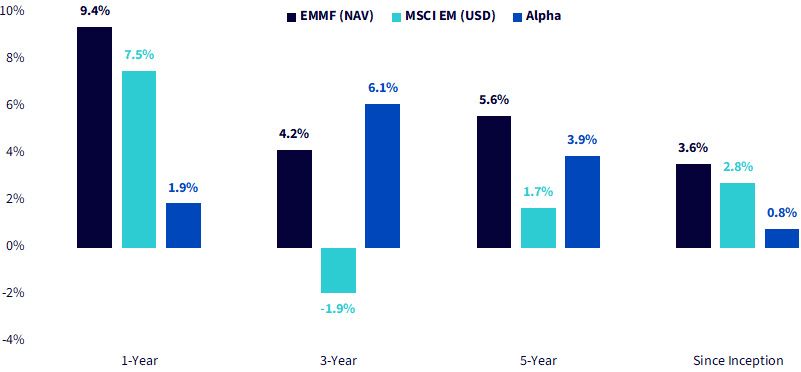
Source: WisdomTree, MSCI, as of 12/31/24. You cannot invest directly in an index. Past performance is not indicative of future results. Investment return and principal value of an investment will fluctuate so that an investor's shares, when redeemed, may be worth more or less than their original cost. Current performance may be lower or higher than the performance data quoted. For the most recent month-end and standardized performances, click here.
EMMF's performance improvement is impressive for a region featuring unexciting returns, but risk reduction compounds the appeal. Over the past 1-, 3-, 5-year and since-inception periods, it reduced volatility by about 4%–5% due to its risk considerations when weighting the equity constituents and its dynamic currency hedge.
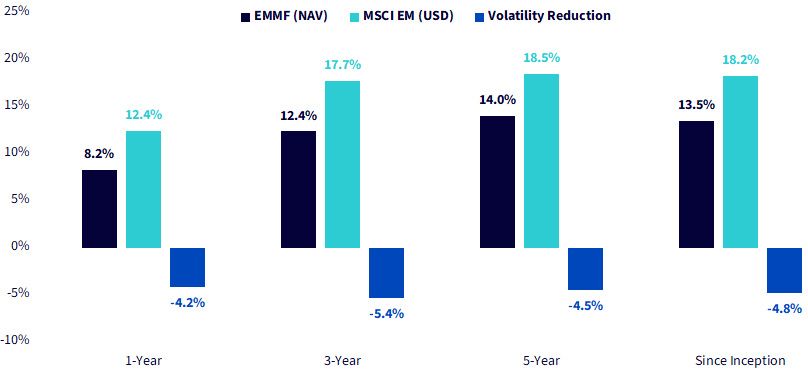
Source: WisdomTree, MSCI, as of 12/31/24. Volatility measured by the annualized standard deviation of monthly returns. You cannot invest directly in an index.
Lower risk is achieved by the low-correlation and momentum screens within our technical factor framework and amplified by the volatility consideration before weighting the final stock basket. As a result, risk-adjusted returns were improved in a region sorely in need.
CurrencyHedgingStabilizes Risk in EM
But its risk improvement is also attributable to the dynamic currency hedge, a component where WisdomTree excels. We first developed strategic currency hedged solutions back in 2009 for the developed world because the interest rate differentials often had positive carry that compounded returns of local markets. In EM, it was historically expensive to apply 100% hedged solutions because of high interest rates, but it's especially appealing today amid elevated FX volatility.
The currency hedge is applied to neutralize fluctuations in the underlying EM currency exposures provided by the equities. Hedge ratios for the various currency exposures are reevaluated and reset each month in accordance with our proprietary signals, and some currencies may be fully hedged, partially hedged or completely unhedged.
Though the ratios may change, the intent of the hedge and the philosophy behind it does not. We believe that unhedged regional currency exposures often add uncompensatedincremental risks for international allocationsthat may be improved through active currency management.
Historical currency returns for the EM region substantiate our thinking.
Figure 3: Calendar Year Returns from EM FX, 2001–2024
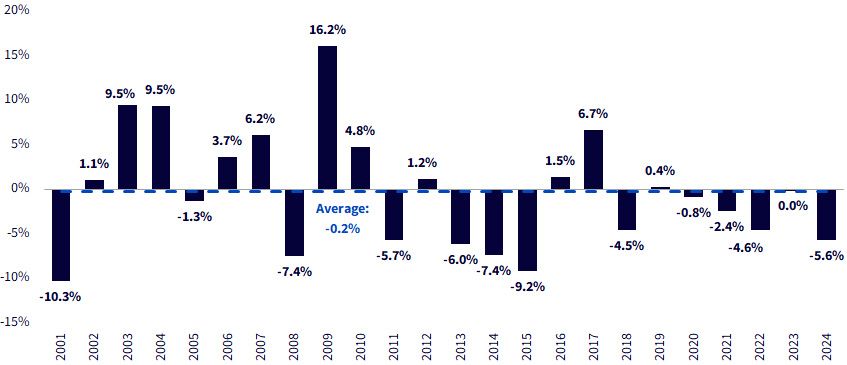
Source: WisdomTree, MSCI, as of 12/31/24. Currency returns represented by the difference in returns for the MSCI EM Index when dominated in local currency and USD. Past performance is not indicative of future results. You cannot invest directly in an index.
Currency risk, meanwhile, added incremental volatility just to erode returns. Over the past 3-, 5- and 10-year periods, EM currency exposure added about 3.5% annualized risk to broader regional numbers, which is an extra 20%–25% contribution atop the volatility provided by stocks alone. Including currency risk made EM more volatile than the S&P 500 over each period.
Figure 4: EM Equity Volatility: A Function of Equity & Currency Risk
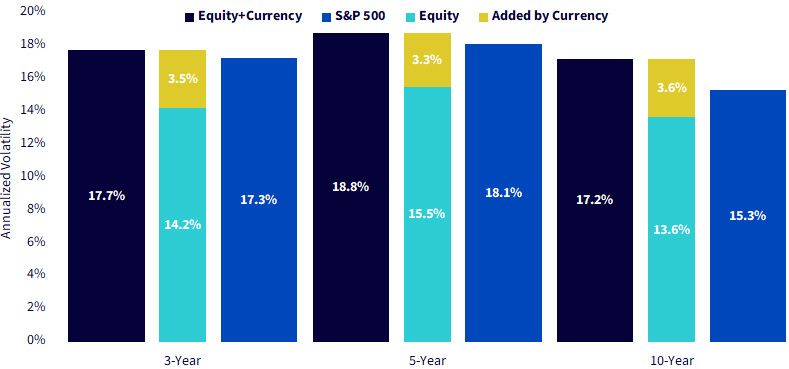
Source: WisdomTree, MSCI, as of 12/31/24. Equity+Currency is represented by the total return volatility of the MSCI Emerging Markets (EM) Index (USD). Volatility measured by the annualized standard deviation of monthly returns. Currency returns represented by the difference in returns for the MSCI EM Index when dominated in local currency and USD. Past performance is not indicative of future results. You cannot invest directly in an index.
Today, hedging EM currencies is increasingly relevant during a period of record dollar strength and rising FX volatility. The 10 worst-performing EM currencies versus the dollar in 2024 all weakened by over 10%, with three losing over 20%.2 Brazil is a prime example, where massive losses in the real required multiple FX market interventions from its central bank last month to stem the declines. Alas, the real fell 21.4% in 2024.
Factor Investing Substantiates EM Ownership
The factor-designed equity basket also validates our approach to EM from a performance and fundamental standpoint.
Over the past three years, EMMF outperformed the dollar-denominated by about 6%. Nearly 4% of that alpha is explained by stock selection effects, or simply picking better performing stocks than the benchmark.
Allocation effects were understandably less pronounced, since EMMF's sector and country allocations are contained to 5% of an identical market cap-weighted universe during each rebalance. The intent is to place a greater performance emphasis on the equities themselves, rather than the sectors or countries they comprise. Allocation effects only added about 70 basis points to the three-year relative performance, with most of that contribution attributable to an under-weight allocation to China and over-weight allocation to India. Over five years, these effects are similar.
A closer look at the underlying fundamentals illuminates the advantages of the factor framework.
Figure 5: Factor Emphasis Evident in Fundamentals vs. Broad EM
Source: WisdomTree, FactSet, as of 12/31/24. You cannot invest directly in an index.
Value is one of the two fundamental factors in our methodology, and its inclusion delivered a and cheaper than that of the MSCI EM Index at the end of 2024. Improvements related to the second fundamental factor, quality, are also evident. and both improved notably compared to the MSCI EM Index.
The reduced risk throughout the Fund's history was obtained via low-correlation and momentum screens in our technical factor framework (along with the inverse volatility influence before weighting), but the blend of all four also introduces an implicit fifth factor exposure: size.
EMMF routinely skews toward smaller companies primarily because its factor framework deviates considerably from conventional market cap weighting. As of December, over 45% of the Fund is comprised of smaller companies along the size spectrum than the MSCI EM Index, creating an equivalent under-weight allocation to large caps and over-weight allocation to mid-caps and small caps of about 24%.
The totality of these factors differentiates EMMF from broader, blanket EM allocations and explains the performance and risk advantages apparent since inception.
Active management often thrives in volatile or rangebound markets with more potential downside influences than upside catalysts. In other words, when beta stagnates, active management accelerates, especially in unfamiliar markets like EM.
Nearing its eighth year since inception, EMMF's dual emphasis on multi-factor equity selection and active currency management has consistently improved the risk-adjusted returns of a neglected market. If the market environment in 2025 remains uncertain, actively managed approaches to EM may prove worthwhile.
1 Represented by the MSCI Emerging Markets Index. You cannot invest directly in an index. Past performance is not indicative of future results.
2 Source: Bloomberg World Currency Ranker, as of 12/31/24. Period: 12/31/23–12/31/24. The three currencies that weakened by over 20% versus the dollar were the Russian ruble (RUB), Brazilian real (BRL), and Argentine peso (ARS). Past performance is not indicative of future results.
Investing involves risk, including the possible loss of principal. Investments in non-U.S. securities involve political, regulatory and economic risks that may not be present in U.S. securities. For example, foreign securities may be subject to risk of loss due to foreign currency fluctuations, political or economic instability, or geographic events that adversely impact issuers of foreign securities. Derivatives used by the Fund to offset exposure to foreign currencies may not perform as intended. There can be no assurance that the Fund’s hedging transactions will be effective. The value of an investment in the Fund could be significantly and negatively impacted if foreign currencies appreciate at the same time that the value of the Fund’s equity holdings falls. While the Fund is actively managed, the Fund’s investment process is expected to be heavily dependent on quantitative models and the models may not perform as intended.
Additional risks specific to EMMF include but are not limited to emerging markets risk. Investments in securities and instruments traded in developing or emerging markets, or that provide exposure to such securities or markets, can involve additional risks relating to political, economic or regulatory conditions not associated with investments in U.S. securities and instruments or investments in more developed international markets. Please read the Fund’s prospectus for specific details regarding the Fund’s risk profile.
Emerging Markets Multifactor Fund

Equity Strategist
Brian Manby is an Equity Strategist at WisdomTree and part of the Investment Strategy team.
He is responsible for developing and communicating equity market insights, investment themes, and portfolio strategies that support the firm’s ETF and investment solutions platform. He evaluates sectors, valuations, fundamentals and equity styles to identify investment opportunities and provide actionable perspectives to clients and advisors. He also helps investors understand how WisdomTree’s equity strategies can be used to achieve long-term investment objectives in evolving market environments.
Brian joined WisdomTree in October 2018 as an Investment Strategy Analyst after a few years as a Consultant for FactSet Research Systems, Inc. He earned a B.A. in Economics and Political Science from the University of Connecticut in 2016 and has been a Chartered Financial Analyst since 2022.


