
WTAI
Artificial Intelligence and Innovation Fund

Published January 2, 2025

Global Head of Research

Senior Associate, Quantitative Research
The AI market has evolved significantly in the past two years, shifting from a heavy reliance on mega-cap and semiconductor dominance to a more diverse set of beneficiaries. The launch of ChatGPT was a landmark moment for AI and a wake-up call for the market. Semiconductors,1 particularly Nvidia, took center stage with its graphics processing units (GPUs), driving a 53% gain in the space over the following 18 months—outperforming the S&P 500 Index by more than 20% for the period. Key players like Micron and SK Hynix played important roles with high-bandwidth memory (HBM) chips, while Taiwan Semiconductor booked its advanced chip manufacturing pipeline well into the future. This semiconductor hardware enabled AI’s early growth, solidifying semiconductors as the foundation of the AI revolution.
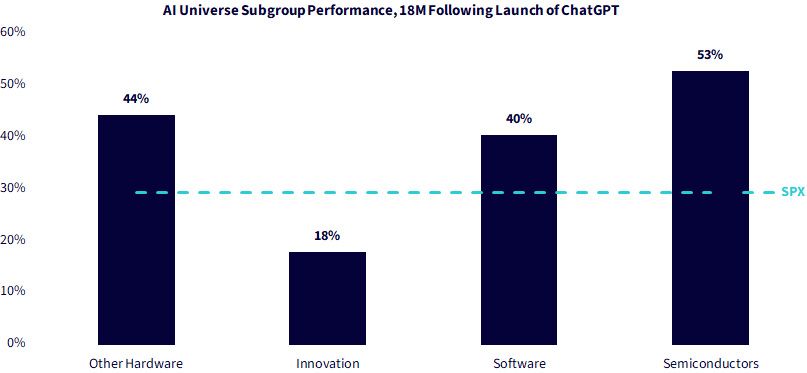
Sources: WisdomTree, FactSet, as of 11/30/24. The AI universe consists of more than 500 companies held across 10 AI-focused exchange-traded funds with more than $50 million in AUM in the WisdomTree Thematics Universe. Classifications are proprietary and made as described according to the WisdomTree Artificial Intelligence & Innovation Index methodology. Performance is calculated on an equal-weighted basis within each group. Past performance is not indicative of future results.
Other firms offering AI solutions—spanning software, robotics, autonomous vehicles and other AI applications—failed to catch the initial wave that benefited semiconductor stocks. Hyperscalers such as Amazon, Microsoft, Alphabet and Meta are leading the AI data center buildout, buying Nvidia’s chips and other semiconductor equipment to create what Nvidia CEO Jensen Huang calls “AI factories.” This infrastructure development is ongoing, with hyperscalers investing more than $200 billion in capex in 2024 and planning an additional $300 billion in 2025. As these AI factories come online, the foundation for AI will be set, and value creation could extend further across the entire AI ecosystem.
Earnings over the last week2 have highlighted that we haven’t made the shift just yet. While compute and memory semiconductors like GPUs and HBMs have historically been the focus, networking firms are now stepping into the spotlight. Companies like Credo Technology (+47.9% following its earnings announcement) and Marvell (+23.2%) posted stellar results due to their capacity to deliver high-speed connectivity solutions for data centers. Broadcom (+24.4%), the designer of Google’s tensor processing unit, also had strong earnings, driven by its networking capabilities. Notably, Elon Musk’s Colossus supercomputer, which connects 100,000 Nvidia GPUs, relies on low-latency, high-bandwidth networking infrastructure to support training at an unprecedented scale. With the latest Nvidia Blackwell chip expected to suffer from supply constraints, investing in the most advanced networking equipment to scale up to a greater total number of GPUs is becoming essential in training more intelligent large language models (LLMs).
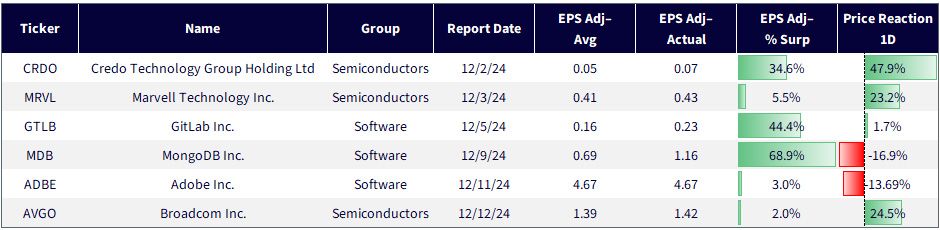
Source: Koyfin, as of 12/16/24. All amounts in USD. Refers to a relevant subset of the AI universe companies that reported earnings within this week’s time. Past performance is not indicative of future returns.
In contrast, software firms have faced a more mixed reception. While MongoDB—a company offering vector database solutions for LLMs—posted a 68.9% earnings surprise, its stock fell 16.9%, signaling investor concerns about valuation amidst a challenging macroeconomic backdrop. GitLab’s earnings beat barely moved its stock (+1.7%), further reflecting a market that is focused on earnings quality and forward guidance. The valuation reset in the software sector—driven by inflation concerns and questions about interest rates—has led to a recent heightened scrutiny of software firms.
The past six months have offered possible early signs of a narrative shift. While the broader semiconductor group’s performance has recorded a 2% loss, and the “AI factory” buildout continues, other players are entering the spotlight. Investors are beginning to recognize that AI’s impact extends beyond Nvidia and a few other key players. Software firms are evolving their strategies to monetize AI capabilities. Meta’s growing advertising revenues, Salesforce’s release of “AgentForce” AI service agents and OpenAI’s $200/month premium tier for advanced AI are all notable examples. Google’s “Willow” project has drawn attention to developments in the space of quantum computing, and smaller players like IonQ have shown early promise. Innovative companies leveraging AI for drug discovery, cybersecurity, robotics and autonomous systems have also captured investor attention, further broadening the scope of beneficiaries. As these technologies and applications mature, the convergence of AI’s influence across industries will become more pronounced.
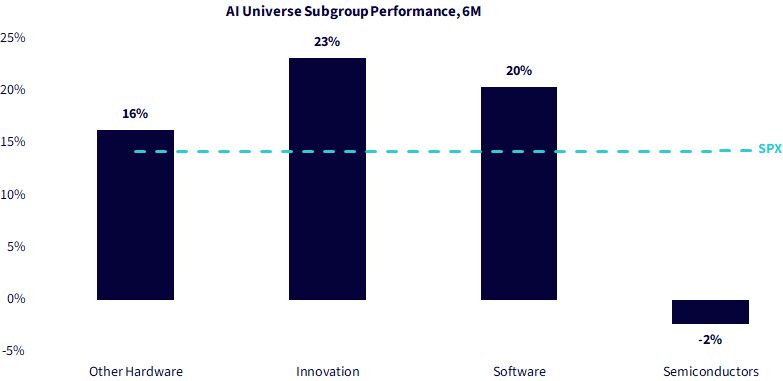
Sources: WisdomTree, FactSet, as of 11/30/24. The AI universe consists of more than 500 companies held across 10 AI-focused exchange-traded funds with more than $50 million in AUM in the WisdomTree Thematics Universe. Classifications are proprietary and made as described according to the WisdomTree Artificial Intelligence & Innovation Index methodology. Performance is calculated on an equal-weighted basis within each group. Past performance is not indicative of future results.
The AI ecosystem is approaching an inflection point. What began as a hardware-driven story is now transforming into a broader narrative, encompassing software integration, next-generation infrastructure and beyond. Investors who understand how these elements fit together will be better positioned to capture the AI investment theme. The future of AI is vast, and as adoption scales, value will be created across the entire ecosystem—from hardware providers to end users.
At WisdomTree, the rubber meets the road with the WisdomTree Artificial Intelligence & Innovation Fund (WTAI), which is designed to track the total return performance, before fees and expenses, of the WisdomTree Artificial Intelligence & Innovation Index. This index is seeking to generate investment returns by allocating across the different aforementioned groups: 1) Semiconductors, 2) Software, 3) Innovation and 4) Other Hardware.
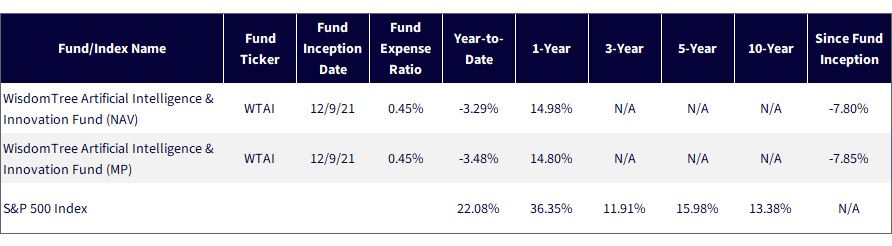
Source: WisdomTree, specifically data from the Fund Comparison Tool in the PATH suite of tools, as of 12/14/24. NAV denotes total return performance at net asset value. MP denotes market price performance. Past performance is not indicative of future results. Investment return and principal value of an investment will fluctuate so that an investor’s shares, when redeemed, may be worth more or less than their original cost. Current performance may be lower or higher than the performance data quoted. For the most recent month-end and standardized performances and to download the Fund’s prospectus, click the ticker: WTAI.
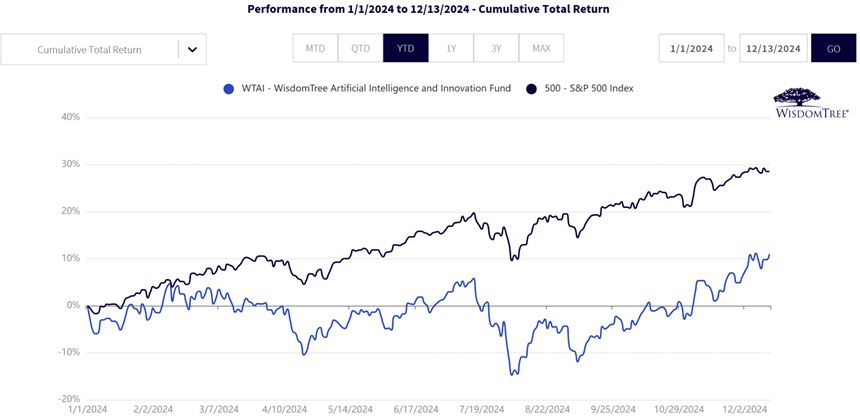
Within figure 5, we see the “2024 experience,” at least so far, with the year nearly on the books. Many are familiar with a strong S&P 500 Index benchmark, delivering nearly 30% cumulatively over this period. Even though the AI topic has generated a lot of attention, WTAI has delivered a return closer to 10%.
We can say that this is a relatively short period and that when we think of AI, we are thinking of a 10–15-year megatrend—not any single year—but we also understand the reality that people may look year-by-year, and they may compare strategies to the big benchmarks.
However, we are encouraged by the period that looks like it starts in early August 2024 in this figure and continues on through the end of the period.
Source: WisdomTree, specifically data from the Fund Comparison Tool in the PATH suite of tools, as of 12/14/24. NAV denotes total return performance at net asset value. MP denotes market price performance. Past performance is not indicative of future results. Investment return and principal value of an investment will fluctuate so that an investor’s shares, when redeemed, may be worth more or less than their original cost. Current performance may be lower or higher than the performance data quoted. For the most recent month-end and standardized performances and to download the Fund’s prospectus, click the ticker: WTAI.
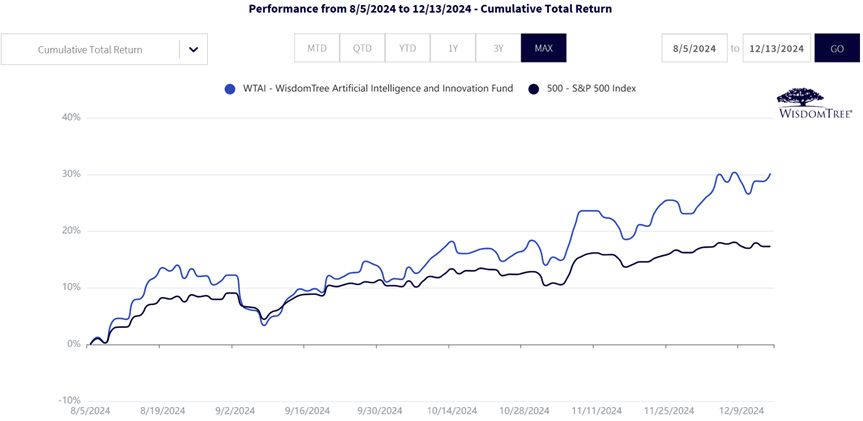
If we zoom in on the period from August 5, 2024, to December 13, 2024, we do, in fact, see an acceleration of WTAI’s performance. The strategy did deliver outperformance over the S&P 500 Index benchmark over this period.
We are, of course, encouraged, but we know that this is still a relatively short period, and many investors would want to see this on a more sustained basis. We believe there is a chance it can continue. We look at this this way:
Source: WisdomTree, specifically data from the Fund Comparison Tool in the PATH suite of tools, for the period 8/5/24 to 12/13/24. NAV denotes total return performance at net asset value. MP denotes market price performance. Past performance is not indicative of future results. Investment return and principal value of an investment will fluctuate so that an investor’s shares, when redeemed, may be worth more or less than their original cost. Current performance may be lower or higher than the performance data quoted. For the most recent month-end and standardized performances and to download the Fund’s prospectus, click the ticker: WTAI.
We remain very excited about the prospects for AI and think that 2025 may be an exciting year.
Check out our PATH suite of tools yourself to explore more around WTAI’s performance and read the latest WisdomTree U.S. Thematic Monthly Update for more AI insights.
For current holdings, please click here. Holdings are subject to risk and change.
There are risks associated with investing, including the possible loss of principal. The Fund invests in companies primarily involved in the investment theme of artificial intelligence (AI) and innovation. Companies engaged in AI typically face intense competition and potentially rapid product obsolescence. These companies are also heavily dependent on intellectual property rights and may be adversely affected by loss or impairment of those rights. Additionally, AI companies typically invest significant amounts of spending on research and development, and there is no guarantee that the products or services produced by these companies will be successful. Companies that are capitalizing on innovation and developing technologies to displace older technologies or create new markets may not be successful. The Fund invests in the securities included in, or representative of, its Index regardless of their investment merit, and the Fund does not attempt to outperform its Index or take defensive positions in declining markets. The composition of the Index is governed by an Index Committee, and the Index may not perform as intended. Please read the Fund’s prospectus for specific details regarding the Fund’s risk profile.
Artificial Intelligence and Innovation Fund

Global Head of Research
Christopher Gannatti began at WisdomTree as a Research Analyst in December 2010, working directly with Jeremy Schwartz, CFA®, Director of Research. In January of 2014, he was promoted to Associate Director of Research where he was responsible to lead different groups of analysts and strategists within the broader Research team at WisdomTree. In February of 2018, Christopher was promoted to Head of Research, Europe, where he was based out of WisdomTree’s London office and was responsible for the full WisdomTree research effort within the European market, as well as supporting the UCITs platform globally. In November 2021, Christopher was promoted to Global Head of Research, now responsible for numerous communications on investment strategy globally, particularly in the thematic equity space. Christopher came to WisdomTree from Lord Abbett, where he worked for four and a half years as a Regional Consultant. He received his MBA in Quantitative Finance, Accounting, and Economics from NYU’s Stern School of Business in 2010, and he received his bachelor’s degree from Colgate University in Economics in 2006. Christopher is a holder of the Chartered Financial Analyst Designation.

Senior Associate, Quantitative Research
Blake Heimann joined WisdomTree in 2020 and, in his current role as Senior Associate, supports the creation, maintenance, and reconstitution of our indices. Blake began his career in finance in 2017 as an Analyst at TD Ameritrade, and later a Quantitative Analyst with focuses on research and development of machine learning applications in finance. Blake has bachelor’s degrees in Mathematics and Economics from Iowa State University, as well as his Masters in Computer Science at Georgia Tech, with a specialization in Machine Learning. He is currently pursuing a Masters in Finance from the London School of Economics.
