
QGRW
U.S. Quality Growth Fund

Published November 25, 2026

Global Head of Research
On Saturday afternoon, November 14, 2026, at about 4:20 p.m. Eastern, the upper stage of a Starship, the spacecraft that sits on top of the world’s largest rocket, came back from orbit, descended onto its launch site at Starbase, Texas, and was caught in midair by two enormous mechanical arms on the launch tower. No company had ever returned the upper stage of an orbital rocket to its pad and caught it.1
Less than a day earlier, something quieter happened in our world. The WisdomTree U.S. Quality Growth Index (“the index”), which underlies the WisdomTree U.S. Quality Growth Fund (QGRW), added Space Exploration Technologies Corp., known as SpaceX, as a holding.2 The change took effect at the close of trading on Friday, November 13, under two hours before the rocket lifted off at 5:47 p.m. The timing is a coincidence, as scheduled launches are often postponed even at the last moment, but the two events tell one story from opposite ends.
They signify what SpaceX is turning into, and where it now sits in a portfolio.
SpaceX shares began trading on the Nasdaq exchange on June 12, 2026, under the ticker SPCX, after an offering that raised $75 billion at $135 a share and valued the company at about $1.77 trillion.3 Most people may think that SpaceX is a rocket company, but the latest financial report shows something different.
In the third quarter of 2026, SpaceX reported revenue of $14.6 billion, up 161% from $5.6 billion a year earlier. The company splits that into three businesses.4
The profit picture changed as well. SpaceX reported net income of $4.4 billion for the quarter, against a net loss of about $1.05 billion in the same quarter a year earlier. Starlink’s consumer subscribers reached 13.6 million, up from 7.2 million a year earlier.5
Another critical number to watch is spending.4
This is a company reinvesting heavily ahead of demand, which is how growth gets built and also where the risk sits if that demand arrives more slowly than planned.
On the October 20 earnings call, Musk, SpaceX’s chief executive, spent much of his time on Starship. He noted that Flight 14 was the first time Starship reached orbit, and that it deployed 26 of the new Starlink V3 satellites. SpaceX says that single launch added about 10 times the data capacity of a launch of Falcon 9, its current workhorse rocket.
The logic is simple: if each launch carries far more capacity, the cost of adding each unit of internet bandwidth falls.
Musk then set out targets, not results.
On Flight 15 (just completed) he said the company would attempt to catch both the booster and the ship, adding, “success is not guaranteed on these first flights, but I’d say it’s more likely than not that this succeeds next flight.”6
He was just as direct about computing. “The constraint on deployment of super intelligence is more in power and cooling and infrastructure than it is in chips,” he said. In plain terms, the bottleneck for artificial intelligence is not only the processors but also the electricity and cooling needed to run them at scale. SpaceX said it had 1.7 gigawatts of computing capacity at the end of the third quarter and expected 2.5 to 3 gigawatts by the end of the fourth, meaning as of December 31, 2026. Remember that a gigawatt is a billion watts, about the output of one large power plant.6 That connects the rocket story to the investment story, as SpaceX is positioning itself as a builder of physical infrastructure for the AI era.
Starship lifted off from Starbase at 5:47 p.m. Eastern on November 13. The first stage, called Super Heavy, did not complete its job. It was meant to return to the tower for a catch, but it ended an engine burn early after a low-fuel alarm; its guidance system determined it was out of position, and it aborted the catch. SpaceX said the root cause was still under investigation.1 The “double catch” of both booster and ship that SpaceX had called the holy grail of rocketry did not happen.7
The upper stage, Ship 42, performed. It reached orbit about 26 minutes after liftoff, deployed all 26 Starlink V3 satellites and circled the Earth for the rest of the day. Three of those satellites carried cameras to photograph the ship’s heat shield, and the images showed it in good condition for the return. About 22.5 hours after liftoff, the tower’s arms caught it.1
The ship matters more than the booster because it is the harder half to bring back. It must survive reentry at orbital speed, steer precisely to a single point and be positioned for the arms. Think of an airline that flies each jet once and scraps it, versus one that refuels and relaunches the same aircraft. Reuse is what changes the cost of each flight, and SpaceX has already caught three boosters and reused two of them.7 Catching the ship extends that same approach to the part that actually reaches orbit.
However, several things remain unproven.7
We are excited to see whether these further milestones are achieved on future flights.
The WisdomTree U.S. Quality Growth Index, put simply, looks for U.S.-listed companies that combine two traits:
Those are the two questions the index asks of every company, and SpaceX’s most recent report speaks to both, as shown by $4.4 billion of net income and revenue up 161%.
The change came through an ad hoc reconstitution, a rebalance outside the index’s regular semiannual schedule. The reconstitution took effect at the close of November 13. It added SpaceX at a weight of 3.29%, as seen in Figure 1, where we note its relative positioning against the rest of the top 10 index holdings.
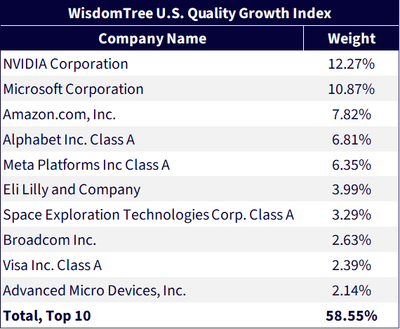
Source: WisdomTree, with data from the Index reconstitution announcement on November 9, 2026, which noted the targeted Index weights to take effect after the market’s close on November 13, 2026. Holdings subject to change.
The catch and the index change are, of course, separate events, now forever tied together by taking place less than a day apart. The important point for investors is that SpaceX has moved from a story about rockets to a business with real profits, a fast-growing subscriber base and a very large spending program to position itself as a provider of hyperscale compute. At 3.29% the index now carries that exposure in a meaningful way.
1 Source: Wall, M., Dinner, J. & Malik, T. (2026, November 14). SpaceX Starship Flight 15 live updates: Starship lands from orbit for 1st time. Space.com.
2 Source: On November 9, 2026, WisdomTree posted that SpaceX would be added as a constituent to the WisdomTree U.S. Quality Growth Index as of the market’s close on November 13, 2026. Initial weight would be 3.29%. Holdings subject to change.
3 Source: Reuters. (2026, June 11). Musk’s SpaceX raises $75 billion in largest IPO ever. StreetInsider.
4 Sources for bullets: Space Exploration Technologies Corp. (2026, October 20). SpaceX reports third quarter 2026 results [Press release, Exhibit 99.1 to Form 8-K]. U.S. Securities and Exchange Commission; Motley Fool Transcribing. (2026, October 20). SpaceX (SPCX) Q3 2026 earnings call transcript [Transcript]. The Motley Fool.
5 Source: Space Exploration Technologies Corp., 2026, October 20.
6 Source: Motley Fool Transcribing, 2026, October 20.
7 Source: Jones, A. (2026, November 13). Double-catch drama: Why Starship’s Flight 15 is so important to SpaceX. Space.com.
There are risks associated with investing, including possible loss of principal. Growth stocks, as a group, may be out of favor with the market and underperform value stocks or the overall equity market. Growth stocks are generally more sensitive to market movements than other types of stocks. The Fund is non-diversified, as a result, changes in the market value of a single security could cause greater fluctuations in the value of Fund shares than would occur in a diversified fund. The Fund invests in the securities included in, or representative of, its Index regardless of their investment merit and the Fund does not attempt to outperform its Index. The composition of the Index is governed by an Index Committee and the Index may not perform as intended. Please read the Fund’s prospectus for specific details regarding the Fund’s risk profile.
U.S. Quality Growth Fund

Global Head of Research
Christopher Gannatti began at WisdomTree as a Research Analyst in December 2010, working directly with Jeremy Schwartz, CFA®, Director of Research. In January of 2014, he was promoted to Associate Director of Research where he was responsible to lead different groups of analysts and strategists within the broader Research team at WisdomTree. In February of 2018, Christopher was promoted to Head of Research, Europe, where he was based out of WisdomTree’s London office and was responsible for the full WisdomTree research effort within the European market, as well as supporting the UCITs platform globally. In November 2021, Christopher was promoted to Global Head of Research, now responsible for numerous communications on investment strategy globally, particularly in the thematic equity space. Christopher came to WisdomTree from Lord Abbett, where he worked for four and a half years as a Regional Consultant. He received his MBA in Quantitative Finance, Accounting, and Economics from NYU’s Stern School of Business in 2010, and he received his bachelor’s degree from Colgate University in Economics in 2006. Christopher is a holder of the Chartered Financial Analyst Designation.

