
GEOA
GeoAlpha Opportunities Fund

Published February 18, 2026

Macro Strategist, Model Portfolios

Global Head of Research
During the latest monthly rebalance, the WisdomTree GeoAlpha Opportunities Index implemented a set of changes that, taken together, sharpen the portfolio's exposure to the three realities defining the geopolitical backdrop of 2026.
1. The rearming of Europe.
2. Tariffs, industrial policy and ‘economic security' are the defining characteristics of the global competitive landscape, especially in autos.
3. A domestic infrastructure nexus where AI-driven electricity demand is rising rapidly, making reliability a strategic asset
The Index is tilting toward policy-driven cash flows and "strategic necessity" industries (defense, grid reliability, staples), while reducing exposure to areas where risk has become more idiosyncratic (event-driven insurance volatility, politically entangled steel integration and a less direct geopolitical link in select holdings).
The war in Ukraine continues to demonstrate a modern battlefield reality. Mass drone attacks, missile strikes and pressure on energy infrastructure have emerged as critical choke points in modern warfare. What matters for portfolio construction is not simply "defense spending is up," but where that spend is being targeted. Taking these realities into account, adding BAE Systems and Colt CZ makes sense.
BAE's inclusion reads like a direct expression of Europe's air defense / counter-drone priority set.
In a world where the Ukraine war is continuously stress-testing interceptor inventories and layered defense concepts, the market is rewarding defense platforms and suppliers that map to those bottlenecks—especially in Europe, where procurement cycles are being shortened and replenishment is a constant.
With geopolitics the focus of the fund, BAE is a clean way to own the European capability gap trade rather than a generic defense beta.
Colt CZ is a different kind of defense exposure. It specializes in small arms and accessories. A sort of "everyday" layer of military readiness that expands when nations grow force readiness, rebuild inventories, and modernize standard issue equipment.
Colt CZ complements a prime contractor addition like BAE. Where BAE expresses high-end air defense and systems, Colt CZ expresses broad-based force readiness, which tends to be persistent in extended rearmament cycles.
Autos have become one of the clearest examples of geopolitics hitting corporate profit and losses (P&Ls) through trade defense tools.
This is exactly the kind of environment where a "Fiscal Shifts" theme (industrial policy, competitiveness policy, and tariff regimes) becomes investable.
To the above points, Mercedes is not being added because geopolitics is "good" for automakers. It's being added because the auto sector is now a policy battleground, and Mercedes is a bellwether for how Europe's champions respond.
Mercedes has warned about continued strain in 2026 tied to weak China sales and tariff costs, explicitly linking geopolitics/trade to margins. At the same time, Europe is actively attempting to bolster competitiveness against Chinese electric vehicle (EV) makers via duties and negotiated trade mechanisms—creating a policy backdrop that can materially affect pricing, sourcing, and location decisions.
Mercedes gives the Index a "live wire" exposure to the intersection of:
Another theme that is rapidly becoming geopolitical is electricity availability.
Increasing Cummins fits the "infrastructure realism" of 2026. Cummins has been communicating directly to the market about solutions for data center backup power and how AI is reshaping data center power infrastructure design. In a world where power availability becomes a gating factor for digital expansion, backup power and service tails look less like a cyclical industrial niche and more like a durable "picks-and-shovels" exposure.
In geopolitically noisy environments, consumers often do two things at once.
That barbell shows up directly in the Kraft Heinz add and the Constellation Brands increase.
Kraft Heinz is a classic expression of the "Consumer Shifts" theme. Kraft Heinz is a large staples platform that can stabilize when discretionary spending gets choppy.
It is leaning into the current environment. The company just introduced a 2026 operating plan centered on incremental investment (including marketing, sales, and product development), with leadership explicitly steering away from a breakup and toward brand reinvigoration and better consumer value.
In a volatile macro/geopolitical backdrop, staples plus reinvestment can be a rational way to own defensiveness with a catalyst (operational/brand execution), rather than defensiveness alone.
The Constellation increase is consistent with the idea that premium-tier categories can remain resilient even when overall volumes soften. Constellation's positioning is explicitly tied to a high-end imported beer portfolio anchored by brands like Corona and Modelo.
When the world gets noisier, strong brands with pricing power and a defendable niche can act as "shock absorbers" in the consumer sleeve.
The GeoAlpha changes reflect the realities of 2026:
The portfolio shifted moderately toward security, sovereignty and resilience—and away from exposures where the risk/reward is increasingly dominated by idiosyncratic or regulatory variables rather than the core geopolitical factor.
The bottom line is how the rigorous application of this monthly process is translating into performance. In Figures 1a and 1b that follow, we see how the WisdomTree GeoAlpha Opportunities Fund (GEOA)2 has been doing against the MSCI ACWI and S&P 500 Indices so far in 2026. While the period is shorter, this track record indicates an ability—at least so far—to follow important geopolitical risk signals. We will continue to track how these decisions, and ultimately the strategy, perform against these benchmarks.
Figure 1a: GEOA's Performance so far in 2026
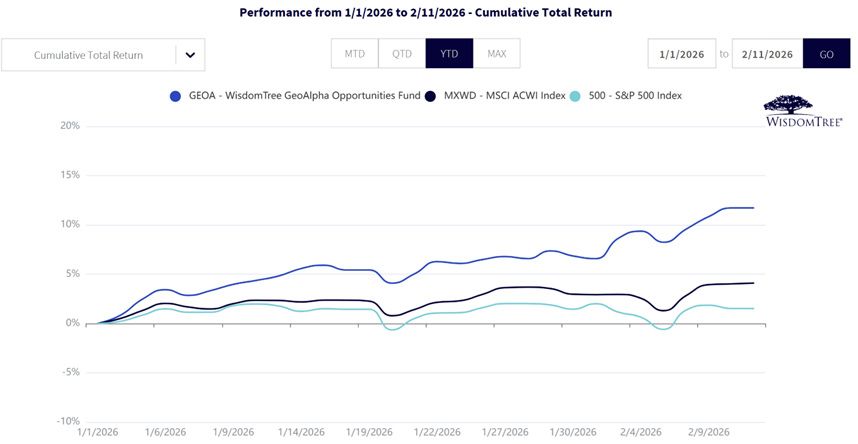
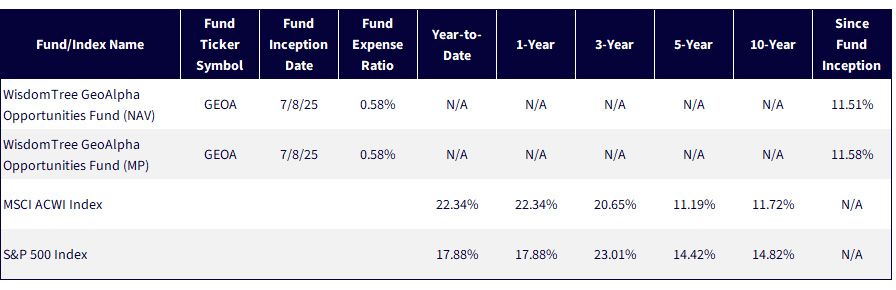
Sources: Morningstar, FactSet and WisdomTree. Data are from the PATH Fund Comparison Tool, accessed February 12, 2026, showing returns for the period ended February 11, 2026, for Figure 1a and December 31, 2025, for Figure 1b. NAV denotes total return performance at net asset value. MP denotes market price performance. Past performance is not indicative of future results. Investment return and principal value of an investment will fluctuate so that an investor's shares, when redeemed, may be worth more or less than their original cost. Current performance may be lower or higher than the performance data quoted.For the most recent month-end and standardized performance, clickhere.
1 Refers to North Atlantic Treaty Organization.
2 The WisdomTree GeoAlpha Opportunities Fund is designed to track the total return performance of, before fees, the WisdomTree GeoAlpha Opportunities Index.
There are risks associated with investing, including possible loss of principal. The economic, political, regulatory and other events and conditions that affect issuers and investments in the United States differ significantly from those associated with other countries and regions. Any event or condition that affects the U.S. economy, whether originating from within or outside of the United States, may have an adverse effect on the Fund’s investments in the United States and thus, the Fund’s performance. Funds focusing their investments on certain sectors and/or regions increase their vulnerability to any single economic or regulatory development. The Fund invests in the securities included in, or representative of, its Index regardless of their investment merit and the Fund does not attempt to outperform its Index. The composition of the Index is governed by an Index Committee and the Index may not perform as intended. Please read the Fund’s prospectus for specific details regarding the Fund’s risk profile.
GeoAlpha Opportunities Fund

Macro Strategist, Model Portfolios
Samuel Rines is a Macro Strategist at WisdomTree, where he extends the firm's custom model portfolio management capabilities. Before joining WisdomTree in 2024, he was the Managing Director at CORBU, LLC, leading the PolyMacro advisory product. With over a decade of experience in economics and finance, Samuel has held significant roles such as Chief Economist at Avalon Investment & Advisory and Economist and Portfolio Manager at Chilton Capital Management LLC. He is also the author of "After Normal: Making Sense of the Global Economy," and holds a Master’s degree in Economics from the UNH Peter T. Paul College of Business and Economics, as well as having studied Economics at the University of Oxford.

Global Head of Research
Christopher Gannatti began at WisdomTree as a Research Analyst in December 2010, working directly with Jeremy Schwartz, CFA®, Director of Research. In January of 2014, he was promoted to Associate Director of Research where he was responsible to lead different groups of analysts and strategists within the broader Research team at WisdomTree. In February of 2018, Christopher was promoted to Head of Research, Europe, where he was based out of WisdomTree’s London office and was responsible for the full WisdomTree research effort within the European market, as well as supporting the UCITs platform globally. In November 2021, Christopher was promoted to Global Head of Research, now responsible for numerous communications on investment strategy globally, particularly in the thematic equity space. Christopher came to WisdomTree from Lord Abbett, where he worked for four and a half years as a Regional Consultant. He received his MBA in Quantitative Finance, Accounting, and Economics from NYU’s Stern School of Business in 2010, and he received his bachelor’s degree from Colgate University in Economics in 2006. Christopher is a holder of the Chartered Financial Analyst Designation.

