

A Dividend Growth Slow-Down: Evaluating Prospects and Drivers
Published January 3, 2017

Global Chief Investment Officer

Director, Research
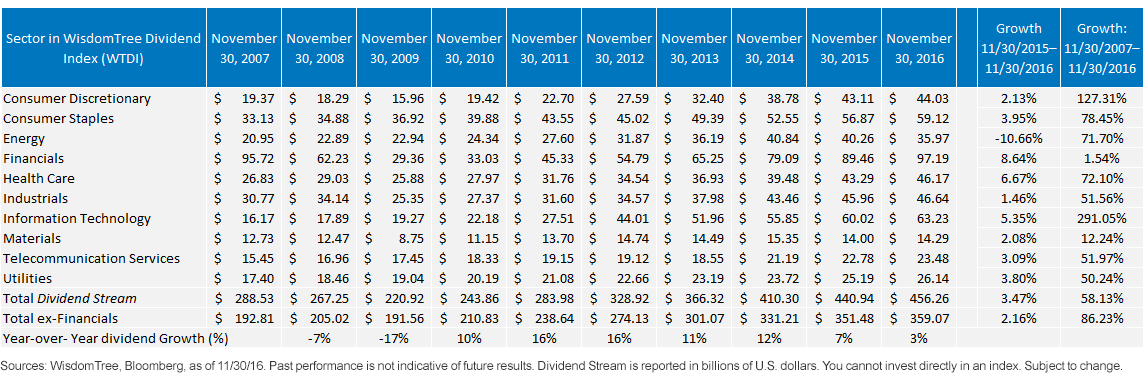
WisdomTree conducts the annual rebalance of its U.S. dividend Index family in December of each year, with the screening date occurring on the last trading day of November.1 The annual screening process provides a plethora of data about how dividends for the U.S. equity markets have changed over time and presents important information about the underlying market fundamentals. In the table below, we look at the Dividend Stream® for the WisdomTree Dividend Index, WisdomTree’s broadest and most inclusive dividend Index.
Dividends, a key gauge of the market’s underlying fundamentals, continue to reach new highs, but the growth in the upcoming year’s dividends—measured by our indicated Dividend Stream—points to the slowest growth in dividends since 2010.
WisdomTree Dividend Index (WTDI) Dividend Stream
Visit the WisdomTree Dividend Index page for current holdings.
Highlights of This Year’s Rebalance:
• Record Dividend Stream: 2016 marks the seventh consecutive year of growth for the U.S. Dividend Stream and a new high—58% above the mark set in 2007. Although the growth was positive, this was the first time in seven years that dividend growth wasn’t above its longer-term average of 5.6%. The Dividend Stream, which considers both shares outstanding and dividends per share, was biased downward due to the reduction in shares outstanding (approximately 1.5% in aggregate). Adding back the 1.5% share reduction can get you closer to an aggregate 5% growth per share.2
• Financials Displayed Highest Growth: The sector has grown its dividends more than 8.5% since last year’s screening and has averaged almost 19% growth per year since hitting bottom in 2009. Also, the Financial sector’s dividends just eclipsed their previous high set in 2007—the last sector to do so. Growth was led by Citigroup and Bank of America, which grew their indicated dividends per share by 220% and 50%, respectively.
• Only Energy Saw Reduction: The Energy sector saw a Dividend Stream drop of 10%, the only sector to record a reduction in dividends. Exxon remains the largest dividend payer in the U.S., with an indicated Dividend Stream of $12.4 billion, and was able to slightly grow its dividend by 2.7% over the period. Chevron, the second-largest dividend payer in the sector, also grew its dividend over the period, albeit by less than 1%. But large cuts of more than 60% from ConocoPhillips, the Williams Companies, National Oilwell Varco and Anadarko Petroleum drove the decline.
• Tech Titan Growth: Information Technology sector dividends have grown a remarkable 290% since November 30, 2007. At its prior peak, this sector constituted only 5.6% of the Dividend Stream, whereas now it constitutes almost 14.0% and is the second-largest dividend-paying sector behind Financials.
Conclusion
With the slowdown in aggregate dividend growth of the market and rising interest rates putting pressure on some of the highest-yield segments of the market such as Utilities, it is perhaps increasingly important to focus on pockets of the market with the best potential to grow dividends.
Certainly some of President-elect Trump’s focus on cutting corporate tax rates and allowing companies to repatriate offshore cash might cause a positive impetus and stimulus for dividend growth toward the end of the year and into 2018.
In future articles we’ll look at dividend growth across a variety of indexes and look toward where we see the most long-term potential for dividend growth based on current fundamentals.
1The annual screening date is when each qualifying company’s indicated dividends per share are measured; the actual rebalancing transactions that adjust the Index to these new weights occur in December.
2Each calendar year mentioned refers to the November 30 screening date for that year.
Important Risks Related to this Article
Dividends are not guaranteed, and a company currently paying dividends may cease paying dividends at any time.
Categories
About the contributors

Global Chief Investment Officer
Jeremy Schwartz has served as Global Chief Investment Officer since November 2021 and leads WisdomTree’s investment strategy team in the construction of WisdomTree’s equity Indexes, quantitative active strategies and multi-asset Model Portfolios. Jeremy joined WisdomTree in May 2005 as a Senior Analyst, adding Deputy Director of Research to his responsibilities in February 2007. He served as Director of Research from October 2008 to October 2018 and as Global Head of Research from November 2018 to November 2021. Before joining WisdomTree, he was a head research assistant for Professor Jeremy Siegel and, in 2022, became his co-author on the sixth edition of the book Stocks for the Long Run. Jeremy is also co-author of the Financial Analysts Journal paper “What Happened to the Original Stocks in the S&P 500?” He received his B.S. in economics from The Wharton School of the University of Pennsylvania and hosts the Behind the Markets podcast. Jeremy is a member of the CFA Society of Philadelphia.
