

U.S. Fixed Income: Skate to Where the Puck Is Going
Published April 20, 2016

Head of Investment and Fixed Income Strategy
With the first quarter of 2016 in the books, investors have been receiving economic data concerning how the three-month period came to a close. This all culminates on April 28, when the Bureau of Economic Analysis (BEA) provides its advanced estimate for Q1 real gross domestic product (GDP). It should be noted that this “advanced estimate” is just that, as the BEA has incomplete data for items such as trade and inventories, and needs to make its own projections in order to come up with a figure for how the U.S. economy performed during the quarter. As a result, this figure is often revised, and in fact, the BEA releases a second and third estimate before all is said and done. Regardless, the markets will still respond in a visible fashion if the report deviates from consensus forecasts. It is interesting to note that Q1 real GDP figures have exhibited a distinct pattern of late. Indeed, in both 2014 and 2015, the opening three-month time frame registered notable weakness as compared to the prior quarter. Although the BEA seasonally adjusts the data, the January to March figures still seem to be adversely impacted if Mother Nature decides to unleash a difficult winter. There is little doubt this effect was on display for both of these years, but in each instance, investors were left to ponder the question: Was it just weather-related or the beginning of a more worrisome downward trend for the U.S. economy? U.S. Real GDP
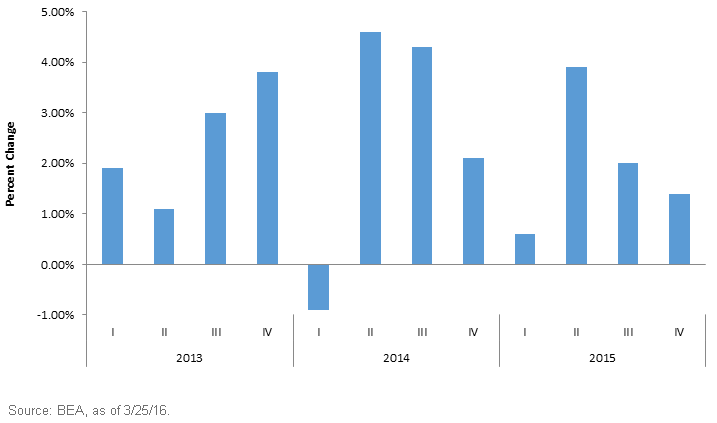
As the table illustrates, investors’ worst fears were not realized, as Q2 real GDP snapped back rather robustly in both 2014 and 2015. The 2014 experience is perhaps more noteworthy because Q1 actually recorded a figure of -0.9%. A figure in the negative column can very easily give way to anxieties that the economy has entered into recessionary territory. However, growth rebounded to +4.6% in Q2, followed by another solid showing of +4.3% in Q3, eliminating any recession fears. For 2016, once again, it looks like the first three months of the year could be on the soft side. As more economic data has become available, forecasters seem to be gravitating around a +1% reading for Q1 real GDP, with some even looking for a potential sub-1% performance. While portions of the country had inclement weather, it does not appear as if this influence will have the same adverse effect as the prior two years. To be sure, the concern is that the slowdown this time around is more fundamental in nature, reflecting the negative impact of the stronger U.S. dollar on trade and manufacturing, as well as the drag effects from lower energy prices. We don’t foresee the slowdown in Q1 activity as a harbinger of a recession, as positive forces from employment, consumer spending and housing should help to keep the economy in the black. It should also be noted that the March ISM Purchasing Managers' Index posted its highest reading in eight months, suggesting the potential for less drag from manufacturing in the months ahead. Conclusion The GDP data is akin to looking into the rearview mirror. In honor of the Stanley Cup play-offs, we thought it would be useful to focus more on “where the puck is going,” rather than where it has been. The U.S. fixed income markets haven’t quite made that adjustment as yet. Through the first half of April, U.S. Treasury 10-Year yields have moved in a rather tight range of 10 basis points (bps), while investment-grade (IG) corporate spreads have traded in an even narrower band of only 6 bps. In our opinion, Treasury and IG valuations appear to have already discounted a soft Q1 economic performance and are awaiting signs of what Q2 may hold. If recent history holds and Q2 activity rebounds, Treasury yields seem susceptible at current levels, while IG spreads could contract further.
About the contributor

Head of Investment and Fixed Income Strategy
Kevin serves as the Head of Investment and Fixed Income Strategy. In this role, he writes macro and fixed income-related content and works closely with the sales, research and marketing teams. In addition, Kevin conducts client-facing webinars and meetings, providing expertise on WisdomTree’s existing and future bond ETFs. Prior to joining WisdomTree, Kevin spent 30 years at Morgan Stanley, where he was Managing Director and Chief Fixed Income Strategist for Wealth Management. He was responsible for tactical and strategic recommendations and created asset allocation models for fixed income securities. He was a contributor to the Morgan Stanley Wealth Management Global Investment Committee, primary author of Morgan Stanley Wealth Management’s monthly and weekly fixed income publications, and collaborated with the firm’s Research and Consulting Group Divisions to build ETF and fund manager asset allocation models. Kevin has an MBA from Pace University’s Lubin Graduate School of Business, and a B.S. in Finance from Fairfield University.