

Ground Observations from India: Oil Re energizing India’s Economy
Published April 21, 2016

Associate Director, Asset Allocation and Modern Alpha
During my recent trip to India, I met with Hemen Modi, head of investor relations at Reliance Industries, the second largest company in India, in terms of both market cap and revenue generation. My meetings also included representatives from other leading energy companies and their analysts. My goal from these meetings was to understand what declining and low global crude oil prices mean for India, its economy, its consumers, its Energy sector and companies in that sector. Below I highlight some of my research and findings. Low Oil Prices Benefiting Retail as Well as Fiscal Revenues Between June 2014 and now (roughly the same period as the Narendra Modi government in India), crude oil prices fell globally from a peak of ~$107 a barrel to $36 a barrel.1 This has benefited India. Let’s break down the benefits into two components: retail and fiscal. Let’s look at retail-side savings first. During the aforesaid period, retail prices of diesel fell from $3.34 to $2.62, while the price of gasoline dropped from $4.16 to $3.49 (in New Delhi). With an approximate total annual consumption of 20.5 billion gallons of diesel and 7 billion gallons of gasoline, the total gain to the consumer works out to around $19.3 billion annually.2 Thus, the decline in oil prices empowers consumers by giving them $19 billion annually to save or spend elsewhere. For an economy that is driven vastly by consumption expenditure , decline in oil prices has been a big windfall. Now, although global oil prices fell from $107 to $36, which is roughly a two-thirds drop, retail prices of oil in Delhi fell nowhere close to two-thirds. This is where the fiscal benefit comes into the picture. Since June 2014, as global crude prices were falling, Modi’s government increased the excise tax on diesel from $0.21 to $0.69 per gallon and $0.55 to $1.13 per gallon for gasoline. Thus, at a time when the government’s revenues should have gone down due to a drop in oil prices, they actually went up three times for diesel and twice for gasoline.
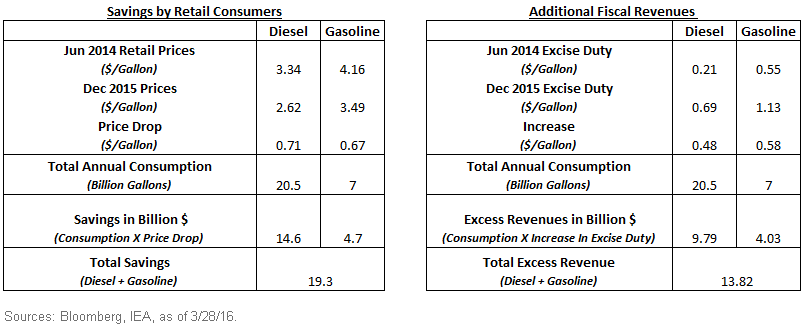
Empowering Consumers & Generating Fiscal Savings/Revenue While some may argue that the complete benefit of lower oil was not transferred to the consumer, this was a sound economic decision by the Modi government. Before 2014, oil prices in India were heavily regulated, and there was a substantial burden on the state exchequer to provide subsidies and keep oil prices low. Modi’s government deregulated oil prices in October 2014. Far from being a drain, oil has become a cash cow for revenue generation for government as well as putting more dollars in consumers’ pockets. Low Oil Prices a Boon for India’s Refining-Dominated Energy Sector Now that we have established the benefits of lower oil prices for the retail and fiscal sides, let’s look at the third leg of the economy that is corporate India. India’s Energy sector is dominated by mid- and downstream companies (oil transportation or refining companies and not oil producers or explorers). About 75% of Energy-sector earnings are attributed to refiners/transporters, while only roughly 25% is attributed to upstream or oil explorers/producers. Falling oil prices have meant cheaper input costs for oil refining while demand has stayed robust. Reliance Industries, which runs world’s biggest oil-refinery complex in Gujarat, reported its third quarter fiscal year 2016 results in January 2016, and its profits reached their highest level in eight years. The WisdomTree India Earnings Index has around 18.75% exposure to the Energy sector in India compared to the MSCI India Index, which is under-weight Energy at 10.10%.3 The chart below highlights declining global crude oil prices and simultaneously improving profit margins for the two big refining companies from India. Profit margin is a measure of the profitability of a company, and an increase implies more profits being generated for shareholders. Reliance Industries is the single biggest exposure in WisdomTree’s India Earnings Index at 10.8%, while BPCL’s exposure is roughly 1%.4 Improving Margins—Oil Refining Companies
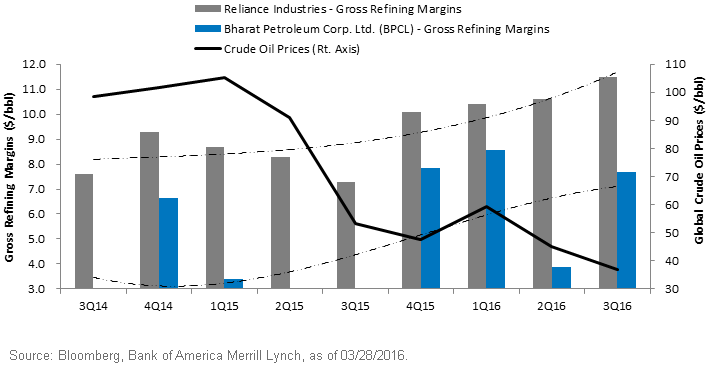
Thus, declining global crude oil prices have resulted in increasing profit margins or profitability for big Energy-sector companies, which are dominated by refiners. In fact, Reliance’s gross refining margin at $11.5 per barrel was above $11 for the first time in seven years. Energy, oil and gas is a key sector in India’s economy and is anticipated to be worth $140 billion in 2015.5 India’s economic growth is very closely related to its energy demands. Thus, as India’s much-talked-about gross domestic product (GDP) growth rate overtakes China’s growth rate, the need for energy is projected to grow manifold, making the sector apt for investments. Further, Modi’s government has allowed 100% foreign direct investment in many segments of the sector, including petroleum products, refineries and natural gas. We believe declining oil prices, along with smart policy actions, have re-energized all three pillars of India’s economy: retail, fiscal and corporate. As global supply continues to put downward pressure on oil prices, India could be an outlier in emerging markets to benefit. Further, if India is set to grow at more than 7.5% (GDP YoY),6 WisdomTree believes investors would be well served by over-weighting the Energy sector, which could be a propellant in rocketing the economy forward. For current holdings of the WisdomTree India Earnings Index, click here. 1Source: Bloomberg. 2Sources: Bloomberg, IEA, as of 3/28/16. 3Source: WisdomTree, as of 3/28/16. 4Source: WisdomTree, as of 3/28/16. 5Source: Indian Brand Equity Foundation, as of 3/28/16. 6Source: IMF, as of 3/28/16.
Important Risks Related to this Article
Investments focused in India increase the impact of events and developments associated with the region, which can adversely affect performance.
Categories
About the contributor
