


Back to Blog
When Code Runs Finance: How Blockchain and AI Are Blurring the Line Between Financial and Non-Financial Risk
July 16, 2026

In traditional finance, risk has usually been divided into two broad categories.
Financial risk includes market risk, liquidity risk, counterparty risk, and credit risk. Non-financial risk includes operational risk, AML and sanctions risk, fraud risk, technology and cyber risk, and reputational risk.
That distinction made sense in a world where those risks were managed by different teams, through different systems, on different timelines.
Onchain finance is changing that.
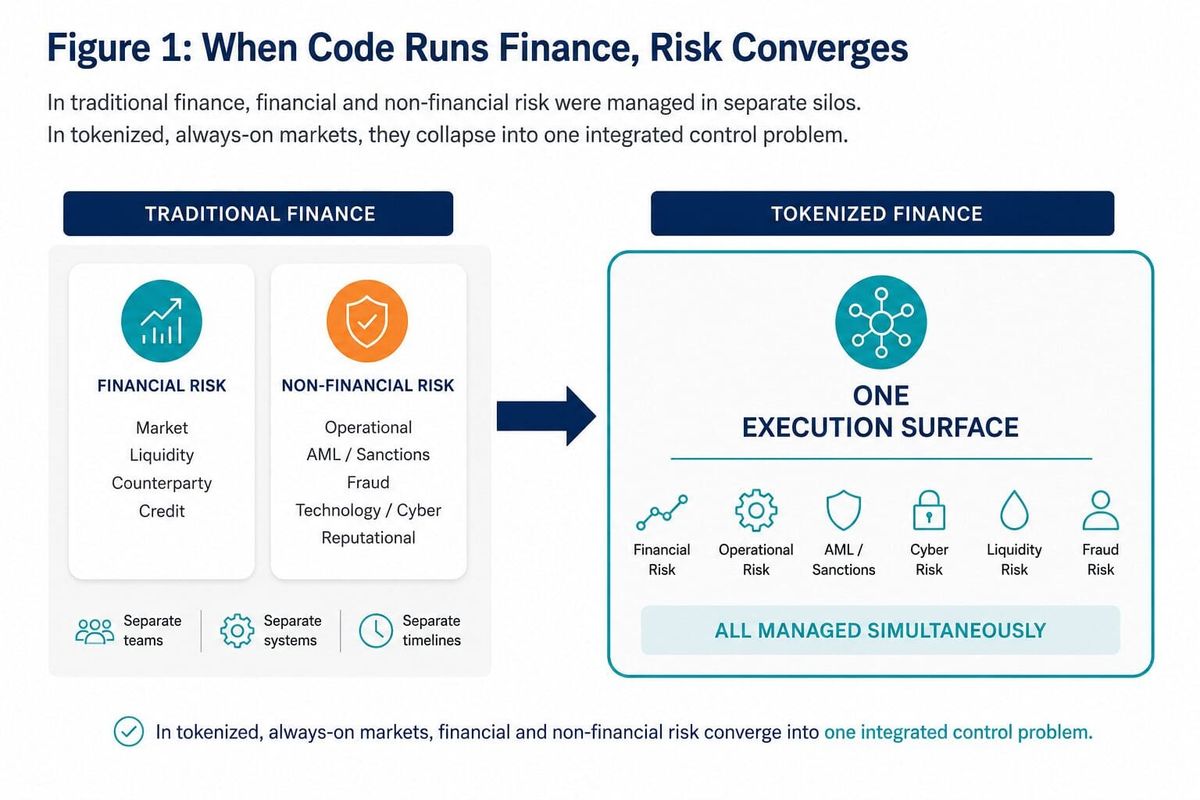
Figure 1: In traditional finance, financial and non-financial risk were managed in separate silos. In tokenized, always-on markets, they collapse into one integrated control problem.
When transactions, lending positions, redemptions, and collateral workflows are governed by smart contracts running 24×7×365, the old separation starts to break down. What once required treasury, operations, AML, fraud, cyber, compliance, and market-risk teams working in sequence can increasingly happen inside one always-on workflow. Financial and non-financial risk increasingly behave as one combined control problem rather than separate operating domains.
The real shift is the increasing convergence of financial and non financial risk.
At WisdomTree, we made an early choice that reflects how seriously we take that shift. At a time when much of the market was choosing faster, lighter, lower-friction structures for digital asset products, we took the harder, but ultimately more responsible, path: ’40 Act mutual funds, blockchain-enabled transfer agent infrastructure, and regulated trust-company architecture. This choice was deliberate. Our founder and CEO, Jono Steinberg, has consistently framed this business around Responsible DeFi. This involves approaching DeFi as a genuine reimagining of financial infrastructure, not as a vehicle for regulatory arbitrage.
This is the north star that shapes how we think about risk and it forces a harder conclusion: the old model of siloed risk management begins to fail across the broader tokenized finance landscape.
When One Event Becomes All Events at Once
The KelpDAO / LayerZero / Aave incident from April is a clear example of how quickly seemingly separate risks can converge.
A bridge-message verification failure (which is the kind of issue many firms would instinctively classify as a non-financial, cyber, or infrastructural risk) allowed an attacker to release unbacked rsETH. That synthetic collateral then moved into Aave, where the protocol’s own lending logic treated it as valid enough to support highly efficient borrowing against WETH.
At what point does a technical failure become a credit problem, liquidity crunch, fraud or AML investigation, or a reputational event? The answer is potentially immediately, and all at once.
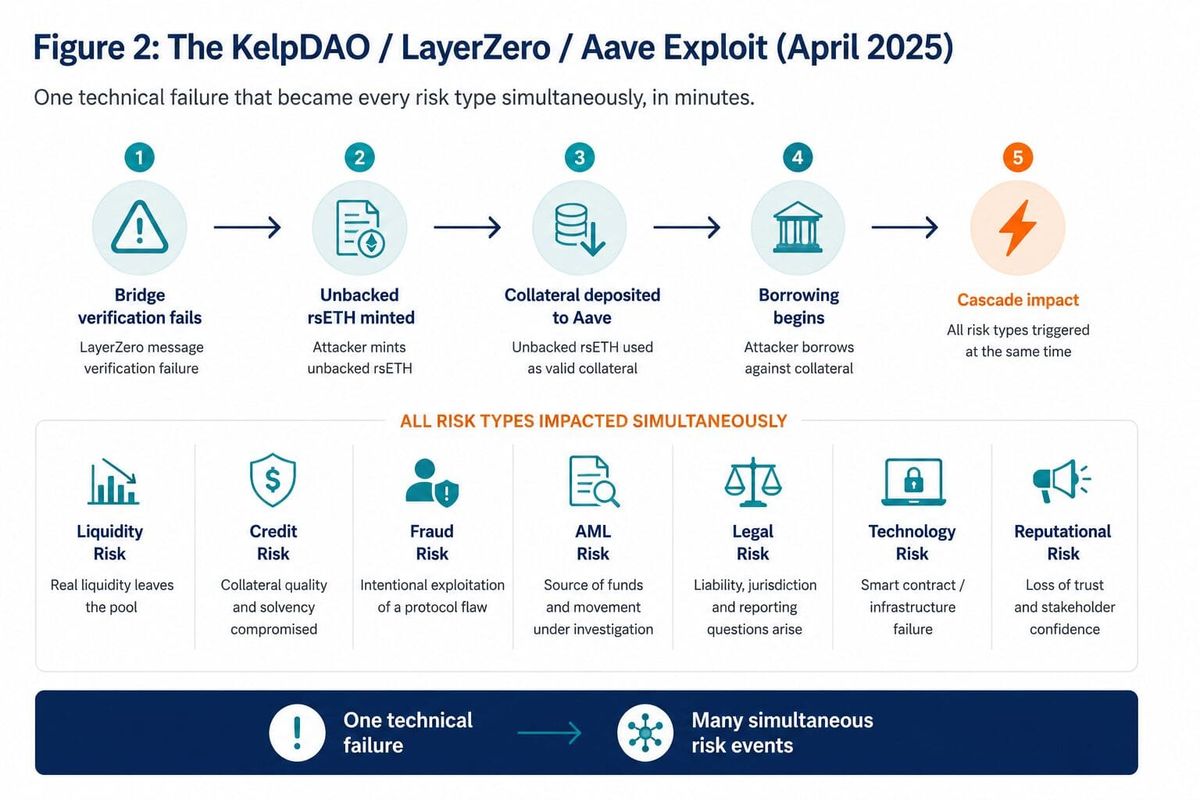
Figure 2: The KelpDAO / LayerZero / Aave exploit (April 2025) — one technical failure that became every risk type simultaneously, in minutes.
That is the point. The exploit did not stay inside one tidy risk bucket. It moved from technical and configuration failure into collateral impairment, lending exposure, real liquidity leaving a pool, governance intervention, legal questions, and reputational consequences in minutes. If a team’s risk function is still organized around separate streams of financial and non-financial risk, then by the time those teams align, the exploit has already settled onchain.
The old taxonomy is not wrong. It is incomplete.
It still describes types of risk. But it no longer describes how those risks behave in always-on, programmable markets.
In traditional finance, a technology outage, an AML concern, a fraud investigation, a credit review, and a liquidity event may affect the same customer or product over time, but they are usually processed through different systems and on different timelines. In tokenized finance, a smart contract can govern access, routing, collateralization, leverage, margin logic, settlement timing, and redemption behavior directly. The moment that happens, the old categories start to blur into one execution surface.
That is why structure matters.
When building through a regulated ’40 Act framework, integrated transfer-agent recordkeeping, controlled issuance and redemption workflows, and governed access, there are both a legal decision as well as an architectural choice about how risk should be absorbed, constrained, and made observable. This approach requires deciding in advance that tokenization is not just a distribution format. Rather, treating it as a new operating environment that must be designed with discipline from the start.
AI as Both an Operating Layer and Productivity Tool
AI increasingly functions as a full-fledged operating layer for risk management, not just a productivity tool bolted onto it.
In onchain finance, AI and specialized agents are likely to become a core operating layer for risk management much sooner than many people expect. This is because now, finance is always on, and so are fraudsters, scammers, attackers, and market dislocations. Pig-butchering schemes, romance scams, elder abuse, coercive wallet activity, mule networks, and account takeovers are not just financial-crime issues. Once value moves onchain and settlement becomes programmable, they can quickly become liquidity events, compliance events, and reputational events.
The same is true for technology risk. A smart-contract exploit, oracle failure, or infrastructure dependency issue can instantly become a financial event. Human teams alone are too slow for this environment, which leads us to a complete rethinking of how we manage risk rather than iterative improvements to disparate legacy systems.
What firms still call “non-financial risk” is often just financial risk with a different point of origin.
That is why the next generation of risk management will not be defined by better dashboards alone. It will be defined by a new architecture.
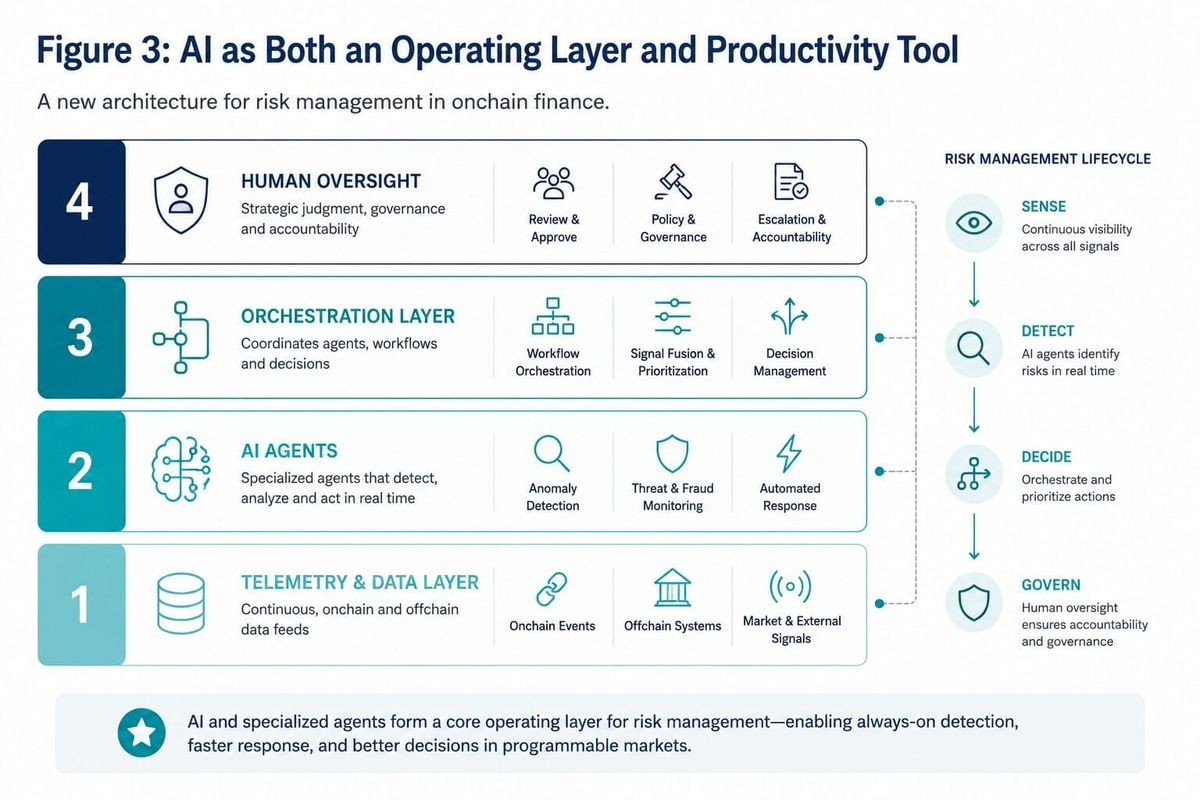
Figure 3: The four-layer AI risk operating system, from continuous telemetry at the base to human oversight and governance at the top.
At the base layer sits telemetry, which covers wallet screening, transaction monitoring, smart-contract events, lending and borrowing positions, collateral ratios, settlement behavior, blockchain conditions, app-layer behavior, infrastructure signals, and books-and-records reconciliation.
Above that sit specialized agents designed to understand one domain deeply. This includes domains such as AML and sanctions, scam typologies and vulnerable-customer abuse, wallet provenance, smart-contract security, protocol exposure, blockchain health, governance changes, and infrastructure dependencies.
An orchestration layer sits above these agents, combining signals, scoring severity, evaluating context, and determining whether confidence is high enough to act immediately or whether escalation is warranted.
And on top of this entire system is the human layer, which includes risk managers, financial crimes teams, legal, compliance, and operations.
But within this new model, the human role changes. It becomes less about manually sifting through endless alerts and more about reviewing high-severity actions, governing policy, and improving the system over time. The goal is not to remove humans from the loop. It is to change where humans sit in the loop, in a way that abstracts away the busywork while ensuring manual inputs are provided when needed.
From Signal to Action: A Three-Step Framework
When it comes to compressing risk signal response times, it’s helpful to think through the approach across three interconnected steps.
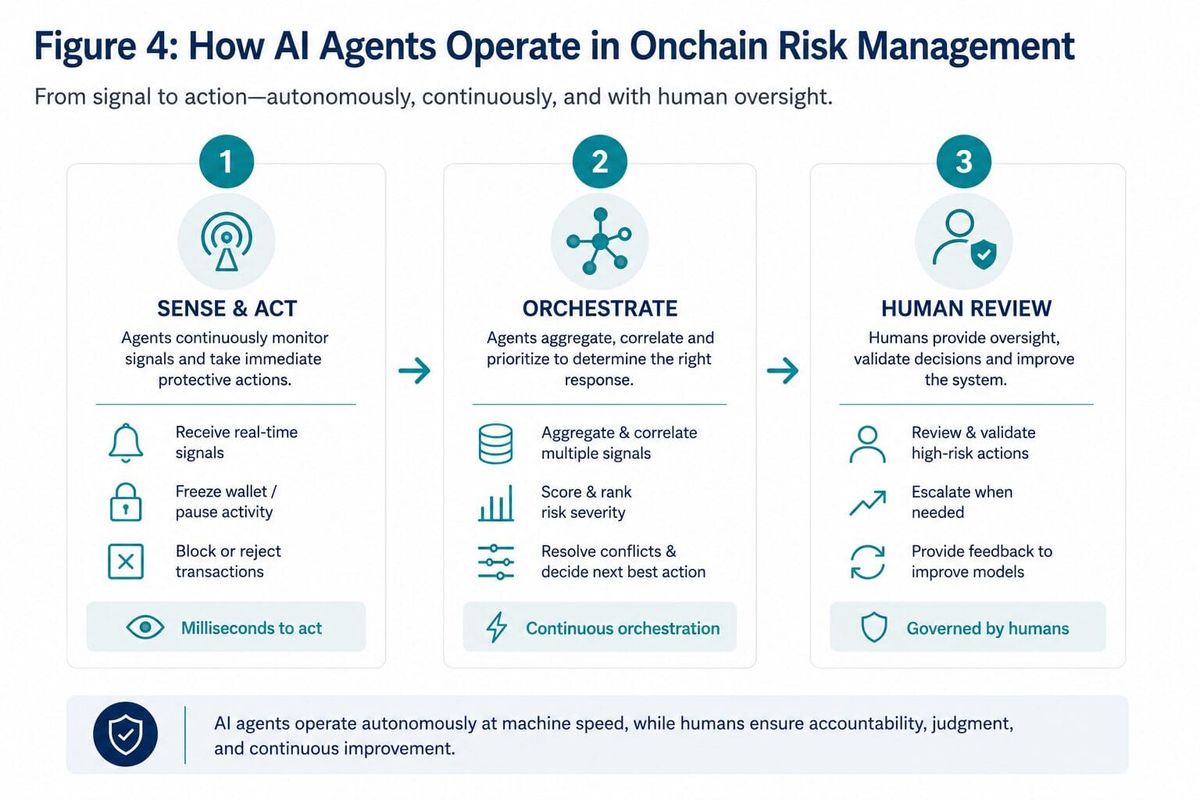
Figure 4: Three-step agentic risk framework — Sense & Act, Orchestrate & Surface, Human Review & Ratification.
Step one: sense and act. Signals come in continuously from blockchain analytics, onchain monitoring, AML and fraud tools, smart contract telemetry, application behavior, and infrastructure health. Specialized agents process those signals in parallel, in real time. If thresholds are breached and confidence is high enough, the system acts by freezing a token, pausing a transaction, blocking a wallet interaction, quarantining a flow, or tightening conditions around what can happen next.
Step two: orchestrate and surface. An orchestration layer aggregates what the agents saw, what they did, where they agree, and where they conflict. It identifies ambiguity, ranks severity, and surfaces the close calls that actually require human judgment. It should also reduce false positives materially over time, replacing blunt rule-based noise with context-aware intervention.
Step three: human review and ratification. A trained analyst or risk officer reviews the actions the system has already taken, validates them, escalates where necessary, and feeds the result back into the model. The human is not a bystander. The human is governing the system, auditing it in near real time, and improving it.
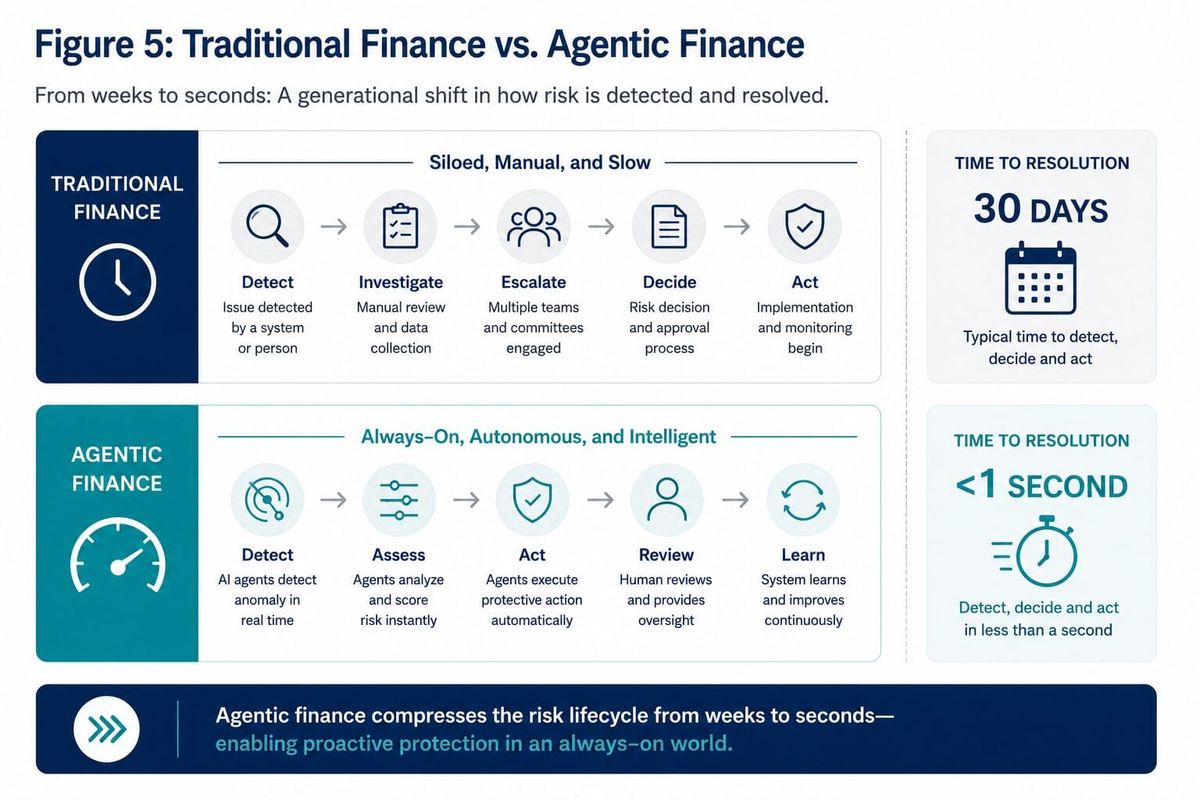
Figure 5: The time-compression imperative, from writing a SAR 30 days after the fact to acting in under a second.
The goal is straightforward: compress the time between “something is wrong” and “we did something about it” from hours to seconds.
Stopping the heist before it happens is a higher priority than writing the SAR after the fact 30 days later.
When Risk Converges
This is the direction risk management is heading, across multiple industries and organization types.
As finance becomes executable software, the risk function has to evolve from reviewing lagging reports to operating a near-real-time control system. That system will not divide the world neatly into financial and non-financial categories. It will evaluate one transaction, one position, one wallet, one smart contract, or one protocol workflow as an integrated risk event.
When code runs finance, risk converges. And when risk converges, the only viable response is a more holistic, more dynamic, and more agentic architecture to manage it.
Perspectives in Onchain Finance
View all

About the contributor

Rohan Ranadive
Chief Risk Officer, WisdomTree Digital Assets
Mr. Ranadive joined WisdomTree in April 2024 to lead Risk Management for the firm’s Digital Assets business. With 25+ years of experience at the intersection of Risk, Technology, and Regulatory Change, Rohan has led enterprise transformation initiatives across top-tier U.S. financial institutions. His leadership at BB&T, Truist, and U.S. Bank delivered strategic business and risk programs that addressed evolving supervisory expectations, cyber resilience, and complex tech modernization efforts. Rohan brings deep domain expertise in digital asset compliance, blockchain risk frameworks, and cyber/digital governance. He is AWS-certified in Solutions Architecture and Machine Learning/AI, and a TRM Labs–certified Advanced Crypto Investigator—demonstrating his commitment to innovation and regulatory readiness in emerging technologies. Rohan holds an MBA from Wake Forest University and completed executive programs at the Stonier School of Banking and Wharton’s Executive Leadership Program.
Thought Leaders

Alice Liu
Senior Associate, Cryptocurrency Investments, WisdomTree Europe

Andrew Okrongly, CFA
Director, Model Portfolios

Blake Heimann
Associate Director, Quantitative Research

Christopher Gannatti, CFA
Global Head of Research

Chris Ryder
Head of WisdomTree Transfers

Dovile Silenskyte
Director, Digital Assets Research

Jason Guthrie
Director of Capital Markets, WisdomTree Europe

Jeff Weniger, CFA
Head of Equity Strategy

Jeremy J. Siegel
WisdomTree Senior Economist

Jeremy Schwartz, CFA
Global Chief Investment Officer

Kevin Flanagan
Head of Investment and Fixed Income Strategy

Mobeen Tahir
Director, Macroeconomics and Thematic Research

Nitesh Shah
Head of Commodities and Macroeconomic Research, WisdomTree Europe

Pierre Debru
Head of Research, Europe

Rick Harper
Chief Investment Officer, Fixed Income and Model Portfolios

Rohan Ranadive
Chief Risk Officer, WisdomTree Digital Assets

Samuel Rines
Macro Strategist, Model Portfolios

Vinh Tran
Associate Director, Business Development, Digital Assets

Will Peck
Head of WisdomTree Onchain

WisdomTree Onchain
Contributor
Alice Liu
Senior Associate, Cryptocurrency Investments, WisdomTree Europe
Andrew Okrongly, CFA
Director, Model Portfolios
Blake Heimann
Associate Director, Quantitative Research
Christopher Gannatti, CFA
Global Head of Research
Chris Ryder
Head of WisdomTree Transfers
Dovile Silenskyte
Director, Digital Assets Research
Jason Guthrie
Director of Capital Markets, WisdomTree Europe
Jeff Weniger, CFA
Head of Equity Strategy
Jeremy J. Siegel
WisdomTree Senior Economist
Jeremy Schwartz, CFA
Global Chief Investment Officer
Kevin Flanagan
Head of Investment and Fixed Income Strategy
Mobeen Tahir
Director, Macroeconomics and Thematic Research
Nitesh Shah
Head of Commodities and Macroeconomic Research, WisdomTree Europe
Pierre Debru
Head of Research, Europe
Rick Harper
Chief Investment Officer, Fixed Income and Model Portfolios
Rohan Ranadive
Chief Risk Officer, WisdomTree Digital Assets
Samuel Rines
Macro Strategist, Model Portfolios
Vinh Tran
Associate Director, Business Development, Digital Assets
Will Peck
Head of WisdomTree Onchain
WisdomTree Onchain
Contributor
Alice Liu
Senior Associate, Cryptocurrency Investments, WisdomTree Europe
Andrew Okrongly, CFA
Director, Model Portfolios
Blake Heimann
Associate Director, Quantitative Research
Christopher Gannatti, CFA
Global Head of Research
Chris Ryder
Head of WisdomTree Transfers
Dovile Silenskyte
Director, Digital Assets Research
Jason Guthrie
Director of Capital Markets, WisdomTree Europe
Jeff Weniger, CFA
Head of Equity Strategy
Jeremy J. Siegel
WisdomTree Senior Economist
Jeremy Schwartz, CFA
Global Chief Investment Officer
Kevin Flanagan
Head of Investment and Fixed Income Strategy
Mobeen Tahir
Director, Macroeconomics and Thematic Research
Nitesh Shah
Head of Commodities and Macroeconomic Research, WisdomTree Europe
Pierre Debru
Head of Research, Europe
Rick Harper
Chief Investment Officer, Fixed Income and Model Portfolios
Rohan Ranadive
Chief Risk Officer, WisdomTree Digital Assets
Samuel Rines
Macro Strategist, Model Portfolios
Vinh Tran
Associate Director, Business Development, Digital Assets
Will Peck
Head of WisdomTree Onchain
WisdomTree Onchain
Contributor