


Dovile Silenskyte
Director, Digital Assets Research
Key Takeaways
- President Donald Trump’s executive order recognizing bitcoin as a strategic reserve asset signals a major shift in U.S. policy toward digital assets.
- With over 200,000 bitcoins in government holdings, the U.S. is positioning itself as a key player in the crypto space, potentially reshaping global financial markets.
- A formal bitcoin reserve would require congressional approval, regulatory coordination, and secure custody frameworks, making full adoption a long-term process.
The United States (U.S.) is no longer just a bitcoin holder – it may be laying the groundwork for a national crypto reserve. Is this the moment bitcoin goes fully mainstream?
Strategic bitcoin accumulation?
Recent estimates suggest that the U.S. government is sitting on 200,000+ bitcoins – over $13 billion worth – mostly seized from criminal operators such as the Silk Road1. That stash makes Uncle Sam one of the largest bitcoin holders in the world. But here is the real question: what is the endgame?
Historically, seized bitcoin was auctioned off at deep discounts, flooding the market with sell pressure. This time, however, President Donald Trump’s latest executive order has put a halt to rapid liquidations, signalling a strategic shift. Instead of fire sales, the U.S. government is deliberately holding onto its bitcoin, driving speculation about a potential long-term reserve strategy.
Is this merely a temporary pause, or the first step toward establishing a full-fledged crypto reserve? While the executive order marks a clear change in approach, formally integrating bitcoin into the U.S. financial system would demand congressional approval, regulatory coordination, and a robust custody framework. The path forward is not just about policy – it is about power.
Digital gold for digital age
Crypto is not just a speculative asset anymore – it is a strategic economic lever in global power dynamics. With the U.S. dollar facing growing pressure from alternative currencies and central bank digital currencies (CBDCs), bitcoin’s appeal as a neutral, hard asset is undeniable.
Unlike traditional assets, bitcoin cannot be printed, seized by sanctions, or easily manipulated. If the U.S. sees what other nations are beginning to recognise – that bitcoin is the 21st century version of gold – it may rethink its role as a long-term reserve asset.
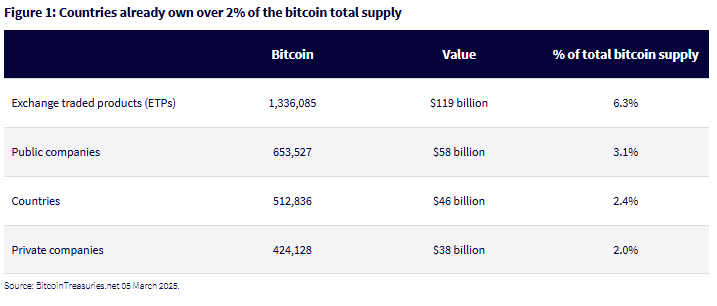
The conversation around crypto is no longer confined to industry circles. President Donald Trump recently issued an executive order officially recognising bitcoin as a strategic reserve asset, marking a significant policy shift. This move has sparked widespread discussion about the future role of digital assets in national reserves.
Further reinforcing this shift, the White House is set to host a Crypto Summit on March 7, where top policymakers and industry leaders will discuss digital assets. While details are scarce, this could be the first step toward formal integration of crypto into U.S. financial policy.
Meanwhile, the Federal Reserve has remained largely silent, leaving questions about its stance on bitcoin’s role in national monetary policy. Will the central bank embrace digital assets, or will it resist this historic shift?
What would it take to make it official?
Turning bitcoin into a recognised U.S. reserve asset is not just a simple executive order. It would require:
- Congressional approval to classify bitcoin and other cryptocurrencies as strategic reserves.
- Regulatory coordination between the Securities and Exchange Commission (SEC), Commodity Futures Trading Commission (CFTC), Federal Reserve, and Treasury.
- A secure custody framework to manage holdings without risking security breaches or market instability.
- A phased rollout – starting with bitcoin before expanding to other cryptocurrencies or beginning with small holdings before gradually increasing them.
This would not happen overnight. A realistic timeline? Years, not months. Expect feasibility studies, pilot programs, and intense political battles before crypto earns a seat next to gold in the U.S. balance sheet.
Market shockwaves
If the U.S. openly adopts bitcoin as a reserve asset, expect seismic shifts in global markets:
- Sovereign bitcoin FOMO2 – other nations would likely follow suit, sparking a global race to accumulate bitcoin.
- Institutional confidence surge – a U.S. endorsement would cement bitcoin’s status as digital gold, driving massive institutional inflows.
- Reduced sell pressure – unlike past cycles of seized bitcoin dumps, retention would tighten supply and bolster price stability.
If this trend accelerates, we could be looking at a fundamental shift in the financial system – one where bitcoin plays a central role in sovereign wealth strategies. The question is not if, but when and how fast governments will adapt to this new reality.
The bottom line
With the world’s largest economy holding one of the biggest bitcoin reserves, the question is not just about policy – it is about power. Will this be the turning point where bitcoin cements itself as the next global reserve currency?
1 US Government Bitcoin Holdings, Bitcoin Treasuries by BiTBO (https://treasuries.bitbo.io/usa/)
2 FOMO = fear of missing out.
Important Risks Related to this Article
Crypto assets, such as bitcoin and ether, are complex, generally exhibit extreme price volatility and unpredictability, and should be viewed as highly speculative assets. Crypto assets are frequently referred to as crypto “currencies,” but they typically operate without central authority or banks, are not backed by any government or issuing entity (i.e., no right of recourse), have no government or insurance protections, are not legal tender and have limited or no usability as compared to fiat currencies. Federal, state or foreign governments may restrict the use, transfer, exchange and value of crypto assets, and regulation in the U.S. and worldwide is still developing. Crypto asset exchanges and/or settlement facilities may stop operating, permanently shut down or experience issues due to security breaches, fraud, insolvency, market manipulation, market surveillance, KYC/AML (know your customer/anti-money laundering) procedures, non-compliance with applicable rules and regulations, technical glitches, hackers, malware or other reasons, which could negatively impact the price of any cryptocurrency traded on such exchanges or reliant on a settlement facility or otherwise may prevent access or use of the crypto asset. Crypto assets can experience unique events, such as forks or airdrops, which can impact the value and functionality of the crypto asset. Crypto asset transactions are generally irreversible, which means that a crypto asset may be unrecoverable in instances where: (i) it is sent to an incorrect address, (ii) the incorrect amount is sent, or (iii) transactions are made fraudulently from an account. A crypto asset may decline in popularity, acceptance or use, thereby impairing its price, and the price of a crypto asset may also be impacted by the transactions of a small number of holders of such crypto asset. Crypto assets may be difficult to value and valuations, even for the same crypto asset, may differ significantly by pricing source or otherwise be suspect due to market fragmentation, illiquidity, volatility and the potential for manipulation. Crypto assets generally rely on blockchain technology and blockchain technology is a relatively new and untested technology which operates as a distributed ledger. Blockchain systems could be subject to internet connectivity disruptions, consensus failures or cybersecurity attacks, and the date or time that you initiate a transaction may be different then when it is recorded on the blockchain. Access to a given blockchain requires an individualized key, which, if compromised, could result in loss due to theft, destruction or inaccessibility. In addition, different crypto assets exhibit different characteristics, use cases and risk profiles. Information provided by WisdomTree regarding digital assets, crypto assets or blockchain networks should not be considered or relied upon as investment or other advice, as a recommendation from WisdomTree, including regarding the use or suitability of any particular digital asset, crypto asset, blockchain network or any particular strategy.
Categories
Perspectives in Onchain Finance
View all

About the contributor

Dovile Silenskyte
Director, Digital Assets Research
Dovile Silenskyte is a director of digital assets research at WisdomTree. Before joining WisdomTree in May 2024, Dovile worked as an index equity product strategist at BlackRock. Currently, she is responsible for conducting analyses for in-house digital assets publications and assisting the sales team with client queries about products and markets. Dovile holds an MSc in Finance from Texas A&M University – Commerce, and she is also a chartered financial analyst (CFA).
Thought Leaders

Alice Liu
Senior Associate, Cryptocurrency Investments, WisdomTree Europe

Andrew Okrongly, CFA
Director, Model Portfolios

Blake Heimann
Associate Director, Quantitative Research

Christopher Gannatti, CFA
Global Head of Research

Chris Ryder
Head of WisdomTree Transfers

Dovile Silenskyte
Director, Digital Assets Research

Jason Guthrie
Director of Capital Markets, WisdomTree Europe

Jeff Weniger, CFA
Head of Equity Strategy

Jeremy J. Siegel
WisdomTree Senior Economist

Jeremy Schwartz, CFA
Global Chief Investment Officer

Kevin Flanagan
Head of Investment and Fixed Income Strategy

Mobeen Tahir
Director, Macroeconomics and Thematic Research

Nitesh Shah
Head of Commodities and Macroeconomic Research, WisdomTree Europe

Pierre Debru
Head of Research, Europe

Rick Harper
Chief Investment Officer, Fixed Income and Model Portfolios

Rohan Ranadive
Chief Risk Officer, WisdomTree Digital Assets

Samuel Rines
Macro Strategist, Model Portfolios

Vinh Tran
Associate Director, Business Development, Digital Assets

Will Peck
Head of WisdomTree Onchain

WisdomTree Onchain
Contributor
Alice Liu
Senior Associate, Cryptocurrency Investments, WisdomTree Europe
Andrew Okrongly, CFA
Director, Model Portfolios
Blake Heimann
Associate Director, Quantitative Research
Christopher Gannatti, CFA
Global Head of Research
Chris Ryder
Head of WisdomTree Transfers
Dovile Silenskyte
Director, Digital Assets Research
Jason Guthrie
Director of Capital Markets, WisdomTree Europe
Jeff Weniger, CFA
Head of Equity Strategy
Jeremy J. Siegel
WisdomTree Senior Economist
Jeremy Schwartz, CFA
Global Chief Investment Officer
Kevin Flanagan
Head of Investment and Fixed Income Strategy
Mobeen Tahir
Director, Macroeconomics and Thematic Research
Nitesh Shah
Head of Commodities and Macroeconomic Research, WisdomTree Europe
Pierre Debru
Head of Research, Europe
Rick Harper
Chief Investment Officer, Fixed Income and Model Portfolios
Rohan Ranadive
Chief Risk Officer, WisdomTree Digital Assets
Samuel Rines
Macro Strategist, Model Portfolios
Vinh Tran
Associate Director, Business Development, Digital Assets
Will Peck
Head of WisdomTree Onchain
WisdomTree Onchain
Contributor