


Dovile Silenskyte
Director, Digital Assets Research
Key Takeaways
- Coinbase’s entry into the S&P 500 on 19 May 2025 signals crypto’s integration into the U.S. financial mainstream, marking a major milestone in institutional acceptance.
- With bitcoin surging past $100,000 and altcoins rallying, Coinbase’s inclusion adds structural credibility and sticky capital to the digital asset market.
- Having emerged stronger from past regulatory and market pressures, Coinbase now offers diversified, profitable operations that bolster the case for crypto's long-term viability.
On Monday, 19 May 2025, Coinbase Global Inc. will officially join the S&P 500 index. This is not just a reshuffle – It is the clearest sign yet that crypto has broken into the financial establishment’s inner sanctum. The premier crypto exchange is now entrenched in the very core of the United States (U.S.) financial markets.
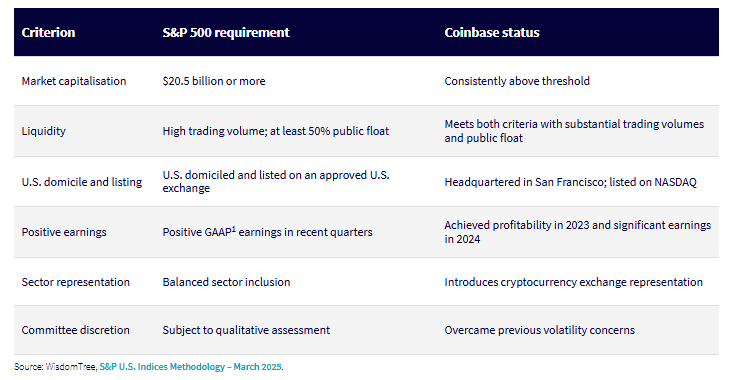
To make the cut, companies must meet stringent criterial defined by the S&P Dow Jones Indices Committee. The process is notoriously selective, designed to reflect the strength, stability, and liquidity of America’s corporate elite. Coinbase did not just sneak in – it earned its spot, hitting every key metric with conviction.
Figure 1: Coinbase meets and exceeds the S&P 500 bar
Why this matters
The inclusion of Coinbase is more than symbolic – it is a structural endorsement. Crypto is no longer a volatile sideshow. It is being hardwired into the financial system’s core architecture.
This milestone comes at a critical inflection point: bitcoin has once again broken through the $100,000 barrier, driving renewed bullish sentiment across the entire digital asset market. Simultaneously, altcoins are enjoying a strong wave of capital inflows, with names such as Solana, Ether, and XRP – along with more speculative tokens – drawing fresh investor attention. Is this the ignition point for a full-blown altcoin resurgence?
Figure 2: Crypto performance in Q2 2025
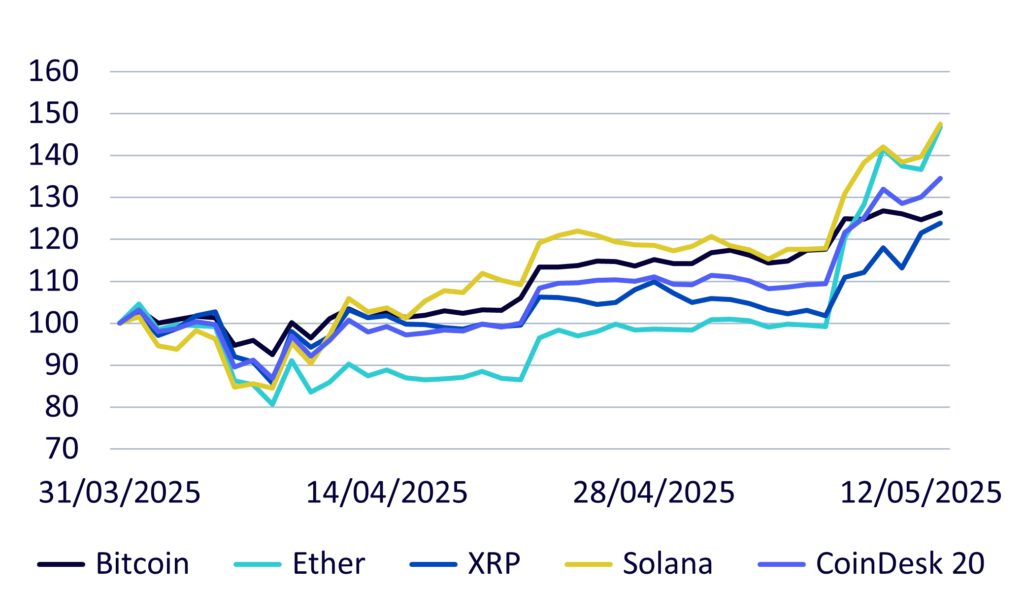
Source: Artemis Terminal, WisdomTree. 13 May 2025. Indexed to 100 on 31 March 2025. Historical performance is not an indication of future performance and any investment may go down in value.
Amid this wave of investor enthusiasm, Coinbase’s inclusion in the S&P 500 adds institutional weight to the rally. It now joins the ranks of Apple, Microsoft, and JP Morgan, helping anchor passive flows from the trillions of dollars benchmarked to the S&P 500 index. That is not just increased visibility – it is sticky capital with structural weight.
What is more, Coinbase has laid to rest the old narrative of crypto unreliability. After being hammered by a brutal bear market and relentless regulatory pressure during 2022–2023 period, the exchange emerged leaner, more focused, and more diversified. It slashed costs, attracted rising institutional flows, and leaned into non-trading revenues such as staking, custody, and blockchain infrastructure.
That operational discipline paid off. By 2024, Coinbase was delivering significant GAAP profits – a critical credential for S&P 500 inclusion. It did not just survive the volatility – it mastered it.
Crypto’s institutionalisation accelerates
For the crypto-curious institutional investor, this milestone removes another barrier. If Coinbase is now “S&P 500 material”, then crypto infrastructure is no longer fringe – it is part of the establishment.
This also raises the stakes for traditional financial firms. If a crypto-native company is now embedded in the U.S. corporate canon, legacy incumbents who have been slow to adapt should take note. Wall Street is no longer just watching from the sidelines – it is participating, allocating, and now, passively exposed.
Conclusion: from fringe to foundational
Coinbase entering the S&P 500 marks the clearest institutional validation yet of crypto’s staying power. This is not just a win for Coinbase – it is a win for the broader digital asset ecosystem.
Crypto is no longer knocking at Wall Street’s door. It has been handed the keys. Bitcoin is above six figures, altcoins are rallying, and now crypto infrastructure is embedded in the world’s most iconic equity index. The next chapter of adoption is not coming – it is already underway.
1 GAAP = Generally Accepted Accounting Principles.
Important Risks Related to this Article
Crypto assets, such as bitcoin and ether, are complex, generally exhibit extreme price volatility and unpredictability, and should be viewed as highly speculative assets. Crypto assets are frequently referred to as crypto “currencies,” but they typically operate without central authority or banks, are not backed by any government or issuing entity (i.e., no right of recourse), have no government or insurance protections, are not legal tender and have limited or no usability as compared to fiat currencies. Federal, state or foreign governments may restrict the use, transfer, exchange and value of crypto assets, and regulation in the U.S. and worldwide is still developing. Crypto asset exchanges and/or settlement facilities may stop operating, permanently shut down or experience issues due to security breaches, fraud, insolvency, market manipulation, market surveillance, KYC/AML (know your customer/anti-money laundering) procedures, non-compliance with applicable rules and regulations, technical glitches, hackers, malware or other reasons, which could negatively impact the price of any cryptocurrency traded on such exchanges or reliant on a settlement facility or otherwise may prevent access or use of the crypto asset. Crypto assets can experience unique events, such as forks or airdrops, which can impact the value and functionality of the crypto asset. Crypto asset transactions are generally irreversible, which means that a crypto asset may be unrecoverable in instances where: (i) it is sent to an incorrect address, (ii) the incorrect amount is sent, or (iii) transactions are made fraudulently from an account. A crypto asset may decline in popularity, acceptance or use, thereby impairing its price, and the price of a crypto asset may also be impacted by the transactions of a small number of holders of such crypto asset. Crypto assets may be difficult to value and valuations, even for the same crypto asset, may differ significantly by pricing source or otherwise be suspect due to market fragmentation, illiquidity, volatility and the potential for manipulation. Crypto assets generally rely on blockchain technology and blockchain technology is a relatively new and untested technology which operates as a distributed ledger. Blockchain systems could be subject to internet connectivity disruptions, consensus failures or cybersecurity attacks, and the date or time that you initiate a transaction may be different then when it is recorded on the blockchain. Access to a given blockchain requires an individualized key, which, if compromised, could result in loss due to theft, destruction or inaccessibility. In addition, different crypto assets exhibit different characteristics, use cases and risk profiles. Information provided by WisdomTree regarding digital assets, crypto assets or blockchain networks should not be considered or relied upon as investment or other advice, as a recommendation from WisdomTree, including regarding the use or suitability of any particular digital asset, crypto asset, blockchain network or any particular strategy.
Categories
Perspectives in Onchain Finance
View all

About the contributor

Dovile Silenskyte
Director, Digital Assets Research
Dovile Silenskyte is a director of digital assets research at WisdomTree. Before joining WisdomTree in May 2024, Dovile worked as an index equity product strategist at BlackRock. Currently, she is responsible for conducting analyses for in-house digital assets publications and assisting the sales team with client queries about products and markets. Dovile holds an MSc in Finance from Texas A&M University – Commerce, and she is also a chartered financial analyst (CFA).
Thought Leaders

Alice Liu
Senior Associate, Cryptocurrency Investments, WisdomTree Europe

Andrew Okrongly, CFA
Director, Model Portfolios

Blake Heimann
Associate Director, Quantitative Research

Christopher Gannatti, CFA
Global Head of Research

Chris Ryder
Head of WisdomTree Transfers

Dovile Silenskyte
Director, Digital Assets Research

Jason Guthrie
Director of Capital Markets, WisdomTree Europe

Jeff Weniger, CFA
Head of Equity Strategy

Jeremy J. Siegel
WisdomTree Senior Economist

Jeremy Schwartz, CFA
Global Chief Investment Officer

Kevin Flanagan
Head of Investment and Fixed Income Strategy

Mobeen Tahir
Director, Macroeconomics and Thematic Research

Nitesh Shah
Head of Commodities and Macroeconomic Research, WisdomTree Europe

Pierre Debru
Head of Research, Europe

Rick Harper
Chief Investment Officer, Fixed Income and Model Portfolios

Rohan Ranadive
Chief Risk Officer, WisdomTree Digital Assets

Samuel Rines
Macro Strategist, Model Portfolios

Vinh Tran
Associate Director, Business Development, Digital Assets

Will Peck
Head of WisdomTree Onchain

WisdomTree Onchain
Contributor
Alice Liu
Senior Associate, Cryptocurrency Investments, WisdomTree Europe
Andrew Okrongly, CFA
Director, Model Portfolios
Blake Heimann
Associate Director, Quantitative Research
Christopher Gannatti, CFA
Global Head of Research
Chris Ryder
Head of WisdomTree Transfers
Dovile Silenskyte
Director, Digital Assets Research
Jason Guthrie
Director of Capital Markets, WisdomTree Europe
Jeff Weniger, CFA
Head of Equity Strategy
Jeremy J. Siegel
WisdomTree Senior Economist
Jeremy Schwartz, CFA
Global Chief Investment Officer
Kevin Flanagan
Head of Investment and Fixed Income Strategy
Mobeen Tahir
Director, Macroeconomics and Thematic Research
Nitesh Shah
Head of Commodities and Macroeconomic Research, WisdomTree Europe
Pierre Debru
Head of Research, Europe
Rick Harper
Chief Investment Officer, Fixed Income and Model Portfolios
Rohan Ranadive
Chief Risk Officer, WisdomTree Digital Assets
Samuel Rines
Macro Strategist, Model Portfolios
Vinh Tran
Associate Director, Business Development, Digital Assets
Will Peck
Head of WisdomTree Onchain
WisdomTree Onchain
Contributor