


Dovile Silenskyte
Director, Digital Assets Research
Key Takeaways
- The first step to valuing bitcoin is understanding what drives its price performance. For this, we have started building a robust Bitcoin Model.
- Currently we see two key explanatory variables for bitcoin price: receiving addresses (+) and VIX index (-).
- Over the coming months, we will continue working on this model and publishing progress updates summarising our key findings.
- The ultimate objective is to have a robust enough model that would help us judge whether bitcoin is priced correctly and how its price may change.
Most investors struggle to value bitcoin as it does not have any cashflows. Few other assets – for example, gold and oil – do not have any cashflows, and investors value them by applying different valuation models.
Currently, there is no consensus on bitcoin valuation.
In our opinion, the first step to valuing bitcoin is understanding what drives its price performance. For this, we have started building a robust Bitcoin Model that we hope will help us all gain the necessary insights over time.
First iteration of the Bitcoin Model
To begin with, we have modelled bitcoin in a multivariate fashion as many different factors affect its price. After an extensive amount of effort, we have been able to identify two key explanatory variables for bitcoin price (direction in parenthesis):
- Receiving Addresses (+)
- VIX Index (-)
That is, it is positive for bitcoin price if a number of unique addresses that receive funds increases and/or if VIX index reduces. For readers’ understanding, number of receiving addresses measures bitcoin as a network, and VIX index is a good proxy for market sentiment (that is, market fear/panic).
When calibrating the model, we considered 30 different independent variables:
- 24 of them were bitcoin specific
- 6 of them were macro focused
We took this approach because we wanted the model to consider both bitcoin and macro factors as it would be naïve to pretend that macro does not have any impact on bitcoin price. Most of those 30 different independent variables had to be dismissed due to high correlations between them.
After trying daily, weekly, and monthly data, we decided to go with monthly. Of course, this type of approach overlooks changes that happen during the month as only month-end points are considered.
Figure 1 shows bitcoin price forecasts when calibrating our model using data from January 2022 to July 2024. It is clear that the two variables – receiving addresses and VIX index – allow our model to track the bitcoin price.
Figure 1: Bitcoin Price Model in ‘out of sample’ test
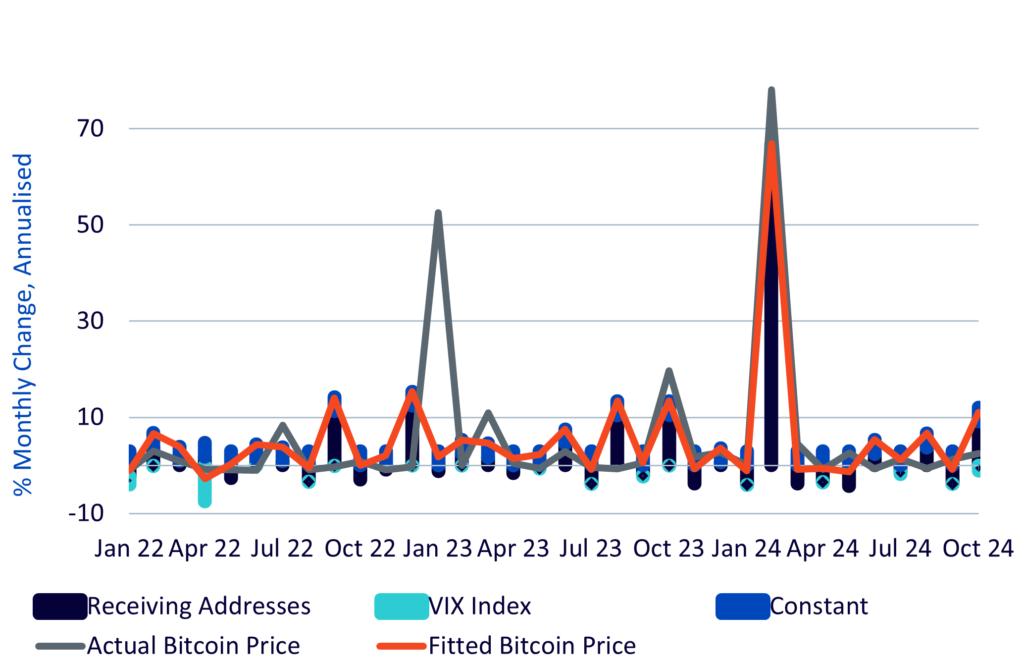
Source: WisdomTree, GlassNode, Bloomberg. 31 October 2024. Model calibration January 2022 to July 2024. 'Out of sample' period August 2024 - October 2024. Forecasts are not an indicator of future performance and any investments are subject to risks and uncertainties.
Bitcoin price attribution
When we talk to investors, most of them ask us to explain the performance of bitcoin. That is, they want to understand the reasons behind bitcoin price movements.
Figure 2: Bitcoin price attribution
As shown in Figure 2, over the past few years bitcoin price increased as the number of receiving addresses grew. This is no surprise as an increase in the number of receiving addresses indicates interest from new investors and/or increased activity from existing bitcoin holders. This tends to happen when the market has a positive outlook for bitcoin price.
Figure 2 also shows that VIX index spikes had a noticeably dampening effect on bitcoin price. This is also no surprise. Bitcoin is a risk asset and risk asset prices tend to go down when the VIX index goes up.
Next steps
Over the coming months, we will continue working on this model. As we do, we will publish progress updates summarising our key findings. The ultimate objective is to have a robust enough model that would help us judge whether bitcoin is priced correctly and how its price may change.
For those interested, we would be more than happy to discuss the current version of our Bitcoin Model in detail.
Important Risks Related to this Article
Crypto assets, such as bitcoin and ether, are complex, generally exhibit extreme price volatility and unpredictability, and should be viewed as highly speculative assets. Crypto assets are frequently referred to as crypto “currencies,” but they typically operate without central authority or banks, are not backed by any government or issuing entity (i.e., no right of recourse), have no government or insurance protections, are not legal tender and have limited or no usability as compared to fiat currencies. Federal, state or foreign governments may restrict the use, transfer, exchange and value of crypto assets, and regulation in the U.S. and worldwide is still developing. Crypto asset exchanges and/or settlement facilities may stop operating, permanently shut down or experience issues due to security breaches, fraud, insolvency, market manipulation, market surveillance, KYC/AML (know your customer/anti-money laundering) procedures, non-compliance with applicable rules and regulations, technical glitches, hackers, malware or other reasons, which could negatively impact the price of any cryptocurrency traded on such exchanges or reliant on a settlement facility or otherwise may prevent access or use of the crypto asset. Crypto assets can experience unique events, such as forks or airdrops, which can impact the value and functionality of the crypto asset. Crypto asset transactions are generally irreversible, which means that a crypto asset may be unrecoverable in instances where: (i) it is sent to an incorrect address, (ii) the incorrect amount is sent, or (iii) transactions are made fraudulently from an account. A crypto asset may decline in popularity, acceptance or use, thereby impairing its price, and the price of a crypto asset may also be impacted by the transactions of a small number of holders of such crypto asset. Crypto assets may be difficult to value and valuations, even for the same crypto asset, may differ significantly by pricing source or otherwise be suspect due to market fragmentation, illiquidity, volatility and the potential for manipulation. Crypto assets generally rely on blockchain technology and blockchain technology is a relatively new and untested technology which operates as a distributed ledger. Blockchain systems could be subject to internet connectivity disruptions, consensus failures or cybersecurity attacks, and the date or time that you initiate a transaction may be different then when it is recorded on the blockchain. Access to a given blockchain requires an individualized key, which, if compromised, could result in loss due to theft, destruction or inaccessibility. In addition, different crypto assets exhibit different characteristics, use cases and risk profiles. Information provided by WisdomTree regarding digital assets, crypto assets or blockchain networks should not be considered or relied upon as investment or other advice, as a recommendation from WisdomTree, including regarding the use or suitability of any particular digital asset, crypto asset, blockchain network or any particular strategy.
Categories
Perspectives in Onchain Finance
View all

About the contributor

Dovile Silenskyte
Director, Digital Assets Research
Dovile Silenskyte is a director of digital assets research at WisdomTree. Before joining WisdomTree in May 2024, Dovile worked as an index equity product strategist at BlackRock. Currently, she is responsible for conducting analyses for in-house digital assets publications and assisting the sales team with client queries about products and markets. Dovile holds an MSc in Finance from Texas A&M University – Commerce, and she is also a chartered financial analyst (CFA).
Thought Leaders

Alice Liu
Senior Associate, Cryptocurrency Investments, WisdomTree Europe

Andrew Okrongly, CFA
Director, Model Portfolios

Blake Heimann
Associate Director, Quantitative Research

Christopher Gannatti, CFA
Global Head of Research

Chris Ryder
Head of WisdomTree Transfers

Dovile Silenskyte
Director, Digital Assets Research

Jason Guthrie
Director of Capital Markets, WisdomTree Europe

Jeff Weniger, CFA
Head of Equity Strategy

Jeremy J. Siegel
WisdomTree Senior Economist

Jeremy Schwartz, CFA
Global Chief Investment Officer

Kevin Flanagan
Head of Investment and Fixed Income Strategy

Mobeen Tahir
Director, Macroeconomics and Thematic Research

Nitesh Shah
Head of Commodities and Macroeconomic Research, WisdomTree Europe

Pierre Debru
Head of Research, Europe

Rick Harper
Chief Investment Officer, Fixed Income and Model Portfolios

Rohan Ranadive
Chief Risk Officer, WisdomTree Digital Assets

Samuel Rines
Macro Strategist, Model Portfolios

Vinh Tran
Associate Director, Business Development, Digital Assets

Will Peck
Head of WisdomTree Onchain

WisdomTree Onchain
Contributor
Alice Liu
Senior Associate, Cryptocurrency Investments, WisdomTree Europe
Andrew Okrongly, CFA
Director, Model Portfolios
Blake Heimann
Associate Director, Quantitative Research
Christopher Gannatti, CFA
Global Head of Research
Chris Ryder
Head of WisdomTree Transfers
Dovile Silenskyte
Director, Digital Assets Research
Jason Guthrie
Director of Capital Markets, WisdomTree Europe
Jeff Weniger, CFA
Head of Equity Strategy
Jeremy J. Siegel
WisdomTree Senior Economist
Jeremy Schwartz, CFA
Global Chief Investment Officer
Kevin Flanagan
Head of Investment and Fixed Income Strategy
Mobeen Tahir
Director, Macroeconomics and Thematic Research
Nitesh Shah
Head of Commodities and Macroeconomic Research, WisdomTree Europe
Pierre Debru
Head of Research, Europe
Rick Harper
Chief Investment Officer, Fixed Income and Model Portfolios
Rohan Ranadive
Chief Risk Officer, WisdomTree Digital Assets
Samuel Rines
Macro Strategist, Model Portfolios
Vinh Tran
Associate Director, Business Development, Digital Assets
Will Peck
Head of WisdomTree Onchain
WisdomTree Onchain
Contributor
Alice Liu
Senior Associate, Cryptocurrency Investments, WisdomTree Europe
Andrew Okrongly, CFA
Director, Model Portfolios
Blake Heimann
Associate Director, Quantitative Research
Christopher Gannatti, CFA
Global Head of Research
Chris Ryder
Head of WisdomTree Transfers
Dovile Silenskyte
Director, Digital Assets Research
Jason Guthrie
Director of Capital Markets, WisdomTree Europe
Jeff Weniger, CFA
Head of Equity Strategy
Jeremy J. Siegel
WisdomTree Senior Economist
Jeremy Schwartz, CFA
Global Chief Investment Officer
Kevin Flanagan
Head of Investment and Fixed Income Strategy
Mobeen Tahir
Director, Macroeconomics and Thematic Research
Nitesh Shah
Head of Commodities and Macroeconomic Research, WisdomTree Europe
Pierre Debru
Head of Research, Europe
Rick Harper
Chief Investment Officer, Fixed Income and Model Portfolios
Rohan Ranadive
Chief Risk Officer, WisdomTree Digital Assets
Samuel Rines
Macro Strategist, Model Portfolios
Vinh Tran
Associate Director, Business Development, Digital Assets
Will Peck
Head of WisdomTree Onchain
WisdomTree Onchain
Contributor