


Dovile Silenskyte
Director, Digital Assets Research
Key Takeaways
- 2025 is set to be a defining year for crypto, as innovation, regulation, and adoption converge.
- Whether it is bitcoin cementing its position as a portfolio staple, Ethereum scaling for mainstream use, or tokenization unlocking liquidity in untapped markets, the crypto ecosystem is evolving.
- For investors and institutions alike, the opportunities have never been clearer or more compelling.
2024 was a landmark year for bitcoin, solidifying its role as a fully institutionalized asset class.
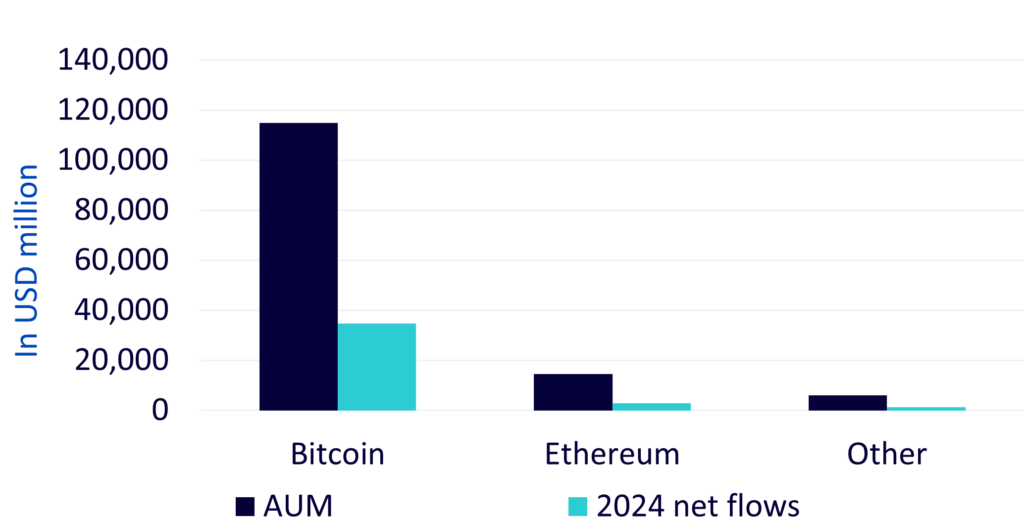
Institutional inflows into physical bitcoin exchange-traded products (ETPs) reached nearly $35 billion1 globally, signalling a major shift in how traditional investors view crypto. As bitcoin continued to enhance portfolios' risk-return profiles, more institutional investors followed suit, reshaping the financial landscape.
Looking ahead, 2025 promises to bring exciting developments across the crypto ecosystem. Here are the top five crypto trends to watch.
1. Fear of being left behind
The era of bitcoin as a niche investment is over. Institutional adoption is creating a ripple effect, forcing hesitant players to reconsider. Portfolios with bitcoin allocations are consistently outperforming those without, highlighting its growing importance.
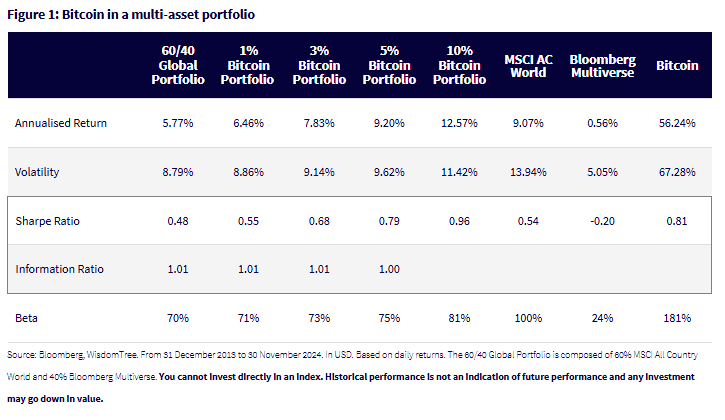
With bitcoin’s ability to noticeably improve portfolios’ risk-return profiles, asset managers face a clear choice: integrate bitcoin into multi-asset portfolios or risk falling behind in a rapidly evolving financial landscape. In 2025, expect the competition to heat up as clients demand exposure to this powerhouse cryptocurrency.
2. Expanding crypto investment options
In 2024, regulatory breakthroughs opened the doors for physical bitcoin and ether ETPs in key developed markets. This marked a critical step towards making cryptocurrencies mainstream, providing seamless access to institutional and retail investors alike.
Figure 2: Global physical crypto ETP assets under management (AUM) and 2024 net flows
Source: Bloomberg, WisdomTree. 02 January 2025. Historical performance is not an indication of future performance and any investment may go down in value.
In 2025, this momentum is expected to accelerate as the crypto regulatory environment becomes more friendly in the United States and as key developed markets follow Europe’s lead and approve ETPs for altcoins2 such as Solana and XRP. With their clear utility and growing adoption, these altcoins are strong candidates for institutional investment vehicles.
This next wave of altcoin ETPs will expand the diversity of crypto investment opportunities and further integrate cryptocurrencies into the global financial system.
3. The maturing of Ethereum’s layer-2 ecosystem
Ethereum’s role as the backbone of decentralised finance (DeFi), non-fungible tokens (NFTs), and Web3 is unmatched, but its scalability challenges remain a hurdle. Layer-2 solutions—technologies such as Arbitrum and Optimism—are transforming Ethereum's scalability and usability by enabling faster, cheaper transactions.
In 2025, Ethereum’s recent upgrades, such as Proto-Danksharding (introduced in the ‘Dencun’ upgrade), will drive layer-2 adoption even further. Innovations like Visa’s layer-2 payment platform leveraging Ethereum for instant cross-border transactions will underscore the platform's evolution.
Expect Ethereum’s layer-2 ecosystem to power real-world use cases ranging from tokenized assets to decentralised gaming, positioning it as the infrastructure of a truly scalable digital economy.
4. Stablecoins: bridging finance and blockchain
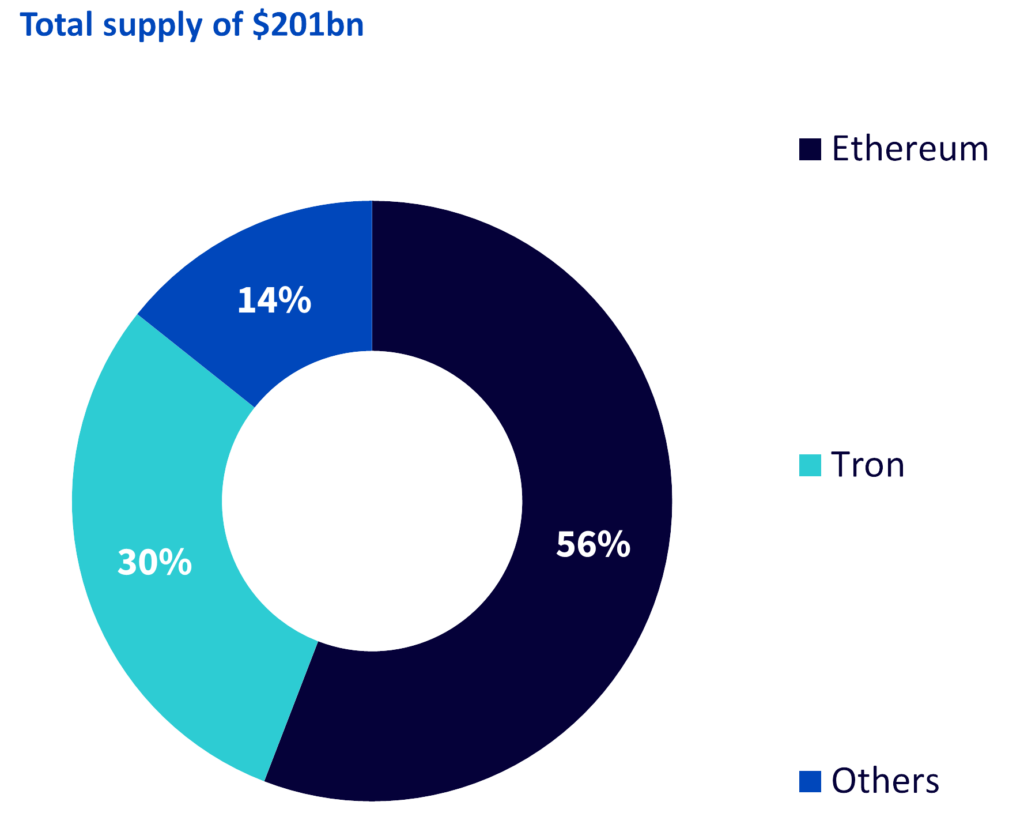
Stablecoins are becoming indispensable to the global financial system, offering the stability of traditional assets with the efficiency of blockchain. Platforms such as Ethereum dominate the stablecoin landscape, hosting stablecoin giants Tether (USDT) and USD Coin (USDC), which facilitate billions in daily transactions.
Figure 3: Key stablecoin chains
Source: Artemis Terminal, WisdomTree. 05 January 2025. Historical performance is not an indication of future performance and any investment may go down in value.
As we move into 2025, stablecoins will increasingly interact with blockchain ecosystems such as Solana and XRP. Solana’s high-speed, low-cost infrastructure makes it ideal for stablecoin payments and remittances, while XRP Ledger’s focus on cross-border efficiency positions it as a leader in global settlements. With institutional adoption rising and DeFi applications booming, stablecoins will serve as the backbone of a seamless, interconnected financial ecosystem.
5. Tokenization: redefining ownership and revolutionising finance
Tokenization is set to redefine how we think about ownership and value. By converting tangible assets like real estate, commodities, stocks, and art into digital tokens, tokenization breaks down barriers to entry and creates unprecedented liquidity.
In 2025, tokenization will expand dramatically, empowering investors to own fractions of high-value assets. Platforms such as Paxos Gold and AspenCoin are already showcasing how tokenization can revolutionize markets for gold and luxury real estate. The integration of tokenized assets into DeFi will unlock new financial opportunities, such as using tokenized real estate as collateral for loans. As tokenization matures, it will transform industries ranging from private equity to venture capital, creating a more inclusive and efficient financial system.
For the avoidance of any doubt, tokenization complements crypto by expanding the use cases of blockchain to include real-world applications.
Looking ahead
2025 is set to be a defining year for crypto, as innovation, regulation, and adoption converge. Whether it is bitcoin cementing its position as a portfolio staple, Ethereum scaling for mainstream use, or tokenization unlocking liquidity in untapped markets, the crypto ecosystem is evolving. For investors and institutions alike, the opportunities have never been clearer or more compelling.
1 Bloomberg, WisdomTree. 02 January 2025.
2 Short for ‘alternative coins’: any cryptocurrency other than the original cryptocurrency, bitcoin, is known as an altcoin. As the Ethereum network grows, it is increasingly being excluded as an altcoin.
Important Risks Related to this Article
Crypto assets, such as bitcoin and ether, are complex, generally exhibit extreme price volatility and unpredictability, and should be viewed as highly speculative assets. Crypto assets are frequently referred to as crypto “currencies,” but they typically operate without central authority or banks, are not backed by any government or issuing entity (i.e., no right of recourse), have no government or insurance protections, are not legal tender and have limited or no usability as compared to fiat currencies. Federal, state or foreign governments may restrict the use, transfer, exchange and value of crypto assets, and regulation in the U.S. and worldwide is still developing. Crypto asset exchanges and/or settlement facilities may stop operating, permanently shut down or experience issues due to security breaches, fraud, insolvency, market manipulation, market surveillance, KYC/AML (know your customer/anti-money laundering) procedures, non-compliance with applicable rules and regulations, technical glitches, hackers, malware or other reasons, which could negatively impact the price of any cryptocurrency traded on such exchanges or reliant on a settlement facility or otherwise may prevent access or use of the crypto asset. Crypto assets can experience unique events, such as forks or airdrops, which can impact the value and functionality of the crypto asset. Crypto asset transactions are generally irreversible, which means that a crypto asset may be unrecoverable in instances where: (i) it is sent to an incorrect address, (ii) the incorrect amount is sent, or (iii) transactions are made fraudulently from an account. A crypto asset may decline in popularity, acceptance or use, thereby impairing its price, and the price of a crypto asset may also be impacted by the transactions of a small number of holders of such crypto asset. Crypto assets may be difficult to value and valuations, even for the same crypto asset, may differ significantly by pricing source or otherwise be suspect due to market fragmentation, illiquidity, volatility and the potential for manipulation. Crypto assets generally rely on blockchain technology and blockchain technology is a relatively new and untested technology which operates as a distributed ledger. Blockchain systems could be subject to internet connectivity disruptions, consensus failures or cybersecurity attacks, and the date or time that you initiate a transaction may be different then when it is recorded on the blockchain. Access to a given blockchain requires an individualized key, which, if compromised, could result in loss due to theft, destruction or inaccessibility. In addition, different crypto assets exhibit different characteristics, use cases and risk profiles. Information provided by WisdomTree regarding digital assets, crypto assets or blockchain networks should not be considered or relied upon as investment or other advice, as a recommendation from WisdomTree, including regarding the use or suitability of any particular digital asset, crypto asset, blockchain network or any particular strategy.
Categories
Perspectives in Onchain Finance
View all

About the contributor

Dovile Silenskyte
Director, Digital Assets Research
Dovile Silenskyte is a director of digital assets research at WisdomTree. Before joining WisdomTree in May 2024, Dovile worked as an index equity product strategist at BlackRock. Currently, she is responsible for conducting analyses for in-house digital assets publications and assisting the sales team with client queries about products and markets. Dovile holds an MSc in Finance from Texas A&M University – Commerce, and she is also a chartered financial analyst (CFA).
Thought Leaders

Alice Liu
Senior Associate, Cryptocurrency Investments, WisdomTree Europe

Andrew Okrongly, CFA
Director, Model Portfolios

Blake Heimann
Associate Director, Quantitative Research

Christopher Gannatti, CFA
Global Head of Research

Chris Ryder
Head of WisdomTree Transfers

Dovile Silenskyte
Director, Digital Assets Research

Jason Guthrie
Director of Capital Markets, WisdomTree Europe

Jeff Weniger, CFA
Head of Equity Strategy

Jeremy J. Siegel
WisdomTree Senior Economist

Jeremy Schwartz, CFA
Global Chief Investment Officer

Kevin Flanagan
Head of Investment and Fixed Income Strategy

Mobeen Tahir
Director, Macroeconomics and Thematic Research

Nitesh Shah
Head of Commodities and Macroeconomic Research, WisdomTree Europe

Pierre Debru
Head of Research, Europe

Rick Harper
Chief Investment Officer, Fixed Income and Model Portfolios

Rohan Ranadive
Chief Risk Officer, WisdomTree Digital Assets

Samuel Rines
Macro Strategist, Model Portfolios

Vinh Tran
Associate Director, Business Development, Digital Assets

Will Peck
Head of WisdomTree Onchain

WisdomTree Onchain
Contributor
Alice Liu
Senior Associate, Cryptocurrency Investments, WisdomTree Europe
Andrew Okrongly, CFA
Director, Model Portfolios
Blake Heimann
Associate Director, Quantitative Research
Christopher Gannatti, CFA
Global Head of Research
Chris Ryder
Head of WisdomTree Transfers
Dovile Silenskyte
Director, Digital Assets Research
Jason Guthrie
Director of Capital Markets, WisdomTree Europe
Jeff Weniger, CFA
Head of Equity Strategy
Jeremy J. Siegel
WisdomTree Senior Economist
Jeremy Schwartz, CFA
Global Chief Investment Officer
Kevin Flanagan
Head of Investment and Fixed Income Strategy
Mobeen Tahir
Director, Macroeconomics and Thematic Research
Nitesh Shah
Head of Commodities and Macroeconomic Research, WisdomTree Europe
Pierre Debru
Head of Research, Europe
Rick Harper
Chief Investment Officer, Fixed Income and Model Portfolios
Rohan Ranadive
Chief Risk Officer, WisdomTree Digital Assets
Samuel Rines
Macro Strategist, Model Portfolios
Vinh Tran
Associate Director, Business Development, Digital Assets
Will Peck
Head of WisdomTree Onchain
WisdomTree Onchain
Contributor