


Back to Blog
The Great Whale Slap: How a Whale Offloaded $4M in Losses to Hyperliquid’s HLP Vault
March 17, 2025

Key Takeaways
- Mechanism Exploits can be as Dangerous as Smart Contract Exploits — The whale didn’t hack the system, but gamed liquidation and copy trader psychology. A copy trader is someone who replicates the trades of another, typically more experienced trader.
- Size Creates an Illusion of Certainty — Many traders mistook the whale’s large position for insider knowledge. The trade was designed to fail on purpose.
- DEXs Must Balance Leverage with Risk Controls — If DEXs (Decentralized Exchange) want high leverage, they will need CEX-like risk management (Centralized Exchange), raising questions about decentralization.
- Copy Trading in DeFi is Riskier Than It Seems — Without full visibility into a trader’s hedging strategy, blindly following large wallets can lead to unforeseen liquidation traps.
Hyperliquid, a decentralized perpetual trading platform, suffered a significant loss when a whale trader executed a calculated maneuver to offload risk onto the platform’s HLP (Hyperliquid Provider) vault. The whale strategically manipulated crowd psychology and liquidation mechanics, withdrawing collateral to force a liquidation at a favorable price while ensuring HLP absorbed the downside risk. The end result? The trader walked away with a $1.8M profit, while HLP took a $4M hit.1
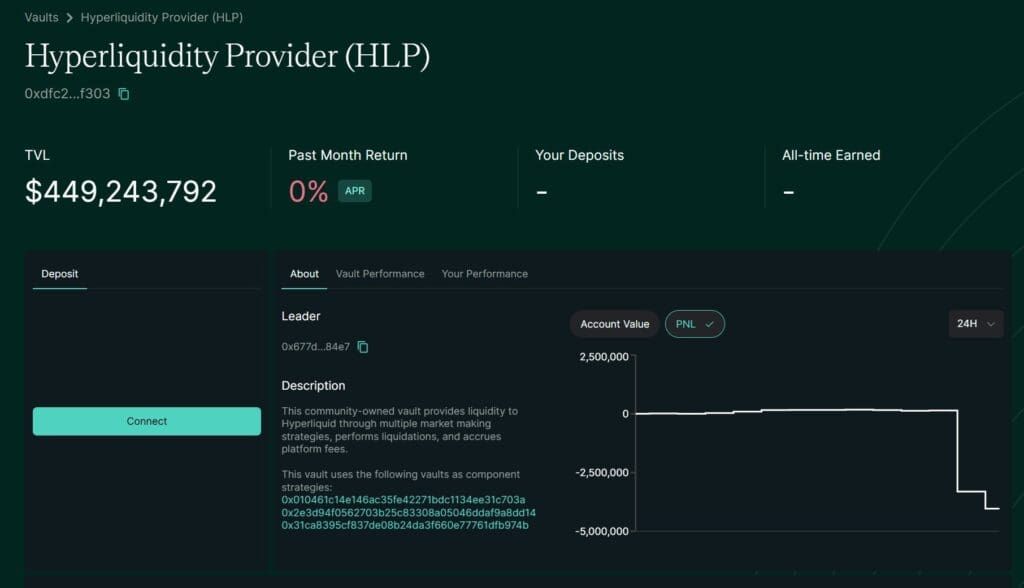
This wasn’t a bug or a protocol exploit; it was a mechanism exploit that relied on mass psychology and structural inefficiencies within leverage trading. The whale’s true “alpha” wasn’t predicting an ETH breakout, but predicting that copy traders would pile in, creating the perfect conditions for their own liquidation play. This is as much a social engineering game as a financial one, leveraging crowd psychology to manufacture a desired end result. Edward Bernays, the grandfather of crowd psychology would be proud!2
What Happened?
- The building up of a Massive Leveraged Position: The whale deposited collateral (margin) into Hyperliquid – about $15.2M in USDC – and used it to open a huge ETH long position. By using very high leverage (reportedly up to 50x), they amassed a position of ~175,000 ETH. For context, that’s a position worth around $300-$340 million at prevailing prices – an extraordinarily large trade on any exchange.3 The position’s average entry price was about $1,884 per ETH with an initial liquidation price around $1,839, meaning if ETH fell below $1,839 the position would start to liquidate. At this stage the trade was extremely risky but not yet a guaranteed loser – it was a bold bet on ETH’s price rising.
- Riding the Wave: Initially. ETH’s price rose, pushing the whale’s unrealized profits to roughly $8 million at peak. The exchange’s PnL (profit and loss) calculations showed a big cushion, and the whale’s account equity swelled well beyond the initial margin. From a risk perspective, this is the only moment in the story where the trader’s position was relatively safe – with ETH going up, there was excess margin headroom. At this point, the trader could have closed the position entirely and made a handsome and honest profit. But instead, they prepared for a more elaborate endgame.
- Withdrawing Collateral (Locking in Profit): Here’s the pivotal move – the trader withdrew a large chunk of funds from their account while the trade was still open. They effectively “cashed out” $17.09M USDC by closing a portion of the position (selling 15,000 ETH) and pulling those proceeds out. This maneuver banked a profit (since they withdrew more than the initial deposit, the difference being profit) without completely closing the trade. Importantly, this left far less collateral backing the remaining position.4 After the withdrawal, about 160,000 ETH were still long, but now with a razor-thin margin buffer. The liquidation price for the remainder shot up closer to the current market price, meaning the position would auto-liquidate on even a mild ETH pullback. In essence, the whale took most of their chips off the table, but kept the bet running with someone else’s money on the line (as we’ll see).
- The Trap is Set – Margin Below Maintenance: By withdrawing so much ETH from collateral, the trader knowingly violated prudent margin levels – the account equity was now below the exchange’s maintenance margin requirement for that large of a position. This is like taking almost all the padding out of a leaning Jenga tower; the next wobble would bring it down. However, before ETH’s price began a drawdown, the whale added additional collateral to try and secure the position, temporarily raising the liquidation price. But sure enough, ETH’s price began a drawdown. It didn’t even take a huge crash; once ETH price slid roughly into the $1915-$1900 range, the whale’s margin ratio fell below the critical threshold. The Hyperliquid liquidation engine kicked in, automatically closing the position to prevent further losses.
- Liquidation and HLP Vault Transfer: On Hyperliquid, when a position is liquidated, it isn’t sold entirely on the open market all at once. Given the size here of this trade, doing so would have a large price impact, ultimately affecting other market participants. To mitigate against this, Hyperliquid transfers the liquidated position to the HLP Vault – a pooled fund of capital from liquidity providers meant to manage these liquidations strategically. Think of HLP like an insurance/clearing fund that “takes over” the position. In this case, the vault assumed the whale’s ~160,000 ETH long at about $1,915 per ETH (the price at the moment of liquidation). The HLP vault now essentially became the owner of that huge ETH bag, which it needed to sell off over time to rebalance.
- Vault Bleeds as It Unwinds the Position: Once the HLP vault absorbed the position, it immediately began unwinding it – i.e., selling off ETH into the market to flatten out the risk. However, unloading such a colossal amount of ETH inevitably pushed prices down further, especially given any existing market weakness. As the market price fell below $1,896, the vault found itself selling much of the ETH at a loss relative to the $1,915 price it took possession of them at. This “toxic” position resulted in a realized loss of over $4,000,000 for the HLP vault (and thus for all the liquidity providers in that vault) within 24 hours. Essentially, the vault bought high and had to sell lower, eating the loss. Meanwhile, our whale’s own position was already closed – they were out, safe with their earlier withdrawn profit. The whale outsmarted the system mechanics and shifted their risk to the HLP vault.
- The Aftermath – Profit for One, Losses Shared by Many: When the dust settled, the trader had netted roughly $1.8M in profit (their withdrawn amount minus their initial deposit), despite their remaining position being forced into liquidation. The HLP vault – funded by many other users seeking to earn yield from providing backstop liquidity – was left with a $4M hole. Hyperliquid announced emergency measures, reducing max leverage from 50x to 25x-40x on major assets going forward to prevent a similar scenario.5,6 They also reminded everyone that HLP vault yields come with risk and that this was not a bug or hack in the code.
In short, one whale’s aggressive strategy ended up socializing the losses across Hyperliquid’s liquidity providers – a stark lesson in how DeFi mechanism design can be gamed when extreme long-tail scenarios aren’t sufficiently constrained.7
While slippage played a role, the bigger issue was allowing the trader to withdraw collateral from an open position in the first place - which meant that once the trade failed, there was no margin left to absorb the loss. The vault essentially became the forced buyer of last resort, but it wasn’t large enough to absorb that level of risk without incurring a negative PnL.
The Psychological Game: How Copy Traders Enabled the Whale’s Exit
The success of this strategy hinged on crowd psychology. Copy traders assumed that the whale must have had insider knowledge to take such a massive position. However, the whale wasn’t betting on an ETH breakout—they were betting that others would follow, creating the ideal exit conditions. This isn’t just about financial mechanics; it’s about social engineering in a trustless, code-driven environment.
Not DeFi’s First Rodeo: GMX and dYdX Comparisons
If all of this sounds familiar, it’s because DeFi has seen similar exploitative strategies before – where clever traders leverage weaknesses in platform mechanics or market structure to profit, often at the expense of a protocol’s liquidity pools or insurance funds. Two notable parallels are the GMX AVAX trade exploit and the dYdX insurance fund attack, which reinforce the theme that weak system design invites exploitation.
- GMX’s AVAX Price Manipulation (September 2022): GMX, another decentralized trading platform, had a design where traders could trade with zero price slippage on certain pairs. All price feeds were taken from external markets (like Binance) without an automated market maker adjusting prices on GMX itself. A savvy trader realized this meant they could open a huge position on AVAX on GMX (with no slippage), then simultaneously push AVAX’s price up on other exchanges, and finally close the GMX position at the now-elevated price.8 This manipulation strategy let the trader net around $565k to $700k in profit , while GMX’s liquidity pool (the counterpart to the trade, similar to Hyperliquid’s HLP) absorbed an equivalent loss. GMX wasn’t “hacked” – it allowed zero-slippage trades by design, and the trader exploited that policy. In response, GMX had to cap open interest and adjust its pricing oracles to prevent a repeat. The parallel with Hyperliquid: in both cases, a trader found a loophole in how prices or liquidations were handled, and by using large size, extracted profit from the protocol’s pooled funds.
- dYdX’s Insurance Fund Exploit (November 2023): dYdX is a decentralized exchange known for its orderbook-style perpetual trading. In late 2023, dYdX’s insurance fund (meant to cover shortfalls from liquidations) took a $9M hit in what the team called a “targeted attack”.9 The attacker(s) seemingly manipulated the price of Yearn Finance’s YFI token – which had low liquidity – causing it to crash 43% in a short time. This sudden drop liquidated about $38M of long YFI positions on dYdX, far beyond what their collateral could cover. The insurance fund had to step in to pay off the debts, thus losing $9M. Again, the code wasn’t broken; rather, the market was manipulated in a way that the platform’s risk controls couldn’t handle. It’s analogous to our Hyperliquid story: a large market movement (whether induced or opportunistic) leading to mass liquidations that exceed the platform’s safety nets. In both scenarios, the platform’s own fund (insurance fund or vault) shouldered the loss, and the responsible trader likely profited elsewhere (e.g., shorting YFI before crashing it).
These events all underscore a common refrain: DeFi protocols must expect that users will push their systems to the limit – and sometimes beyond. Whether it’s zero slippage loopholes, under-collateralized positions, or thinly traded asset manipulation, any gap in the armor will, sooner or later, be exploited for profit. In traditional finance, exchanges and regulators have seen similar circumstances before – from portfolio margin loopholes to cornering markets – and they have many guardrails (and legal consequences) to curb egregious behavior. DeFi, by contrast, operates by code and incentives in an open environment, which is why resilient mechanism design is absolutely critical. Each of these incidents (Hyperliquid, GMX, dYdX) has led to changes in parameters – e.g. lowering leverage or open interest, adding circuit breakers, raising margin requirements – but the goal for the industry is to proactively design systems that don’t allow a single actor to incur outsized losses for everyone else.
It’s also worth noting that exploiting system mechanics walks a gray ethical line. Some consider it just “smart trading” or stress-testing the system, while others label it as malicious exploitation. Regardless of intent, the impact is real: other users and liquidity providers end up footing the bill. The GMX and dYdX cases shook user confidence (just as Hyperliquid’s did, evidenced by the HYPE token dip and user concern expressed across social media). Ultimately, each incident pushes DeFi to evolve and harden itself – much as each cybersecurity incident forces better practices. But those improvements often come after innocent participants have paid a price.
The Future of DeFi Perps: DEXs Becoming CEXs?
Definition: Perpetual futures (or perps) are a type of derivative contract that enables traders to speculate on the price movements of cryptocurrencies or other assets, without owning the underlying assets.
This incident raises a broader question: Can DEX perps sustainably offer high leverage without adopting CEX-like risk management?
Potential Solutions:
- Lowering Max Leverage — Hyperliquid already reduced ETH leverage from 50x to 25x, but this could hurt business.
- Dynamic Risk Limits — As position sizes grow, leverage could automatically reduce (like in CEXs).
- Market Surveillance — DEXs may need CEX-like tools to detect manipulation.
- Open Interest Limits — Preventing a single trader from holding too large a position.
If DEXs continue to tighten risk management, they risk becoming more centralized. The challenge is whether new liquidation mechanisms can be designed that don’t rely on traditional risk oversight.
Conclusion
In cybersecurity, the weakest link is often human error or social engineering because attackers tend to exploit people rather than breaking encryption or security protocols. However, in DeFi and programmatic financial systems, the weakest link is often mechanism design—the way incentives, risk parameters, and economic models interact. The Hyperliquid whale incident underscores that DeFi's vulnerabilities extend beyond code flaws—human behavior and interaction with the system play a crucial role. The whale didn’t need an exploit; they just needed a predictable crowd response.
Hyperliquid’s response to lower leverage is a short-term fix, but long-term solutions will likely involve mechanism design that accounts for an edge-case such as this.10 As DeFi evolves, protocols will need to engineer incentives that prevent social engineering exploits and consider applicable risk management, not just technical ones.
Sources:
1 Malwa, Shaurya. Hyperliquid Loses $4M After Whale's Over $200M Ether Trade Unwinds. Edited by Parikshit Mishra, 12 Mar. 2025, CoinDesk, updated at 6:40 p.m. UTC, published at 12:40 p.m. UTC. https://www.coindesk.com/markets/2025/03/12/hyperliquid-loses-usd4m-after-whale-s-over-usd200m-ether-trade-unwinds
2 "Edward Bernays and Group Psychology: Manipulating the Masses." Freedom vs Tyranny, Psychology, Sick Society - Dystopia, Videos, 12 July 2017. https://academyofideas.com/2017/07/edward-bernays-group-psychology-manipulating-the-masses/
3 threesigmaxyz. One trader VS. Hyperliquid’s HLP vault. Twitter/X, March 2025. https://x.com/threesigmaxyz/status/1899798137000145067
4 Mirza, Farah. "Did This Whale Manipulate HYPE’s Liquidation System for Profit?" AMB Crypto, 12 Mar. 2025, https://ambcrypto.com/did-this-whale-manipulate-hyperliquids-liquidation-system-for-profit/.
5 Jones, Wayne. "HYPE Sinks 8.5% as Whale Liquidation Causes $4M Hyperliquid Vault Loss." CryptoPotato, 12 Mar. 2025, https://cryptopotato.com/hype-sinks-8-5-as-whale-liquidation-causes-4m-hyperliquid-vault-loss/.
6 HyperliquidX. Official statement on liquidation event. Twitter/X, March 2025. https://x.com/HyperliquidX/status/1899768864705237211
7 DU09BTC. “A Hyperliquid ETH trader nuked the HLP vault by $4 mil in minutes and erased 30 days of profits. ” X, 12 Mar. 2025, 11:58 a.m., https://x.com/DU09BTC/status/1899852622917677099
8 Malwa, Shaurya. "DeFi Trader Nets Over $500K by Using DEX GMX to Manipulate Avalanche Token." CoinDesk, 19 Sept. 2022, updated 11 May 2023, https://www.coindesk.com/markets/2022/09/19/defi-trader-nets-over-500k-by-using-dex-gmx-to-manipulate-avalanche-token.
9 Pereira, Ana Paula. "dYdX Founder Claims Targeted Attack Led to $9M Insurance Claim." Cointelegraph, 18 Nov. 2023, https://cointelegraph.com/news/founder-dydx-targeted-attack-insurance-use.
10 BenByBit. Hyperliquid liquidation discussion. Twitter/X, March 2025. https://x.com/benbybit/status/1900061577656615229
Definitions:
DEX (Decentralized Exchange):
A DEX is a platform that facilitates peer-to-peer trading of cryptocurrencies directly between users without the need for a centralized authority. These exchanges operate on blockchain technology, enabling users to retain control of their funds while trading through smart contracts.
CEX (Centralized Exchange):
A CEX is a trading platform where all transactions are managed and facilitated by a central authority or company. This type of exchange typically holds users' funds and oversees order matching, security, and regulatory compliance, often offering higher liquidity and more user-friendly interfaces.
Perps (Perpetual Contracts):
"Perps" refers to perpetual contracts, a type of derivative in cryptocurrency trading. Unlike traditional futures contracts that have set expiration dates, perpetual contracts do not expire, allowing traders to hold positions indefinitely. They usually include funding mechanisms to keep the contract price aligned with the underlying asset's spot price.
Perspectives in Onchain Finance
View all

About the contributor

Kelly Reddington
Marketing and Research Analyst
Kelly Reddington is a Marketer and Research Analyst at WisdomTree, specializing in digital assets and the evolving financial infrastructure. He plays a key role in product marketing, executive communications, and content strategy for WisdomTree's digital assets initiatives, helping articulate the firm's vision for the future of tokenization and onchain finance. Prior to joining WisdomTree, Kelly built a career at the intersection of cybersecurity, marketing, and blockchain technology. He holds a degree in Business Administration and Marketing from the University at Buffalo. With a passion for crypto, DeFi, and emerging financial technologies, Kelly brings a unique perspective to how these innovations are communicated and understood by both institutional and retail audiences.
Thought Leaders

Alice Liu
Senior Associate, Cryptocurrency Investments, WisdomTree Europe

Andrew Okrongly, CFA
Director, Model Portfolios

Blake Heimann
Associate Director, Quantitative Research

Christopher Gannatti, CFA
Global Head of Research

Chris Ryder
Head of WisdomTree Transfers

Dovile Silenskyte
Director, Digital Assets Research

Jason Guthrie
Director of Capital Markets, WisdomTree Europe

Jeff Weniger, CFA
Head of Equity Strategy

Jeremy J. Siegel
WisdomTree Senior Economist

Jeremy Schwartz, CFA
Global Chief Investment Officer

Kevin Flanagan
Head of Investment and Fixed Income Strategy

Mobeen Tahir
Director, Macroeconomics and Thematic Research

Nitesh Shah
Head of Commodities and Macroeconomic Research, WisdomTree Europe

Pierre Debru
Head of Research, Europe

Rick Harper
Chief Investment Officer, Fixed Income and Model Portfolios

Rohan Ranadive
Chief Risk Officer, WisdomTree Digital Assets

Samuel Rines
Macro Strategist, Model Portfolios

Vinh Tran
Associate Director, Business Development, Digital Assets

Will Peck
Head of WisdomTree Onchain

WisdomTree Onchain
Contributor
Alice Liu
Senior Associate, Cryptocurrency Investments, WisdomTree Europe
Andrew Okrongly, CFA
Director, Model Portfolios
Blake Heimann
Associate Director, Quantitative Research
Christopher Gannatti, CFA
Global Head of Research
Chris Ryder
Head of WisdomTree Transfers
Dovile Silenskyte
Director, Digital Assets Research
Jason Guthrie
Director of Capital Markets, WisdomTree Europe
Jeff Weniger, CFA
Head of Equity Strategy
Jeremy J. Siegel
WisdomTree Senior Economist
Jeremy Schwartz, CFA
Global Chief Investment Officer
Kevin Flanagan
Head of Investment and Fixed Income Strategy
Mobeen Tahir
Director, Macroeconomics and Thematic Research
Nitesh Shah
Head of Commodities and Macroeconomic Research, WisdomTree Europe
Pierre Debru
Head of Research, Europe
Rick Harper
Chief Investment Officer, Fixed Income and Model Portfolios
Rohan Ranadive
Chief Risk Officer, WisdomTree Digital Assets
Samuel Rines
Macro Strategist, Model Portfolios
Vinh Tran
Associate Director, Business Development, Digital Assets
Will Peck
Head of WisdomTree Onchain
WisdomTree Onchain
Contributor
Alice Liu
Senior Associate, Cryptocurrency Investments, WisdomTree Europe
Andrew Okrongly, CFA
Director, Model Portfolios
Blake Heimann
Associate Director, Quantitative Research
Christopher Gannatti, CFA
Global Head of Research
Chris Ryder
Head of WisdomTree Transfers
Dovile Silenskyte
Director, Digital Assets Research
Jason Guthrie
Director of Capital Markets, WisdomTree Europe
Jeff Weniger, CFA
Head of Equity Strategy
Jeremy J. Siegel
WisdomTree Senior Economist
Jeremy Schwartz, CFA
Global Chief Investment Officer
Kevin Flanagan
Head of Investment and Fixed Income Strategy
Mobeen Tahir
Director, Macroeconomics and Thematic Research
Nitesh Shah
Head of Commodities and Macroeconomic Research, WisdomTree Europe
Pierre Debru
Head of Research, Europe
Rick Harper
Chief Investment Officer, Fixed Income and Model Portfolios
Rohan Ranadive
Chief Risk Officer, WisdomTree Digital Assets
Samuel Rines
Macro Strategist, Model Portfolios
Vinh Tran
Associate Director, Business Development, Digital Assets
Will Peck
Head of WisdomTree Onchain
WisdomTree Onchain
Contributor