


Jeremy Schwartz, CFA
Global Chief Investment Officer
WisdomTree Prime was built to help consumers save, spend, and invest. I outlined some of the innovative use cases for the fixed income line up of Digital Funds that were made available to transform spending with various maturities of fixed income instruments and tenors. Going from earning little in traditional checking/spending accounts to spending from Digital Treasury Funds is a Prime use case. But now I want to review how we thought about investment opportunities focused on long-term growth that we curated for the app– notably those highlighted in my work with WisdomTree Senior Economist Jeremy Siegel in his book Stocks for the Long Run. The title of his book happens to say it all: we believe investors should be thinking about stocks—for the long run—in their long-term asset mix.Professor Siegel starts off all his presentations with this central chart showing the after inflation return -what is referred to as the ‘real return’ of the major asset classes over the last 200-years of history he collected.
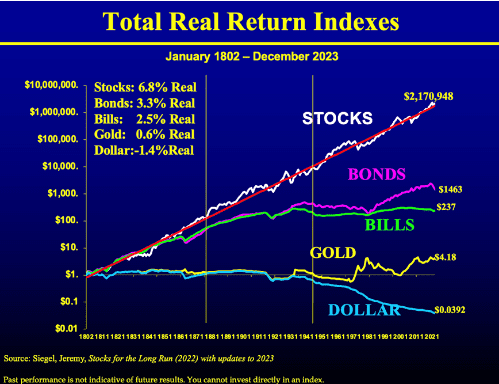
Understanding the Total Real Return Indexes Chart: This chart illustrates the historical real returns of major asset classes from 1802 to 2023, adjusted for inflation. Each asset class is represented by a distinct dataset or index, as described below:
- Stocks: Based on historical data of U.S. equities, reflecting reinvested dividends and inflation adjustments.
- Bonds: Represents long-term U.S. government bonds, including interest payments reinvested and adjusted for inflation.
- Bills: Reflects short-term U.S. Treasury bills, known for their safety and liquidity, adjusted for inflation.
- Gold: Shows gold’s inflation-adjusted historical price changes.
- Dollar: Illustrates the erosion of the U.S. dollar’s purchasing power over time due to inflation, based on CPI data.
All returns are hypothetical, historical, and not indicative of future performance. Taxes, fees, and trading costs are excluded from these calculations. Past performance does not guarantee future results. One cannot directly invest into an index. The real return averages shown are based on historical data and should not be used to predict future performance, as market conditions and economic factors differ significantly over time.While stocks are undoubtedly the most volatile asset on a day to day or year to year basis, when zoomed out over the long-term, they had remarkable stability in providing a hedge against inflation. While the U.S. dollar lost 25 times its purchasing power ($1 from 1802 buys less than 4 cents of goods today), $1 invested in stocks grew at over 6.8% per year after inflation for the next 200 plus years.We talk about how the forward returns to both stocks and bonds are likely to be below the averages Siegel cites. The current inflation adjusted bond yields are just over 2%, while bonds historically returned 3.5% per year after inflation over the last 200-years. Stock valuations – notably the P/E ratio (see definitions below) is higher than it was historically. Instead of selling around 16 times earnings (a 6.5% earnings yield), now stocks are selling over 21x forward earnings – a sub 5% earnings yield. This means, to us, that stocks are priced for lower real returns – but at a healthy cushion above those inflation adjusted TIPS bonds.How to Allocate to Stocks Professor Siegel has long been an advocate of diversified index tracking funds to get exposure to the market. The SPIVA 2023 scorecard highlights a telling trend: over the past decade, a mere fraction, less than 13%, of U.S. large-cap funds have managed to surpass the S&P 500’s performance.2In WisdomTree Prime, we have made a series of funds available to provide exposure to equities to participate in the long-term equity market growth that Siegel espouses. We started providing solutions for both beta, which refers to broad market exposure that tracks the overall risk and return of a market index like the S&P 500. Beta represents how a fund's performance moves in relation to the market as a whole, allowing investors to capture general market trends. Additionally, we offer factor-tilted representations that focus on more valuation-sensitive factors for those seeking potential outperformance through targeted investment strategies.Market Exposures (‘Beta instruments’) SPXUX:WisdomTree 500 Digital FundThe WisdomTree 500 Index is designed to give you access to the largest 500 U.S. companies, weighted by market capitalization. This index mirrors the performance of major companies in the U.S. economy, from tech giants to retail leaders, giving you broad exposure to the U.S. stock market. It’s a cost-effective way to invest in some of the biggest and most stable companies in the country, making it ideal for investors seeking long-term growth through a diversified portfolio.Why SPXUX?
- Designed to track the performance of the WisdomTree 500 Index.
- Provides cost-effective access to the 500 largest companies domiciled and listed in the U.S.
TECHX:WisdomTree Technology & Innovation 100 Digital FundThe WisdomTree Technology and Innovation Index focuses on U.S. companies that are at the forefront of technological advancements and innovation. Unlike some indices that use exchange listings as a filter (like the Nasdaq), this index is designed to capture companies benefiting from cutting-edge technologies, regardless of where they are listed. It provides exposure to a broad array of technology companies, from established giants to newer innovators, allowing investors to participate in the rapid growth of the tech sector.Why TECHX?
- Designed to track the performance of the WisdomTree Technology and Innovation 100 Index.
- Provides cost-effective access to the U.S. exchange-listed companies that benefit from technological advances and innovation.
- It has a 0.10% expense ratio and only a $25 minimum to invest. Brokerage commissions are expected to apply on all purchase and sell orders of Fund shares.
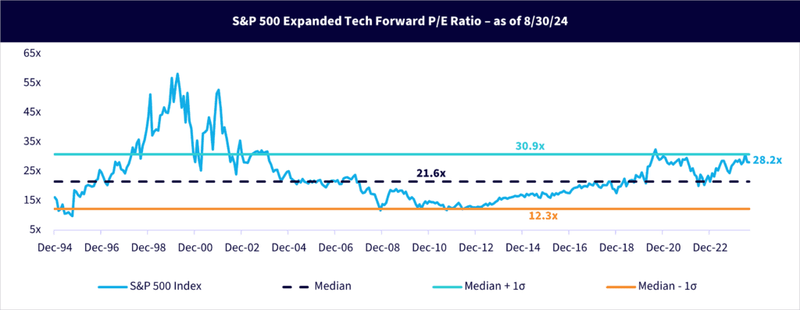
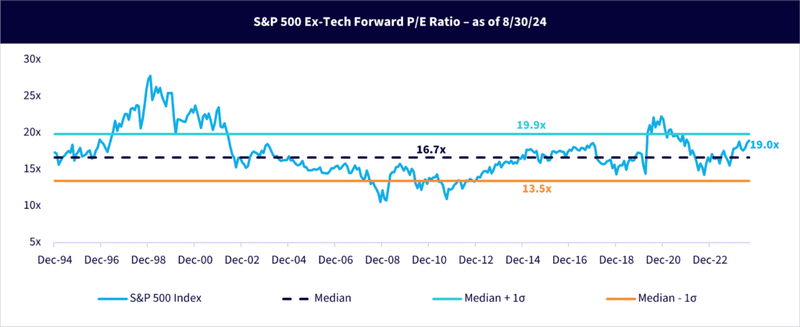
If there is a concern about the technology sector in 2024, it is that these stocks are priced well above their long-term averages. In the WisdomTree daily dashboard, we show the forward P/E (see definitions below) of the S&P 500 expanded tech sector had a median of 21x over the last 30-years, but today’s forward P/E is approaching 30x.A number of investors make a comparison between tech stocks in 2000 and these levels. We point out that in 2000, this tech sector composite had a P/E ratio twice as high as current levels—so we are nowhere near those levels. But with the non-tech sector selling for just 18 times earnings, there are lower valuation segments of the market available.
Past performance does not guarantee future results. One cannot directly invest into an index.Global Stocks for the Long RunSome of Professor Siegel’s long-term research has emphasized the importance of value stocks and dividends and the dangers of just focusing on growth at all costs. He also believes in the principles of global diversification, as many of the stocks in foreign markets are selling for much lower multiples than U.S. stocks. Yes, the U.S. delivers some of the world’s most innovative technologies and companies. But if a foreign market is selling at a 50% discount to the U.S. like many European companies are, perhaps they can offer good long-term returns still. These principles are factored into building the WisdomTree Global Equity Digital Fund that is available in WisdomTree Prime.EQTYX:WisdomTree Siegel Global Equity Digital FundThe WisdomTree Siegel Global Equity Digital Fund seeks long-term capital appreciation utilizing an asset allocation strategy by predominantly investing in exchange traded funds, including a significant portion of WisdomTree ETFs. EQTYX invests at least 80% of its net assets, plus the amount of any borrowings for investment purposes, in equity investments (including U.S. and international, and may include emerging markets). The Fund's asset allocation is constructed by the Fund's adviser, WisdomTree Digital Management, Inc. and implemented by a sub-adviser.The Fund leverages insights from Professor Jeremy J. Siegel, Senior Economist to WisdomTree and Emeritus Professor of Finance at The Wharton School of the University of Pennsylvania. Professor Siegel does not have any day-to-day responsibility with respect to the fund.Why EQTYX?
- The fund provides diversified exposure to US and international stocks and tilts towards factors such as dividend yield and low valuation ratios to seek higher income generation and outperformance potential.
- The Fund has a 0.43% expense ratio and only a $25 minimum to invest. Brokerage commissions are expected to apply on all purchase and sell orders of Fund shares.
ConclusionI have worked with Jeremy Siegel for the last 23 years. It is exciting that WisdomTree Prime has found ways to incorporate some of his best ideas into exposures in the app – both from including low cost, broad market index instruments like we have for the large cap 500 and the technology and innovation 100, as well as a family of funds tied to Siegel’s research on value investing and long-term global equity factors. We encourage you to learn more about each of these Digital Funds.PRODUCTS AND SERVICES AVAILABLE VIA WisdomTree PRIME: NOT FDIC INSURED | NO BANK GUARANTEE | NOT A BANK DEPOSIT | MAY LOSE VALUE | NOT SIPC PROTECTED | NOT INSURED BY ANY GOVERNMENT AGENCY The WisdomTree Prime digital wallet and digital asset services are made available through WisdomTree Digital Movement, Inc., a federally registered money services business, state-licensed money transmitter and financial technology company (NMLS ID: 2372500) or WisdomTree Digital Trust Company, LLC, in select U.S. jurisdictions and may be limited where prohibited by law. WisdomTree Digital Trust Company, LLC is chartered as a limited purpose trust company by the New York State Department of Financial Services to engage in virtual currency business. The products and services available through the WisdomTree Prime app are not endorsed, indemnified or guaranteed by any regulatory agency. There are risks associated with investing, including possible loss of principal. Because the Funds are new, they have limited performance history. Investments focused in a particular sector, such as technology, are subject to greater risk, and are more greatly impacted by market volatility, than more diversified investments. Companies that are capitalizing on innovation and developing technologies to displace older technologies or create new markets may not be successful. U.S. Treasury obligations may provide relatively lower returns than those of other securities. Changes to the financial condition or credit rating of the U.S. government may cause the value to decline. Securities with floating rates can be less sensitive to interest rate changes than securities with fixed interest rates, but may decline in value and negatively impact the Fund’s NAV, particularly if changes in prevailing interest rates are more frequent or sudden than the rate changes for floating rates notes, which can only occur periodically. Fixed income securities are subject interest rate, credit, inflation, and reinvestment risks. Generally, as interest rates rise, the value of fixed-income securities falls. Risk specific to EQTYX - The Fund’s investment performance and risks will be directly related to the investment performance and risks of underlying funds, which are exchange traded funds that the Fund invests in, such as: securities that pay dividends, as a group, may be out of favor with the market and underperform the overall equity market or stocks of companies that do not pay dividends. Investments in non-U.S. securities involve political, regulatory, and economic risks that may not be present in U.S. securities. These and other factors can make investments in the Fund more volatile and potentially less liquid than other types of investments and may be heightened in connection with investments in developing or emerging markets countries. The Fund focusing its investments on certain sectors increases its vulnerability to any single economic or regulatory development, which may result in greater share price volatility. The Fund is actively managed using proprietary investment strategies and processes. There can be no guarantee that these strategies and processes will be successful or that the Fund will achieve its investment objective.Investors should carefully consider the investment objectives, risks, charges and expenses of the Fund before investing. To obtain a prospectus containing this and other important information, visit WisdomTree.com/investments. Read it carefully. Blockchain technology is a relatively new and untested technology, with little regulation. Potential risks include vulnerability to fraud, theft, or inaccessibility, and future regulatory developments affect its viability. Cybersecurity attacks affecting third-party service providers, App, blockchain network, or assets may subject the products and services available in the App to many of the same risks associated with direct cybersecurity breaches. WisdomTree Digital Funds are distributed by WisdomTree Securities, Inc., Member FINRA.FINRA’s BrokerCheck – check the background of this firm or your investment professional on FINRA’s BrokerCheck. The WisdomTree Prime Visa Debit Card is issued by Stride Bank, N.A. Member FDIC, pursuant to a license from Visa USA Inc. Applicable taxes may apply in connection with each transaction made using the WisdomTree Prime Visa Debit Card. To the extent a Debit Card holder selects the Fund as the funding mechanism for a Debit Card transaction and thereafter uses the Debit Card for a transaction, the Debit Card holder, as a Fund investor, is authorizing (instructing) the redemption of Fund shares for the equivalent U.S. Dollar amount sufficient to fund the Debit Card transaction in U.S. Dollars at settlement, and any related fees and charges per applicable account and user agreements, and the transfer of such funds as necessary for Debit Card transaction settlement. References to “save” generally refers to a user’s ability to select one or more highly liquid, relatively low risk cash management solutions and references to “spend” generally refers to a user’s ability to designate one or more digital asset(s) and/or other assets to be sold, or to sell one or more digital asset(s) with near instant settlement, to fund a debit card purchase. Spending, paying bills and making purchases will require actions to be taken in the discretion of the user which require user actions outside of the domain or functionality of the app and which rely on third parties for which the user will need to have a separate relationship. Certain Products (including Digital Funds) and Services are made available through third parties, including affiliates of WisdomTree Digital in the case of Digital Funds.Definitions:What Is the Price-to-Earnings (P/E) Ratio? The price-to-earnings (P/E) ratio measures a company's share price relative to its earnings per share (EPS). Often called the price or earnings multiple, the P/E ratio helps assess the relative value of a company's stock. It's handy for comparing a company's valuation against its historical performance, against other firms within its industry, or the overall market. What is Forward P/E Ratio? The Forward P/E ratio is similar to the traditional P/E ratio but uses projected earnings instead of historical earnings. This metric helps investors gauge the valuation of a company based on its estimated future earnings, typically over the next 12 months. The Forward P/E ratio is useful for comparing current stock prices to expected future earnings, providing insights into growth expectations and how the market is pricing future performance.
Categories
Perspectives in Onchain Finance
View all

About the contributor

Jeremy Schwartz, CFA
Global Chief Investment Officer
Jeremy Schwartz has served as Global Chief Investment Officer since November 2021 and leads WisdomTree’s investment strategy team in the construction of WisdomTree’s equity Indexes, quantitative active strategies and multi-asset Model Portfolios. Jeremy joined WisdomTree in May 2005 as a Senior Analyst, adding Deputy Director of Research to his responsibilities in February 2007. He served as Director of Research from October 2008 to October 2018 and as Global Head of Research from November 2018 to November 2021. Before joining WisdomTree, he was a head research assistant for Professor Jeremy Siegel and, in 2022, became his co-author on the sixth edition of the book Stocks for the Long Run. Jeremy is also co-author of the Financial Analysts Journal paper “What Happened to the Original Stocks in the S&P 500?” He received his B.S. in economics from The Wharton School of the University of Pennsylvania and hosts the Behind the Markets podcast. Jeremy is a member of the CFA Society of Philadelphia.
Thought Leaders

Alice Liu
Senior Associate, Cryptocurrency Investments, WisdomTree Europe

Andrew Okrongly, CFA
Director, Model Portfolios

Blake Heimann
Associate Director, Quantitative Research

Christopher Gannatti, CFA
Global Head of Research

Chris Ryder
Head of WisdomTree Transfers

Dovile Silenskyte
Director, Digital Assets Research

Jason Guthrie
Director of Capital Markets, WisdomTree Europe

Jeff Weniger, CFA
Head of Equity Strategy

Jeremy J. Siegel
WisdomTree Senior Economist

Jeremy Schwartz, CFA
Global Chief Investment Officer

Kevin Flanagan
Head of Investment and Fixed Income Strategy

Mobeen Tahir
Director, Macroeconomics and Thematic Research

Nitesh Shah
Head of Commodities and Macroeconomic Research, WisdomTree Europe

Pierre Debru
Head of Research, Europe

Rick Harper
Chief Investment Officer, Fixed Income and Model Portfolios

Rohan Ranadive
Chief Risk Officer, WisdomTree Digital Assets

Samuel Rines
Macro Strategist, Model Portfolios

Vinh Tran
Associate Director, Business Development, Digital Assets

Will Peck
Head of WisdomTree Onchain

WisdomTree Onchain
Contributor
Alice Liu
Senior Associate, Cryptocurrency Investments, WisdomTree Europe
Andrew Okrongly, CFA
Director, Model Portfolios
Blake Heimann
Associate Director, Quantitative Research
Christopher Gannatti, CFA
Global Head of Research
Chris Ryder
Head of WisdomTree Transfers
Dovile Silenskyte
Director, Digital Assets Research
Jason Guthrie
Director of Capital Markets, WisdomTree Europe
Jeff Weniger, CFA
Head of Equity Strategy
Jeremy J. Siegel
WisdomTree Senior Economist
Jeremy Schwartz, CFA
Global Chief Investment Officer
Kevin Flanagan
Head of Investment and Fixed Income Strategy
Mobeen Tahir
Director, Macroeconomics and Thematic Research
Nitesh Shah
Head of Commodities and Macroeconomic Research, WisdomTree Europe
Pierre Debru
Head of Research, Europe
Rick Harper
Chief Investment Officer, Fixed Income and Model Portfolios
Rohan Ranadive
Chief Risk Officer, WisdomTree Digital Assets
Samuel Rines
Macro Strategist, Model Portfolios
Vinh Tran
Associate Director, Business Development, Digital Assets
Will Peck
Head of WisdomTree Onchain
WisdomTree Onchain
Contributor