


Jeremy Schwartz, CFA
Global Chief Investment Officer
It is now prime time for WisdomTree Prime as the core functionality for the innovative wallet has been released. There is a lot of excitement about the promises of blockchain technology and what it can do for the future of financial infrastructure rails, but the future is now and this wallet highlights a number of transformational use cases.Let’s review the initial list of asset exposures WisdomTree curated for this app. This first blog will start with the use cases for the fixed income and U.S. Treasury funds and in a future blog we’ll discuss other assets like crypto, gold, and equities. Save-Spend-InvestWisdomTree Prime can transform how you save, spend, and invest. Most checking accounts don’t pay interest or pay close to zero interest rates.There has been a flight to money market funds and certificates of deposit to capture higher rates, yet still consumers may leave too much money in the bank accounts potentially earning nothing. One of the core functionalities being built in WisdomTree Prime is the ability to spend from Digital Assets and Digital Funds and we launched a full suite of U.S. Treasury funds that allow you to pick the maturity profile to denominate spending from. Some investors will opt to allocate to and then spend from the WisdomTree Government Money Market Digital Fund (WTGXX). This fund is designed to give investors a stable $1 net asset value (NAV) like other money market funds that earn interest. But connecting regular spending functionality to assets like this is a major innovation. Why WTGXX?
- Provide investors a high level of current income consistent with the preservation of capital and liquidity and the maintenance of a stable net asset value through investments in short-term government securities
- It has a 0.25% expense ratio and only a $1 minimum to invest.
In addition to the money market fund with a stable $1.00 net asset value, we also launched a further suite of government treasury funds with various maturities from the shortest duration Treasuries (those with a floating rate and 1-week duration) up to the Long-term treasuries with a duration of 16.5.Yield Curve ChoicesCurrently the U.S. Treasury yield curve is inverted, which means shorter maturities offer higher yields than longer duration securities. Usually, the reverse is true. We update an image of this yield curve on page 2 of our Daily Dashboard that readers can follow along on a daily basis with how the curve changes.
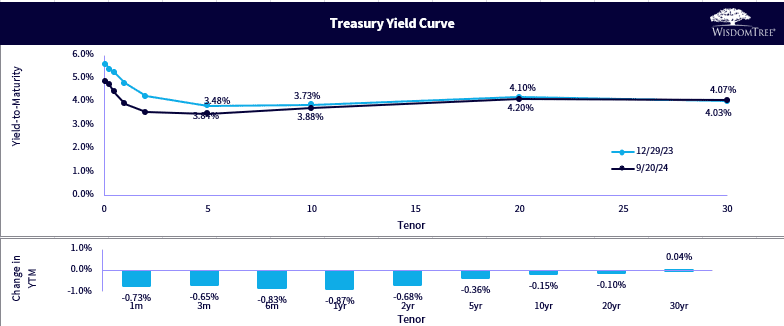
Source: WisdomTree, Federal Reserve Economic Data as of 9/20/2024In a more normal market environment and over the longer-run, our Senior Economist Jeremy Siegel believes the neutral Federal Funds rate is approximately 3.5%. This rate combines a neutral real interest rate when the Federal Reserve is neither too accommodative nor restrictive with monetary policy and adds the Fed’s 2% inflation target. Professor Siegel also expects an upward sloping yield curve to revert so longer-end maturities would offer approximately 50-75 basis points more yield than short term maturities.WisdomTree wanted to offer the full range of maturities of U.S. Treasury bonds available in the Prime wallet, with a particular focus to improve upon traditional spending functionality and allow consumers to incorporate a variety of assets with income streams to spend off of. The below visual illustrates the 4 particular U.S. Treasury fund duration profiles that are currently available – with the idea of providing the most common points along the Treasury curve investors might desire.
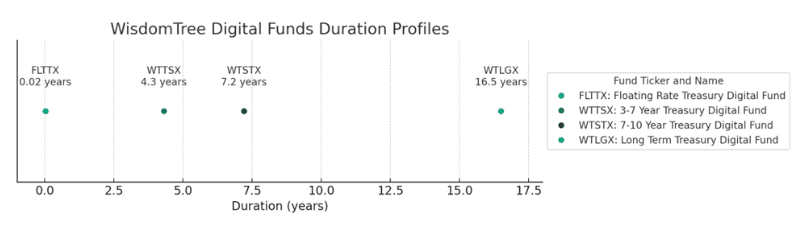
Data as of 7/31/2024How to use: while the current interest rate environment means that the shortest floating rate treasury instruments have the highest yield today, investors cannot guarantee these rates will stay where they are. The inverted yield curve implies investors expect rates from the Federal Reserve to ultimately come down. Investors often buy longer duration bonds if they view the economy is entering a recession and think interest rates will decline or just want a balance to other risks in their portfolios.Bonds, but with “inflation protection”One of the primary risks to bond investments is inflation and the U.S. government offered inflation adjusted bonds referred to as Treasury inflation protected securities (TIPS) to provide a new tool for investors to hedge their inflation risks. These bonds get adjustments every year tied to the CPI but it means the interest rates offered on those securities must be lower.The duration of our TIPS basket in the WisdomTree TIPS Digital Fund (TIPSX) is currently 6.5 years as of 7/31/2024.You can see a visual of the TIPS yields and how they compare to nominal yields also in the Daily dashboard referenced earlier. There was a time recently the 10-year TIPS yields went negative—which was suggesting investors were willing to loan the U.S. government $100 and accept less than $90 of purchasing power 10-years later. That was an extreme form of risk aversion reflected in that market pricing. Now with TIPS providing around 1.5% yields for both the 5-year and 10-year TIPS, there is more appropriate compensation from a real yield perspective in the market.
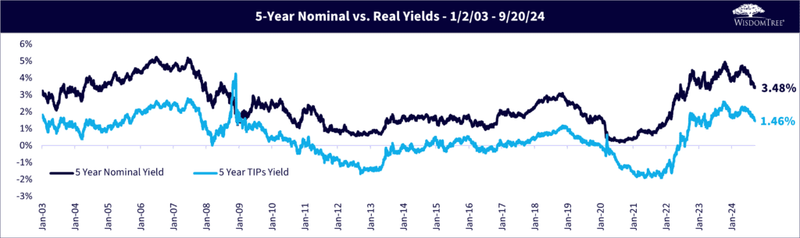
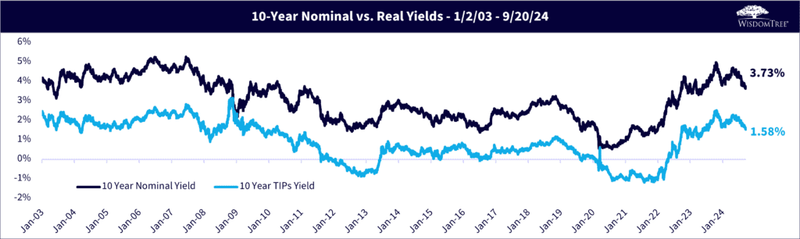
When you compare the TIPS yields vs nominal yields, you get a sense what the market expects for inflation. There is a breakeven inflation rate where would have been better to buy the nominal bond vs TIPS bonds and this dashboard above can help you see the trend in these two rates on a daily basis.Why TIPSX?
- Designed to track the performance, before fees and expenses, of the Solactive U.S. Treasury Inflation-Linked Bond Index.
- Provides cost-effective access to the inflation protected obligations of the U.S. Treasury.
- It has a .05% expense ratio and only a $25 minimum to invest. Brokerage commissions are expected to apply on all purchase and sell orders of Fund shares.
ConclusionThis blog focused on one of the transformational use cases of WisdomTree Prime—which is that consumers can choose a variety of different fixed income Digital Funds to invest in, but at same time, connecting spending to these funds. This is a transformational story for the traditional spending that comes with checking accounts that pay zero interest rates.There are a variety of considerations about where along this interest rate curve you want to invest based on your view of Fed policy and the economy. But these tools allow you to earn more income off your spending accounts and that is a big win no matter your view of the path for interest rates.PRODUCTS AND SERVICES AVAILABLE VIA WisdomTree PRIME: NOT FDIC INSURED | NO BANK GUARANTEE | NOT A BANK DEPOSIT | MAY LOSE VALUE | NOT SIPC PROTECTED | NOT INSURED BY ANY GOVERNMENT AGENCY The WisdomTree Prime digital wallet and digital asset services are made available through WisdomTree Digital Movement, Inc., a federally registered money services business, state-licensed money transmitter and financial technology company (NMLS ID: 2372500) or WisdomTree Digital Trust Company, LLC, in select U.S. jurisdictions and may be limited where prohibited by law. WisdomTree Digital Trust Company, LLC is chartered as a limited purpose trust company by the New York State Department of Financial Services to engage in virtual currency business. The products and services available through the WisdomTree Prime app are not endorsed, indemnified or guaranteed by any regulatory agency.There are risks associated with investing, including possible loss of principal. Because the Funds are new, they have limited performance history. U.S. Treasury obligations may provide relatively lower returns than those of other securities. Changes to the financial condition or credit rating of the U.S. government may cause the value to decline. Securities with floating rates can be less sensitive to interest rate changes than securities with fixed interest rates, but may decline in value and negatively impact the Fund’s NAV, particularly if changes in prevailing interest rates are more frequent or sudden than the rate changes for floating rates notes, which can only occur periodically. Fixed income securities are subject interest rate, credit, inflation, and reinvestment risks. Generally, as interest rates rise, the value of fixed-income securities falls. The WisdomTree Government Money Market Digital Fund’s (the “Fund”) yield may be affected by changes in interest rates and changes in credit ratings. The 7-Day Yield is based on the average income return over the previous seven days, assuming the rate stays the same for one year. You could lose money by investing in the Money Market Fund. Although the Fund seeks to preserve the value of your investment at $1.00 per share, it cannot guarantee it will do so. An investment in the Fund is not a bank account and is not insured or guaranteed by the Federal Deposit Insurance Corporation or any other government agency. The Fund’s advisor is not required to reimburse the Fund for losses, and you should not expect that the advisor will provide financial support to the Fund at any time, including during periods of market stress. Investors should carefully consider the investment objectives, risks, charges and expenses of the Fund before investing. To obtain a prospectus containing this and other important information, visit WisdomTree.com/investments. Read it carefully. Blockchain technology is a relatively new and untested technology, with little regulation. Potential risks include vulnerability to fraud, theft, or inaccessibility, and future regulatory developments affect its viability. Cybersecurity attacks affecting third-party service providers, App, blockchain network, or assets may subject the products and services available in the App to many of the same risks associated with direct cybersecurity breaches. WisdomTree Digital Funds are distributed by WisdomTree Securities, Inc., Member FINRA.FINRA’s BrokerCheck – check the background of this firm or your investment professional on FINRA’s BrokerCheck. The WisdomTree Prime Visa Debit Card is issued by Stride Bank, N.A. Member FDIC, pursuant to a license from Visa USA Inc. Applicable taxes may apply in connection with each transaction made using the WisdomTree Prime Visa Debit Card. To the extent a Debit Card holder selects the Fund as the funding mechanism for a Debit Card transaction and thereafter uses the Debit Card for a transaction, the Debit Card holder, as a Fund investor, is authorizing (instructing) the redemption of Fund shares for the equivalent U.S. Dollar amount sufficient to fund the Debit Card transaction in U.S. Dollars at settlement, and any related fees and charges per applicable account and user agreements, and the transfer of such funds as necessary for Debit Card transaction settlement. Duration - A measure of a bond’s sensitivity to changes in interest rates. Yield to maturity (YTM) - is the overall interest rate earned by an investor who buys a bond at the market price and holds it until maturity.References to “save” generally refers to a user’s ability to select one or more highly liquid, relatively low risk cash management solutions and references to “spend” generally refers to a user’s ability to designate one or more digital asset(s) and/or other assets to be sold, or to sell one or more digital asset(s) with near instant settlement, to fund a debit card purchase. Spending, paying bills and making purchases will require actions to be taken in the discretion of the user which require user actions outside of the domain or functionality of the app and which rely on third parties for which the user will need to have a separate relationship. Certain Products (including Digital Funds) and Services are made available through third parties, including affiliates of WisdomTree Digital in the case of Digital Funds.
Categories
Perspectives in Onchain Finance
View all

About the contributor

Jeremy Schwartz, CFA
Global Chief Investment Officer
Jeremy Schwartz has served as Global Chief Investment Officer since November 2021 and leads WisdomTree’s investment strategy team in the construction of WisdomTree’s equity Indexes, quantitative active strategies and multi-asset Model Portfolios. Jeremy joined WisdomTree in May 2005 as a Senior Analyst, adding Deputy Director of Research to his responsibilities in February 2007. He served as Director of Research from October 2008 to October 2018 and as Global Head of Research from November 2018 to November 2021. Before joining WisdomTree, he was a head research assistant for Professor Jeremy Siegel and, in 2022, became his co-author on the sixth edition of the book Stocks for the Long Run. Jeremy is also co-author of the Financial Analysts Journal paper “What Happened to the Original Stocks in the S&P 500?” He received his B.S. in economics from The Wharton School of the University of Pennsylvania and hosts the Behind the Markets podcast. Jeremy is a member of the CFA Society of Philadelphia.
Thought Leaders

Alice Liu
Senior Associate, Cryptocurrency Investments, WisdomTree Europe

Andrew Okrongly, CFA
Director, Model Portfolios

Blake Heimann
Associate Director, Quantitative Research

Christopher Gannatti, CFA
Global Head of Research

Chris Ryder
Head of WisdomTree Transfers

Dovile Silenskyte
Director, Digital Assets Research

Jason Guthrie
Director of Capital Markets, WisdomTree Europe

Jeff Weniger, CFA
Head of Equity Strategy

Jeremy J. Siegel
WisdomTree Senior Economist

Jeremy Schwartz, CFA
Global Chief Investment Officer

Kevin Flanagan
Head of Investment and Fixed Income Strategy

Mobeen Tahir
Director, Macroeconomics and Thematic Research

Nitesh Shah
Head of Commodities and Macroeconomic Research, WisdomTree Europe

Pierre Debru
Head of Research, Europe

Rick Harper
Chief Investment Officer, Fixed Income and Model Portfolios

Rohan Ranadive
Chief Risk Officer, WisdomTree Digital Assets

Samuel Rines
Macro Strategist, Model Portfolios

Vinh Tran
Associate Director, Business Development, Digital Assets

Will Peck
Head of WisdomTree Onchain

WisdomTree Onchain
Contributor
Alice Liu
Senior Associate, Cryptocurrency Investments, WisdomTree Europe
Andrew Okrongly, CFA
Director, Model Portfolios
Blake Heimann
Associate Director, Quantitative Research
Christopher Gannatti, CFA
Global Head of Research
Chris Ryder
Head of WisdomTree Transfers
Dovile Silenskyte
Director, Digital Assets Research
Jason Guthrie
Director of Capital Markets, WisdomTree Europe
Jeff Weniger, CFA
Head of Equity Strategy
Jeremy J. Siegel
WisdomTree Senior Economist
Jeremy Schwartz, CFA
Global Chief Investment Officer
Kevin Flanagan
Head of Investment and Fixed Income Strategy
Mobeen Tahir
Director, Macroeconomics and Thematic Research
Nitesh Shah
Head of Commodities and Macroeconomic Research, WisdomTree Europe
Pierre Debru
Head of Research, Europe
Rick Harper
Chief Investment Officer, Fixed Income and Model Portfolios
Rohan Ranadive
Chief Risk Officer, WisdomTree Digital Assets
Samuel Rines
Macro Strategist, Model Portfolios
Vinh Tran
Associate Director, Business Development, Digital Assets
Will Peck
Head of WisdomTree Onchain
WisdomTree Onchain
Contributor
Alice Liu
Senior Associate, Cryptocurrency Investments, WisdomTree Europe
Andrew Okrongly, CFA
Director, Model Portfolios
Blake Heimann
Associate Director, Quantitative Research
Christopher Gannatti, CFA
Global Head of Research
Chris Ryder
Head of WisdomTree Transfers
Dovile Silenskyte
Director, Digital Assets Research
Jason Guthrie
Director of Capital Markets, WisdomTree Europe
Jeff Weniger, CFA
Head of Equity Strategy
Jeremy J. Siegel
WisdomTree Senior Economist
Jeremy Schwartz, CFA
Global Chief Investment Officer
Kevin Flanagan
Head of Investment and Fixed Income Strategy
Mobeen Tahir
Director, Macroeconomics and Thematic Research
Nitesh Shah
Head of Commodities and Macroeconomic Research, WisdomTree Europe
Pierre Debru
Head of Research, Europe
Rick Harper
Chief Investment Officer, Fixed Income and Model Portfolios
Rohan Ranadive
Chief Risk Officer, WisdomTree Digital Assets
Samuel Rines
Macro Strategist, Model Portfolios
Vinh Tran
Associate Director, Business Development, Digital Assets
Will Peck
Head of WisdomTree Onchain
WisdomTree Onchain
Contributor