


Samuel Rines
Macro Strategist, Model Portfolios
Key Takeaways
- There is the sense that tariffs are going to rile corporate America with the potential to rekindle “excuseflation.”1 But corporate America is not as scary as might be commonly thought.
- Many companies have been reshaping their supply chains over the past several years. And that preparation may pay off.
There is no lack of content regarding tariffs. Everyone seems to have an opinion on the potential consequences. But there is far too little discussion around what companies are actually saying about tariffs. We believe that should be the starting point for any conversation about the potential economic and market impacts.
American Eagle
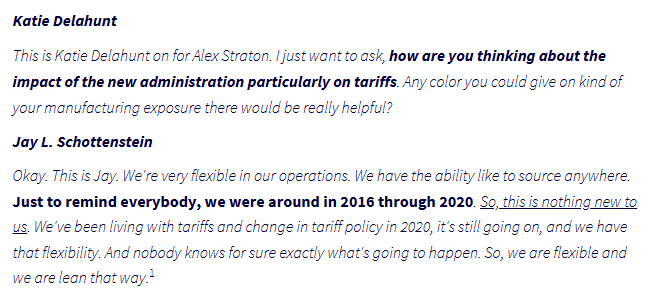
American Eagle may have stated it best. This is not the first go around. Companies navigated the first bout of tariffs and good ones have a game plan. And it is not as though the sourcing headwinds waned in the intervening years. The first Trump Administration was the initial catalyst for a rethinking of supply chains, and the Covid related interruptions accentuated it. In essence, the past several years have hardened parts of the U.S. economy to tariffs.
Lennox International
Newell Brands
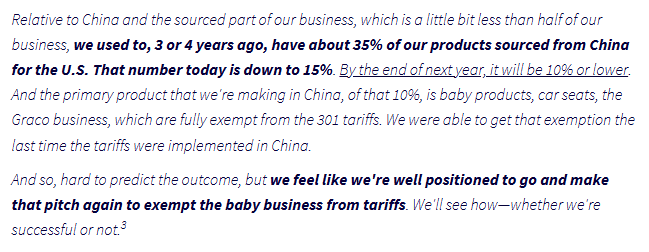
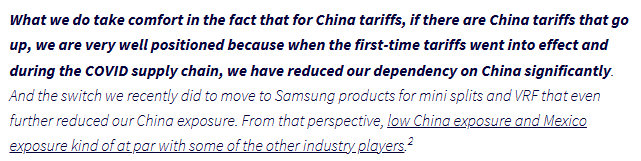
Two very different companies made rather similar statements. Lennox is a maker of air conditioners and the like. And they are almost excited about the potential for tariffs. Why? Because they took the opportunity to rework their supply chain and reduced their exposure to China. Newell Brands said something similar. Not only is their reliance on China significantly lower than previously (from 35% to 15%). But there is also the assumption that baby products will be exempt from the 301 tariffs.
Lands' End
Academy Sports and Outdoors
Ollie's Bargain Bin
When it comes to the question of who is most affected by tariffs, the first companies that come to mind are retailers. This makes sense given the historic buying patterns and the "made in China" tags of the past. The only issue being the "historic" part of that statement. As it turns out, the world has changed a bit since 2016.
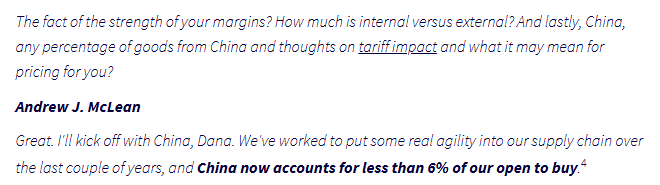
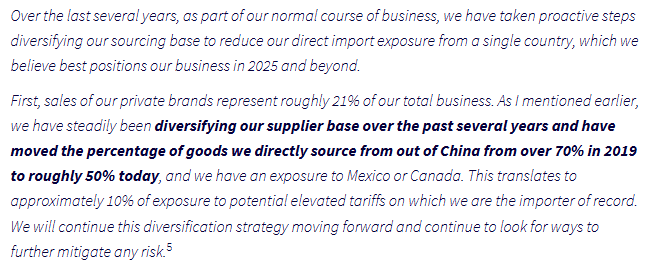
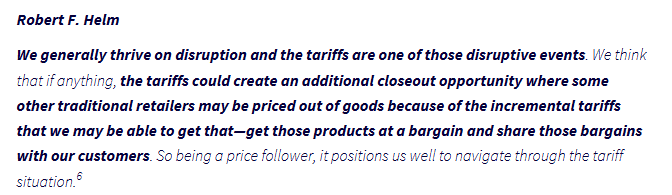
Lands' End—a clothing retailer—only has a 6% exposure to direct China purchases. When it comes to sporting goods, the news is less positive. But still trending in the correct direction. For Academy Sports and Outdoors, the China sourcing has declined from 70% in 2019 to 50% today. The process of diversifying their suppliers continues. On the discount retail front, there is an odd amount of excitement about the prospect for tariffs. Ollie's Bargain Bin sees the disruptions as an opportunity to buy more closeouts at bargain prices and pass the bargains on to consumers. If there is ever something to challenge the narrative of "the consumer will feel the pain," it is how companies have reacted over the past several years to challenges and expect to react this time around.
Tractor Supply
Casey's General Store
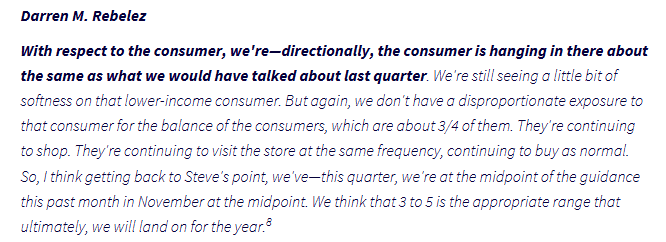
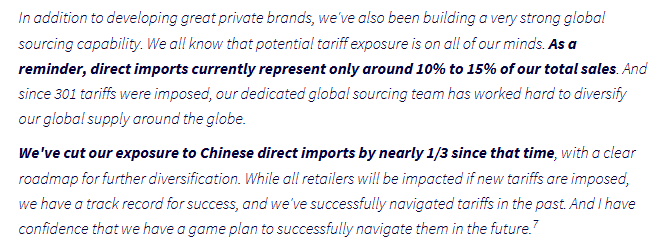
And then there is the ongoing resilience of Middle America. There are few companies that target the Midwest and/or rural areas. Tractor Supply and Casey's General Store are two of them. Tractor Supply only has 10%–15% sales exposure to imported products—not products that might face tariffs—products that are imported. For a retailer, that is a rather small figure. There was not a single mention of tariffs on the Casey's General Store earnings call. That says something on its own, but it was the statements made around the health of the consumer that jumped out. There has been little to no change. Lower income under pressure, everyone else is fine.
What does all of this mean? Maybe the tariff threats and rhetoric are slightly overblown. Certainly, tariffs are not great for businesses. But it is not as though companies are being caught off guard. They have been in this situation before and many learned their lessons and adapted. That should not be underestimated. The idea that inflation could reaccelerate is a reasonable one, but it is not straightforward either (as seen with the Ollie's Bargain Bin statements). Excuseflation—the idea that companies would use tariffs as an excuse to raise prices—may well occur in certain areas. But it may not be across the board. Not to mention, Middle America might not feel the tariff effects as much as anticipated either.
Simply, the potential for tariffs to be disruptive is something to pay close attention to over the coming months. But companies will be affected by tariffs in different ways. For some, it may even be an opportunity.
1 "Excuseflation" is a term used to describe when companies raise prices by taking advantage of one-off disruptions.
2 American Eagle earnings call, 12/10/24 (emphasis added).
3 Lennox International, as of 12/10/24 (emphasis added).
4 Newell Brands, as of 12/10/24 (emphasis added).
5 Lands' End, as of 12/10/24 (emphasis added).
6 Academy Sports and Outdoors, as of 12/10/24 (emphasis added).
7 Ollie's Bargain Bin, as of 12/10/24 (emphasis added).
8 Tractor Supply, as of 12/10/24 (emphasis added).
9 Casey's General Store, as of 12/10/24 (emphasis added).companies are saying (whether positive for their stock prices or negative) will be illuminating—it always is.
Perspectives in Onchain Finance
View all

About the contributor

Samuel Rines
Macro Strategist, Model Portfolios
Samuel Rines is a Macro Strategist at WisdomTree, where he extends the firm's custom model portfolio management capabilities. Before joining WisdomTree in 2024, he was the Managing Director at CORBU, LLC, leading the PolyMacro advisory product. With over a decade of experience in economics and finance, Samuel has held significant roles such as Chief Economist at Avalon Investment & Advisory and Economist and Portfolio Manager at Chilton Capital Management LLC. He is also the author of "After Normal: Making Sense of the Global Economy," and holds a Master’s degree in Economics from the UNH Peter T. Paul College of Business and Economics, as well as having studied Economics at the University of Oxford.
Thought Leaders

Alice Liu
Senior Associate, Cryptocurrency Investments, WisdomTree Europe

Andrew Okrongly, CFA
Director, Model Portfolios

Blake Heimann
Associate Director, Quantitative Research

Christopher Gannatti, CFA
Global Head of Research

Chris Ryder
Head of WisdomTree Transfers

Dovile Silenskyte
Director, Digital Assets Research

Jason Guthrie
Director of Capital Markets, WisdomTree Europe

Jeff Weniger, CFA
Head of Equity Strategy

Jeremy J. Siegel
WisdomTree Senior Economist

Jeremy Schwartz, CFA
Global Chief Investment Officer

Kevin Flanagan
Head of Investment and Fixed Income Strategy

Mobeen Tahir
Director, Macroeconomics and Thematic Research

Nitesh Shah
Head of Commodities and Macroeconomic Research, WisdomTree Europe

Pierre Debru
Head of Research, Europe

Rick Harper
Chief Investment Officer, Fixed Income and Model Portfolios

Rohan Ranadive
Chief Risk Officer, WisdomTree Digital Assets

Samuel Rines
Macro Strategist, Model Portfolios

Vinh Tran
Associate Director, Business Development, Digital Assets

Will Peck
Head of WisdomTree Onchain

WisdomTree Onchain
Contributor
Alice Liu
Senior Associate, Cryptocurrency Investments, WisdomTree Europe
Andrew Okrongly, CFA
Director, Model Portfolios
Blake Heimann
Associate Director, Quantitative Research
Christopher Gannatti, CFA
Global Head of Research
Chris Ryder
Head of WisdomTree Transfers
Dovile Silenskyte
Director, Digital Assets Research
Jason Guthrie
Director of Capital Markets, WisdomTree Europe
Jeff Weniger, CFA
Head of Equity Strategy
Jeremy J. Siegel
WisdomTree Senior Economist
Jeremy Schwartz, CFA
Global Chief Investment Officer
Kevin Flanagan
Head of Investment and Fixed Income Strategy
Mobeen Tahir
Director, Macroeconomics and Thematic Research
Nitesh Shah
Head of Commodities and Macroeconomic Research, WisdomTree Europe
Pierre Debru
Head of Research, Europe
Rick Harper
Chief Investment Officer, Fixed Income and Model Portfolios
Rohan Ranadive
Chief Risk Officer, WisdomTree Digital Assets
Samuel Rines
Macro Strategist, Model Portfolios
Vinh Tran
Associate Director, Business Development, Digital Assets
Will Peck
Head of WisdomTree Onchain
WisdomTree Onchain
Contributor