


Dovile Silenskyte
Director, Digital Assets Research
Key Takeaways
- Institutional adoption is poised to deepen further as bitcoin exchange-traded product (ETP) flows grow and regulatory barriers fall, likely accelerating crypto’s integration into global asset allocation strategies.
- With fiscal expansion and de-dollarisation trends intensifying, bitcoin could increasingly serve as a dual-purpose asset – both a macro hedge and growth play – potentially reaching $250,000 by 2030.
- The next phase of crypto growth will be driven by tokenisation and decentralised finance, opening new frontiers for investors through yield-generating digital assets and real-world blockchain integration.
Crypto markets have entered autumn 2025 with renewed conviction. After a turbulent start to the year – shaped by geopolitics, trade wars, and shifting macro narratives – digital assets are showing signs of durable momentum. Bitcoin remains near its newly set all-time high just above $124,0001, institutional inflows are accelerating, and altcoins with real-world utility are carving out distinct roles.
But beneath the headlines, a more profound transformation is underway. Market structure is maturing, regulatory clarity is emerging, and crypto is embedding itself into the real economy at a scale not seen before. For investors, identifying the structural tailwinds that will shape capital flows and long-term adoption is key.
Here are five forces propelling crypto’s next chapter and their investor implications.
1) Institutional adoption becomes self-reinforcing
Crypto has moved well beyond the fringes of finance. It now sits firmly in the portfolios of sovereigns, asset managers, corporates, and hedge funds.
- Flows into physical bitcoin exchange-traded products (ETPs) exceeded $37 billion over the past year, bringing global assets under management (AUM) to nearly $148 billion2.
- Public companies now own nearly 5% of the circulating bitcoin supply3.
- Hedge fund activity is booming, with bitcoin futures open interest at $45 billion and options open interest at $43 billion4.
Figure 1: Bitcoin futures and options open interest\
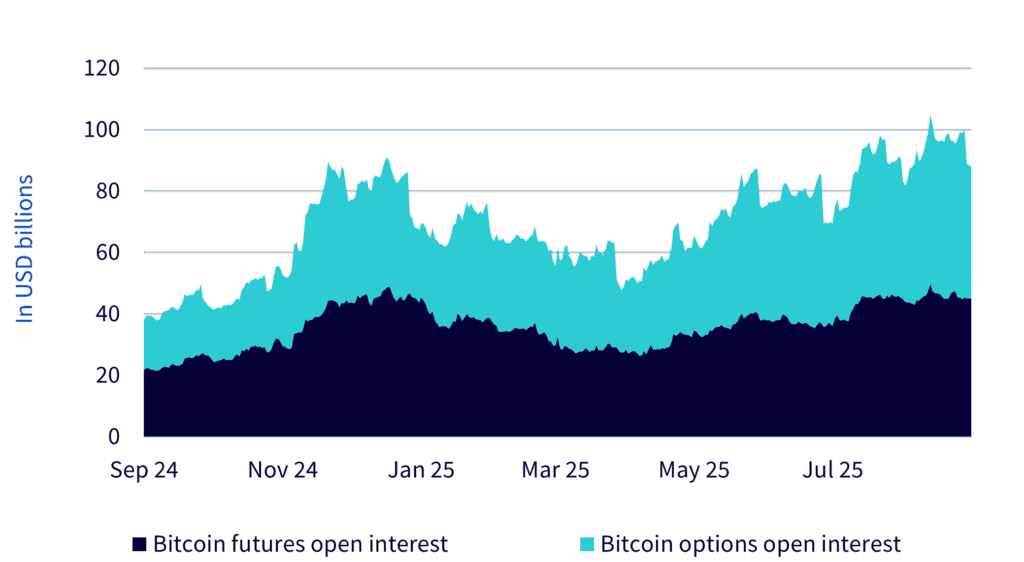
Source: Glassnode. 31 August 2025. Historical performance is not an indication of future performance and any investment may go down in value.
This adoption is creating a momentum loop: as demand grows, access improves; as access improves, adoption broadens. Even the UK’s Financial Conduct Authority (FCA) is opening the door for retail access to Bitcoin ETPs.
Implication for investors: institutional adoption is now a market reality – reshaping liquidity, dampening volatility, and embedding crypto into mainstream allocation. Delays risk entering a more crowded, less asymmetric market later.
2) A supportive macro backdrop for store-of-value assets
Crypto’s resurgence is aligned with broader macro forces.
- US deficit above 6% of gross domestic product (GDP), and national debt above $34 trillion and rising5.
- Congressional Budget Office projects debt-to-GDP ratio climbing toward 156% by 20256.
- Dollar debasement risks grow under expansionary fiscal policy and recurring debt-ceiling standoffs.
- Globally, de-dollarisation is accelerating, with China, Russia, and others settling trade in alternative currencies and accumulating gold.
Against this backdrop, bitcoin’s apolitical, transparent issuance model stands out. Our base-case projects bitcoin could reach $250,000 by 2030 under continued monetary expansion7.
Implication for investors: bitcoin captures both store-of-value flows (like gold) and growth-asset upside (like technology and artificial intelligence). Few assets straddle both narratives as effectively.
3) Altcoins shift from speculation to real economy utility
The days when bitcoin’s rise lifted all altcoins equally are over. Today, investors demand real-world integration.
- Solana has re-emerged as a leading blockchain for everyday users. It supports applications that connect digital incentive with real-world infrastructure (such as wireless or sensor networks), retail-facing applications, and blockchain-based gaming platforms.
- Ethereum remains the backbone for institutional adoption. It underpins more than half of the stablecoins in circulation8 and leads the way in turning traditional assets such as bonds or treasuries into blockchain-based tokens9.
- XRP has become a ready-to-use system for fast, low-cost international payments. With growing adoption, it is increasingly viewed as a practical alternative to the traditional SWIFT10 network for cross-border transfers.
Meanwhile, projects lacking substance are being repriced. Capital is concentrating where adoption is tangible.
Implication for investors: precision matters. Altcoins must be assessed on use-case integration, not as homogenous high-beta bets on bitcoin.
4) Regulatory clarity unlocks institutional flows
After years of uncertainty, 2025 has delivered important regulatory progress:
- US GENIUS11 Act: a new law that sets clear rules for stablecoins (digital tokens linked to traditional currencies). This marks a step toward digital assets becoming part of the mainstream financial system.
- Europe’s MiCA12 regime: now live, creating a single rulebook for the EU covering exchanges, stablecoins, and service providers, which helps bring consistency and predictability for investors.
- Global hubs: various countries – such as the United Arab Emirates (UAE) and Switzerland – are competing to be leaders in crypto by offering regulated environments, secure custody services, and approvals for ETPs.
Implication for investors: regulatory clarity removes the largest barrier to institutional entry. Capital deployment will now accelerate, but selectively.
5) The rise of tokenisation and DeFi 2.0
Crypto’s utility layer is undergoing a renaissance.
Figure 2: Top three blockchains by total value locked
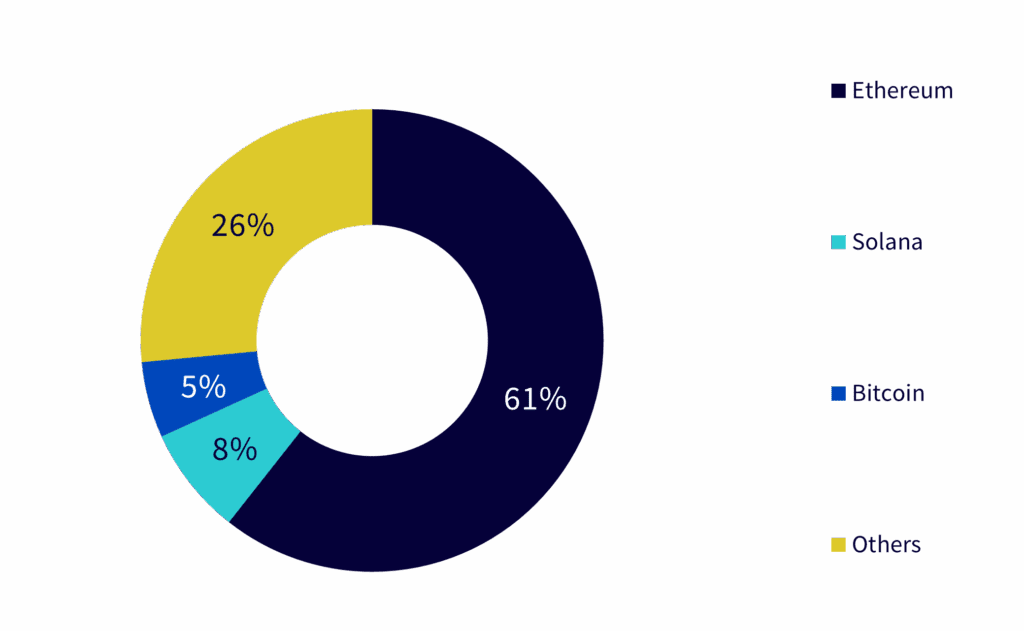
Source: WisdomTree, coingecko. 02 September 2025. Historical performance is not an indication of future performance and any investment may go down in value.
- Decentralised finance (DeFi) has bounced back strongly, with around $150 billion13 now active in lending, trading, and investment pools. These platforms increasingly use regulated structures, identity checks, and permissioned systems to attract mainstream investors.
- A $28 billion market14 of tokenised real-world assets (RWAs) is emerging as bonds, treasuries, private credit, and even commodities are being issued and traded on blockchain. This brings traditional assets into a digital format that can be more easily transferred and programmed.
- Digital tokens pegged to traditional currencies – also known as stablecoins – are acting as a bridge between traditional finance and decentralised finance. They provide the stability and liquidity that allow crypto markets to interact smoothly with banks and payment systems.
Together, these trends mark crypto’s “real economy moment”.
Implication for investors: the investible universe now includes yield-bearing, cashflow-linked instruments. Early allocators to tokenised assets and permissioned decentralised finance could capture new return streams unavailable in legacy markets.
Putting it all together
These five structural tailwinds – spanning institutional adoption, macro support, utility-driven altcoins, regulatory clarity, and tokenisation / DeFi 2.0 – are converging to propel crypto into its most transformative phase to date.
Crypto is evolving well beyond its origins as a hedge or speculative play. It is fast becoming a multi-trillion-dollar cornerstone of the global financial system.
The next decade will not be about whether crypto survives. It will be about how fast it reshapes global finance.
Sources:
1 Source: Artemis Terminal. 02 September 2025.
2 Source: Bloomberg, WisdomTree. 01 September 2025.
3 Source: WisdomTree, Bitcoin Treasuries. 02 September 2025. https://bitbo.io/treasuries/countries/
4 Source: Glassnode. 31 August 2025.
5 Source: Congressional Budget Office. The Long-Term Budget Outlook: 2025 to 2055.
6 Source: Congressional Budget Office. The Long-Term Budget Outlook: 2025 to 2055.
7 Source: WisdomTree. June 2025. Bitcoin and gold: 3 model forecasts for 2030 and beyond
8 Source: Artemis Terminal. 01 August 2025. Refers to stablecoin supply issued on Ethereum-based protocols.
9 Source: rwa.xyz. 02 September 2025.
10 Society for Worldwide Interbank Financial Telecommunication.
11 Guiding and Establishing National Innovation for US Stablecoins.
12 Markets in Crypto-Assets.
13 Source: Coingecko. 02 September 2025.
14 Source: rwa.xyz. 02 September 2025.
Important Risks Related to this Article
Crypto assets, such as bitcoin and ether, are complex, generally exhibit extreme price volatility and unpredictability, and should be viewed as highly speculative assets. Crypto assets are frequently referred to as crypto “currencies,” but they typically operate without central authority or banks, are not backed by any government or issuing entity (i.e., no right of recourse), have no government or insurance protections, are not legal tender and have limited or no usability as compared to fiat currencies. Federal, state or foreign governments may restrict the use, transfer, exchange and value of crypto assets, and regulation in the U.S. and worldwide is still developing. Crypto asset exchanges and/or settlement facilities may stop operating, permanently shut down or experience issues due to security breaches, fraud, insolvency, market manipulation, market surveillance, KYC/AML (know your customer/anti-money laundering) procedures, non-compliance with applicable rules and regulations, technical glitches, hackers, malware or other reasons, which could negatively impact the price of any cryptocurrency traded on such exchanges or reliant on a settlement facility or otherwise may prevent access or use of the crypto asset. Crypto assets can experience unique events, such as forks or airdrops, which can impact the value and functionality of the crypto asset. Crypto asset transactions are generally irreversible, which means that a crypto asset may be unrecoverable in instances where: (i) it is sent to an incorrect address, (ii) the incorrect amount is sent, or (iii) transactions are made fraudulently from an account. A crypto asset may decline in popularity, acceptance or use, thereby impairing its price, and the price of a crypto asset may also be impacted by the transactions of a small number of holders of such crypto asset. Crypto assets may be difficult to value and valuations, even for the same crypto asset, may differ significantly by pricing source or otherwise be suspect due to market fragmentation, illiquidity, volatility and the potential for manipulation. Crypto assets generally rely on blockchain technology and blockchain technology is a relatively new and untested technology which operates as a distributed ledger. Blockchain systems could be subject to internet connectivity disruptions, consensus failures or cybersecurity attacks, and the date or time that you initiate a transaction may be different then when it is recorded on the blockchain. Access to a given blockchain requires an individualized key, which, if compromised, could result in loss due to theft, destruction or inaccessibility. In addition, different crypto assets exhibit different characteristics, use cases and risk profiles. Information provided by WisdomTree regarding digital assets, crypto assets or blockchain networks should not be considered or relied upon as investment or other advice, as a recommendation from WisdomTree, including regarding the use or suitability of any particular digital asset, crypto asset, blockchain network or any particular strategy.
Categories
Perspectives in Onchain Finance
View all

About the contributor

Dovile Silenskyte
Director, Digital Assets Research
Dovile Silenskyte is a director of digital assets research at WisdomTree. Before joining WisdomTree in May 2024, Dovile worked as an index equity product strategist at BlackRock. Currently, she is responsible for conducting analyses for in-house digital assets publications and assisting the sales team with client queries about products and markets. Dovile holds an MSc in Finance from Texas A&M University – Commerce, and she is also a chartered financial analyst (CFA).
Thought Leaders

Alice Liu
Senior Associate, Cryptocurrency Investments, WisdomTree Europe

Andrew Okrongly, CFA
Director, Model Portfolios

Blake Heimann
Associate Director, Quantitative Research

Christopher Gannatti, CFA
Global Head of Research

Chris Ryder
Head of WisdomTree Transfers

Dovile Silenskyte
Director, Digital Assets Research

Jason Guthrie
Director of Capital Markets, WisdomTree Europe

Jeff Weniger, CFA
Head of Equity Strategy

Jeremy J. Siegel
WisdomTree Senior Economist

Jeremy Schwartz, CFA
Global Chief Investment Officer

Kevin Flanagan
Head of Investment and Fixed Income Strategy

Mobeen Tahir
Director, Macroeconomics and Thematic Research

Nitesh Shah
Head of Commodities and Macroeconomic Research, WisdomTree Europe

Pierre Debru
Head of Research, Europe

Rick Harper
Chief Investment Officer, Fixed Income and Model Portfolios

Rohan Ranadive
Chief Risk Officer, WisdomTree Digital Assets

Samuel Rines
Macro Strategist, Model Portfolios

Vinh Tran
Associate Director, Business Development, Digital Assets

Will Peck
Head of WisdomTree Onchain

WisdomTree Onchain
Contributor
Alice Liu
Senior Associate, Cryptocurrency Investments, WisdomTree Europe
Andrew Okrongly, CFA
Director, Model Portfolios
Blake Heimann
Associate Director, Quantitative Research
Christopher Gannatti, CFA
Global Head of Research
Chris Ryder
Head of WisdomTree Transfers
Dovile Silenskyte
Director, Digital Assets Research
Jason Guthrie
Director of Capital Markets, WisdomTree Europe
Jeff Weniger, CFA
Head of Equity Strategy
Jeremy J. Siegel
WisdomTree Senior Economist
Jeremy Schwartz, CFA
Global Chief Investment Officer
Kevin Flanagan
Head of Investment and Fixed Income Strategy
Mobeen Tahir
Director, Macroeconomics and Thematic Research
Nitesh Shah
Head of Commodities and Macroeconomic Research, WisdomTree Europe
Pierre Debru
Head of Research, Europe
Rick Harper
Chief Investment Officer, Fixed Income and Model Portfolios
Rohan Ranadive
Chief Risk Officer, WisdomTree Digital Assets
Samuel Rines
Macro Strategist, Model Portfolios
Vinh Tran
Associate Director, Business Development, Digital Assets
Will Peck
Head of WisdomTree Onchain
WisdomTree Onchain
Contributor