


Dovile Silenskyte
Director, Digital Assets Research
Key Takeaways
- In 2024, the launch of spot bitcoin exchange-traded products (ETPs) significantly deepened market liquidity, signalling a shift toward institutional adoption and improved execution quality in crypto markets.
- Liquidity metrics such as market depth and execution cost now serve as early indicators of crypto market cycles, often forecasting capital inflows or risk aversion before price reacts.
- With Ether/bitcoin (ETH/BTC) liquidity spreads offering insight into investor sentiment shifts, savvy allocators can use these real-time signals to anticipate risk-on versus risk-off rotations in digital assets.
In financial markets, liquidity is often treated as a secondary variable – a derivative of price action, investor sentiment, or macro conditions. In crypto, it is the opposite. Liquidity is not the echo; it is the signal.
As the asset class matures and institutional adoption deepens, liquidity is becoming a barometer for market health, risk appetite, and even macroeconomic turning points. It is no longer just about who is trading—it is about why capital is moving, where risk is being priced, and how the next market cycle might unfold.
Liquidity signals crypto cycles
Traditional markets benefit from deep order books, regulated venues, and a mature set of standardised liquidity metrics. Crypto operates on a different landscape: thinner books, fragmented liquidity pools, and a relentless 24/7 volatility. But this comes with an edge.
Crypto liquidity dynamics are often sharper, more transparent, and arguably more predictive than those in traditional markets. They react faster, offering early signals of capital inflows and outflows.
Two key metrics anchor this liquidity landscape:
Execution cost—slippage and bid-ask spreads, especially on larger trades.
Market depth—how much capital it takes to move the price.
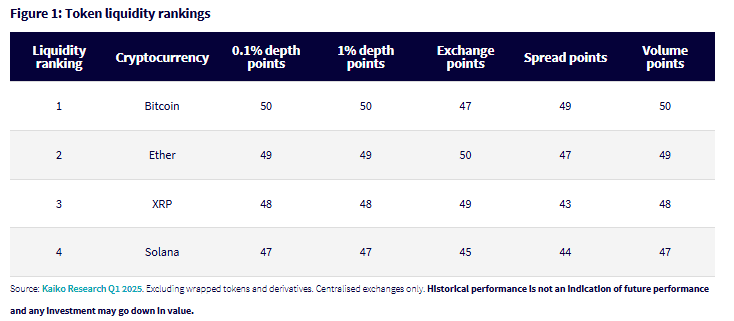
Bitcoin leads the liquidity rankings and scores the highest across depth and volume metrics:
- 0.1% depth: can absorb significant order flow with minimal price impact.
- 1% depth: offers excellent execution and low slippage on large trades.
- Volume: indicates strong, consistent trading activity.
Where could bitcoin improve:
- More listings on regulated venues would boost accessibility (exchange points).
- Narrower spreads would reduce execution costs even further (spread points).
When order books thicken and spreads tighten, that is often the first sign that capital is returning. Conversely, when liquidity dries up, it is the canary in the coal mine—a warning that risk appetite is fading fast.
Liquidity regimes and macro turning points
Crypto liquidity is reflexive. Improved liquidity compresses volatility, attracts institutional allocators, and drives volume—a flywheel that powers rallies. But the same dynamic works in reverse, exacerbating drawdowns and panic.
Consider late 2022. Post-FTX, bitcoin liquidity collapsed—spot depth on major exchanges fell over 50%, hitting levels not seen since 2018. This was not merely a symptom of price declines. It was a leading indicator of capital flight and counterparty distrust.
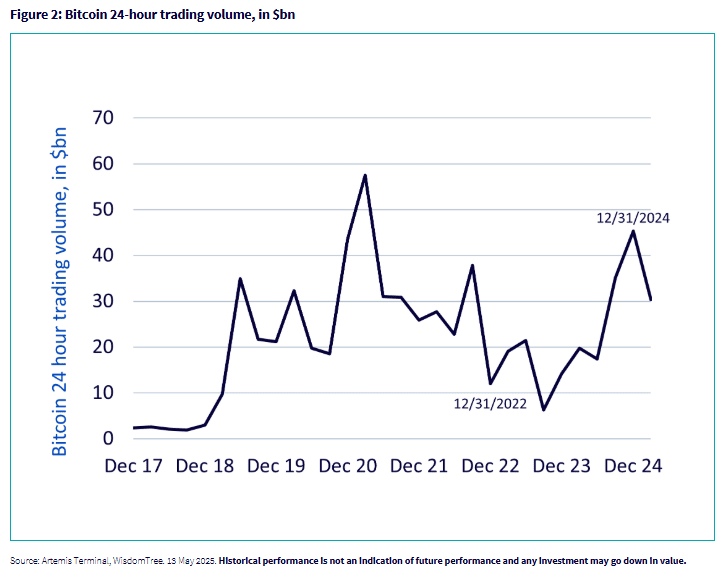
Fast forward to 2024. The US launch of spot bitcoin exchange-traded products (ETPs) changed the game. Inflows drove not only volumes but also deeper books, tighter spreads, and structurally improved market quality. This was not just institutions kicking the tires, this was meaningful capital deployment, visible in real-time through the liquidity lens.
Reading the room through liquidity
ETPs are now critical to the crypto liquidity equation. They are not just products, they are infrastructure. Every inflow into a crypto ETP translates directly into underlying market flows: deepening books, reducing spreads, and lowering friction for everyone else.
This is where liquidity reveals its full analytical power. It provides granular, real-time insight into capital positioning and behavioural shifts that traditional markets struggle to capture.
It tells us:
- Which venues are earning trust through consistent execution quality.
- How much capital is still sidelined versus actively at work.
- Where capital might rotate next, using indicators such as Ether/bitcoin (ETH/BTC) liquidity spreads to signal risk-on/risk-off moves.
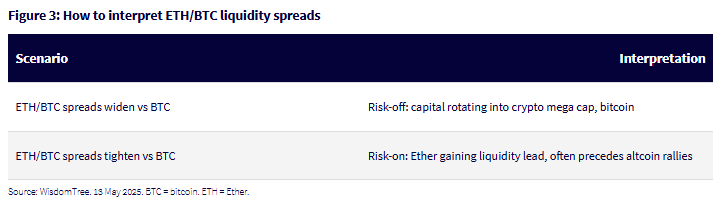
This brings the barometer analogy full circle:
- Spiking crypto ETP inflows? Institutional conviction is rising.
- Tighter spreads on exchanges? Execution risk is falling.
- Improved liquidity in smaller tokens? Risk-on is back.
Liquidity in crypto is not a background condition, it is a leading signal. A behavioural thermometer. A real-time forecast of investor intent.
Key takeaways
In crypto, liquidity does not just follow demand, it defines it. For allocators and active managers, liquidity metrics should be front and centre when assessing market conditions and strategy.
Because in this market, liquidity is not just the barometer. It is the weather forecast. And sometimes, it is the storm warning.
Important Risks Related to this Article
Crypto assets, such as bitcoin and ether, are complex, generally exhibit extreme price volatility and unpredictability, and should be viewed as highly speculative assets. Crypto assets are frequently referred to as crypto “currencies,” but they typically operate without central authority or banks, are not backed by any government or issuing entity (i.e., no right of recourse), have no government or insurance protections, are not legal tender and have limited or no usability as compared to fiat currencies. Federal, state or foreign governments may restrict the use, transfer, exchange and value of crypto assets, and regulation in the U.S. and worldwide is still developing. Crypto asset exchanges and/or settlement facilities may stop operating, permanently shut down or experience issues due to security breaches, fraud, insolvency, market manipulation, market surveillance, KYC/AML (know your customer/anti-money laundering) procedures, non-compliance with applicable rules and regulations, technical glitches, hackers, malware or other reasons, which could negatively impact the price of any cryptocurrency traded on such exchanges or reliant on a settlement facility or otherwise may prevent access or use of the crypto asset. Crypto assets can experience unique events, such as forks or airdrops, which can impact the value and functionality of the crypto asset. Crypto asset transactions are generally irreversible, which means that a crypto asset may be unrecoverable in instances where: (i) it is sent to an incorrect address, (ii) the incorrect amount is sent, or (iii) transactions are made fraudulently from an account. A crypto asset may decline in popularity, acceptance or use, thereby impairing its price, and the price of a crypto asset may also be impacted by the transactions of a small number of holders of such crypto asset. Crypto assets may be difficult to value and valuations, even for the same crypto asset, may differ significantly by pricing source or otherwise be suspect due to market fragmentation, illiquidity, volatility and the potential for manipulation. Crypto assets generally rely on blockchain technology and blockchain technology is a relatively new and untested technology which operates as a distributed ledger. Blockchain systems could be subject to internet connectivity disruptions, consensus failures or cybersecurity attacks, and the date or time that you initiate a transaction may be different then when it is recorded on the blockchain. Access to a given blockchain requires an individualized key, which, if compromised, could result in loss due to theft, destruction or inaccessibility. In addition, different crypto assets exhibit different characteristics, use cases and risk profiles. Information provided by WisdomTree regarding digital assets, crypto assets or blockchain networks should not be considered or relied upon as investment or other advice, as a recommendation from WisdomTree, including regarding the use or suitability of any particular digital asset, crypto asset, blockchain network or any particular strategy.
Categories
Perspectives in Onchain Finance
View all

About the contributor

Dovile Silenskyte
Director, Digital Assets Research
Dovile Silenskyte is a director of digital assets research at WisdomTree. Before joining WisdomTree in May 2024, Dovile worked as an index equity product strategist at BlackRock. Currently, she is responsible for conducting analyses for in-house digital assets publications and assisting the sales team with client queries about products and markets. Dovile holds an MSc in Finance from Texas A&M University – Commerce, and she is also a chartered financial analyst (CFA).
Thought Leaders

Alice Liu
Senior Associate, Cryptocurrency Investments, WisdomTree Europe

Andrew Okrongly, CFA
Director, Model Portfolios

Blake Heimann
Associate Director, Quantitative Research

Christopher Gannatti, CFA
Global Head of Research

Chris Ryder
Head of WisdomTree Transfers

Dovile Silenskyte
Director, Digital Assets Research

Jason Guthrie
Director of Capital Markets, WisdomTree Europe

Jeff Weniger, CFA
Head of Equity Strategy

Jeremy J. Siegel
WisdomTree Senior Economist

Jeremy Schwartz, CFA
Global Chief Investment Officer

Kevin Flanagan
Head of Investment and Fixed Income Strategy

Mobeen Tahir
Director, Macroeconomics and Thematic Research

Nitesh Shah
Head of Commodities and Macroeconomic Research, WisdomTree Europe

Pierre Debru
Head of Research, Europe

Rick Harper
Chief Investment Officer, Fixed Income and Model Portfolios

Rohan Ranadive
Chief Risk Officer, WisdomTree Digital Assets

Samuel Rines
Macro Strategist, Model Portfolios

Vinh Tran
Associate Director, Business Development, Digital Assets

Will Peck
Head of WisdomTree Onchain

WisdomTree Onchain
Contributor
Alice Liu
Senior Associate, Cryptocurrency Investments, WisdomTree Europe
Andrew Okrongly, CFA
Director, Model Portfolios
Blake Heimann
Associate Director, Quantitative Research
Christopher Gannatti, CFA
Global Head of Research
Chris Ryder
Head of WisdomTree Transfers
Dovile Silenskyte
Director, Digital Assets Research
Jason Guthrie
Director of Capital Markets, WisdomTree Europe
Jeff Weniger, CFA
Head of Equity Strategy
Jeremy J. Siegel
WisdomTree Senior Economist
Jeremy Schwartz, CFA
Global Chief Investment Officer
Kevin Flanagan
Head of Investment and Fixed Income Strategy
Mobeen Tahir
Director, Macroeconomics and Thematic Research
Nitesh Shah
Head of Commodities and Macroeconomic Research, WisdomTree Europe
Pierre Debru
Head of Research, Europe
Rick Harper
Chief Investment Officer, Fixed Income and Model Portfolios
Rohan Ranadive
Chief Risk Officer, WisdomTree Digital Assets
Samuel Rines
Macro Strategist, Model Portfolios
Vinh Tran
Associate Director, Business Development, Digital Assets
Will Peck
Head of WisdomTree Onchain
WisdomTree Onchain
Contributor