

Back to Blog
Crypto Chaos: Solana’s Struggles, Bybit’s Breach, and Leveraged Liquidations
March 4, 2025


Blake Heimann
Associate Director, Quantitative Research
Key Takeaways
- Leverage Reset, Not Collapse: The recent crypto market sell-off appears to be a leverage cleanse rather than a broader market breakdown.
- A Perfect Storm: The market experienced the effects of many negative factors all at once: macro uncertainty, a major exchange hack, memecoin exodus, token unlocks, and mass leveraged liquidations—creating a volatile and unforgiving trading environment.
- Long-Term Fundamentals Remain Intact: Institutional adoption, improving regulation, and sovereign bitcoin accumulation continue despite the short-term volatility. We remain constructive on the asset class.
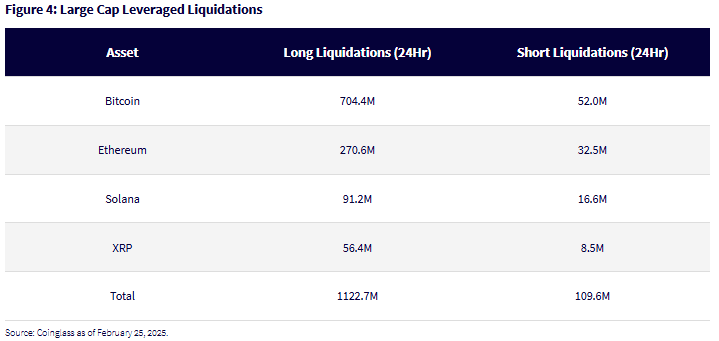
Crypto markets tumbled this week, flushing out leverage and exposing weak points across the space. Until now, large-cap assets—Bitcoin, Ethereum, and Solana—had largely avoided the worst of the altcoin sell-off, but all that changed this week. On Tuesday, over $1 billion in leveraged long positions were liquidated as prices spiralled downward. Bitcoin slid below $86,000, down 13% from last week’s high of $99,000. Ethereum fell to $2,400, while Solana cratered to $140—down 15% on the week and 40% over the past month.
Several factors have been building that lead to this violent price action. A weaker macro outlook emerged after the latest U.S. Federal Reserve (Fed) minutes suggested a preference to keep rates at 4.25%-4.5% for longer. This, combined with disappointing consumer sentiment data last Friday, triggered a growth scare. Both equities and crypto sold off, while the 10-year Treasury yield declined as investors reassessed risk.
Adding to the chaos, the largest crypto hack in history was revealed, sending shockwaves through the market. The Bybit hack—a $1.4 billion Ethereum exploit—fuelled uncertainty, while Solana’s memecoin meltdown amplified the broader risk-off sentiment. To make matters worse, mass liquidations triggered a "reverse short squeeze" for bitcoin. With so much happening, where do we begin?
Solana’s Memecoin Trader Exodus
Solana’s meteoric rise has hit a wall, largely due to its memecoin-fuelled rally and the inevitable unwinding that followed. At the height of the frenzy, Pump.fun, a memecoin-minting platform, pushed trading volumes and fees to record levels. But that momentum has reversed, with the recent Libra token collapse serving as the tipping point.
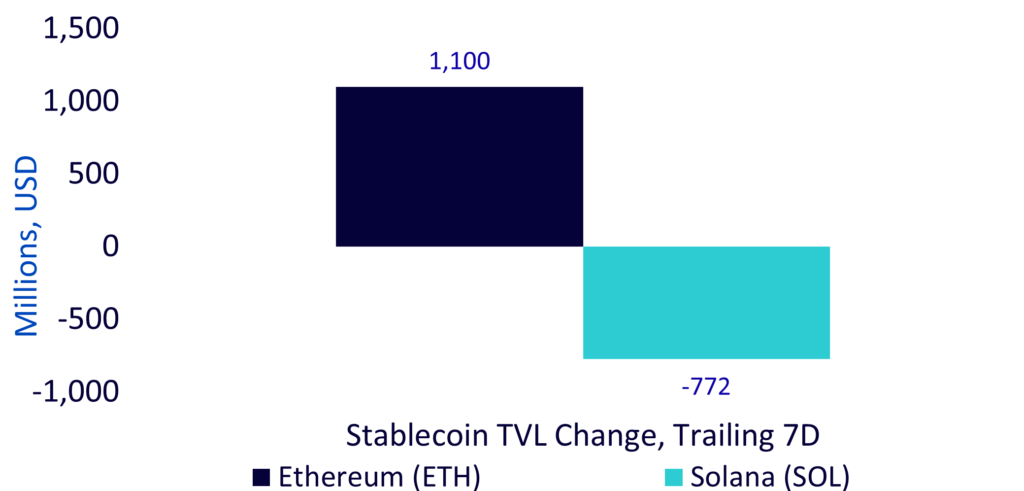
Launched in mid-February with Argentine President Javier Milei’s endorsement, Libra skyrocketed to a $4.5 billion market cap, only to crash 90% within hours. Insiders allegedly pulled $107 million beforehand, sparking fraud allegations and regulatory scrutiny. The fallout was swift: Solana’s stablecoin AUM dropped by $700 million in a week, while Ethereum saw $1 billion in inflows as capital fled to safety.
Figure 1: Stablecoin flows the week of the LIBRA token scandal
Source: LookOnChain as of February 17, 2025.
Bybit Hack Intensifies Solana’s Woes
The Bybit exchange hack only deepened the crisis. On February 21, hackers stole $1.4 billion, laundering part of the funds through Solana-based memecoins on Pump.fun. This triggered $5.5 billion in withdrawals from Bybit, rattling market confidence and adding further selling pressure.
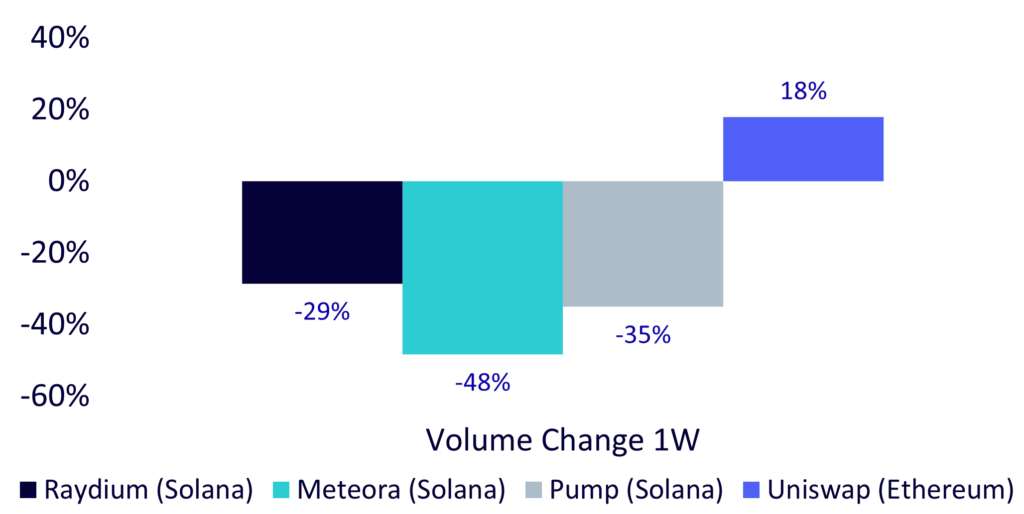
Meanwhile, Solana’s DeFi ecosystem, historically a bright spot for trading activity and liquidity, saw a sharp decline in volumes as traders continued to pull capital to avoid the mess.
Figure 2: Weekly change in decentralised exchange volumes
Source: DefiLlama as of Feb, 25, 2025.
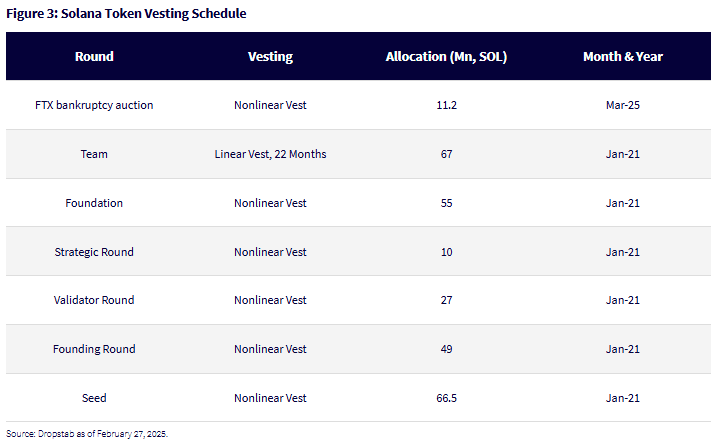
The hack—reminiscent of past cycle woes—coincides with another looming event: Solana’s upcoming token unlock on March 1. Over 11M of these tokens will be unlocked and are tied to the FTX bankruptcy estate, which is currently repaying its creditors. Market participants expect these unlocked tokens to be sold for cash, adding uncertainty around supply absorption and near-term price action.
Leveraged Liquidations
On Tuesday, with mounting pressure on the crypto ecosystem, the final straw broke the camel’s back. Over $1 billion in bitcoin leveraged long positions crossed their liquidation thresholds, triggering a cascading wave of forced selling as leverage unwound in a ‘reverse short squeeze’.
Liquidation heatmaps suggested that bitcoin may find support around $85,000, where most leverage had been flushed out, but it remains to be seen if prices will stabilize here. As of time of writing, bitcoin is trading around $84,000.
The Bright Spot
Amid the turbulence, the key tenets of our 2025 crypto market outlook remain intact. Institutional adoption continues, with growing use cases for tokenization and stablecoin payments. The U.S. regulatory environment is improving, and bitcoin is increasingly being adopted as a reserve asset, following continued strong institutional investor interest.
At this juncture, this appears to be more of a leverage reset than a collapse – a necessary cleanse. Solana’s memecoin bubble has finally popped, Bybit’s hack has shaken sentiment, and a macro scare has blown out leverage positions forcing traders to de-risk. However, despite this turbulence, the underlying fundamentals remain unchanged.
Barring a major macro downturn, which is not our base case, the broader positive narrative remains intact.
Perspectives in Onchain Finance
View all

About the contributor

Blake Heimann
Associate Director, Quantitative Research
Blake Heimann joined WisdomTree in 2020 and supports the creation, maintenance, and reconstitution of WisdomTree’s indices. Blake began his career in finance in 2017 as an Analyst at TD Ameritrade and, later, a Quantitative Analyst with a focus on the development of machine learning applications in finance.
Blake has bachelor’s degrees in Mathematics and Economics from Iowa State University, as well as a master’s in Computer Science from Georgia Tech, with a specialisation in Machine Learning. He is currently pursuing a master’s in Finance from the London School of Economics
Thought Leaders

Alice Liu
Senior Associate, Cryptocurrency Investments, WisdomTree Europe

Andrew Okrongly, CFA
Director, Model Portfolios

Blake Heimann
Associate Director, Quantitative Research

Christopher Gannatti, CFA
Global Head of Research

Chris Ryder
Head of WisdomTree Transfers

Dovile Silenskyte
Director, Digital Assets Research

Jason Guthrie
Director of Capital Markets, WisdomTree Europe

Jeff Weniger, CFA
Head of Equity Strategy

Jeremy J. Siegel
WisdomTree Senior Economist

Jeremy Schwartz, CFA
Global Chief Investment Officer

Kevin Flanagan
Head of Investment and Fixed Income Strategy

Mobeen Tahir
Director, Macroeconomics and Thematic Research

Nitesh Shah
Head of Commodities and Macroeconomic Research, WisdomTree Europe

Pierre Debru
Head of Research, Europe

Rick Harper
Chief Investment Officer, Fixed Income and Model Portfolios

Rohan Ranadive
Chief Risk Officer, WisdomTree Digital Assets

Samuel Rines
Macro Strategist, Model Portfolios

Vinh Tran
Associate Director, Business Development, Digital Assets

Will Peck
Head of WisdomTree Onchain

WisdomTree Onchain
Contributor
Alice Liu
Senior Associate, Cryptocurrency Investments, WisdomTree Europe
Andrew Okrongly, CFA
Director, Model Portfolios
Blake Heimann
Associate Director, Quantitative Research
Christopher Gannatti, CFA
Global Head of Research
Chris Ryder
Head of WisdomTree Transfers
Dovile Silenskyte
Director, Digital Assets Research
Jason Guthrie
Director of Capital Markets, WisdomTree Europe
Jeff Weniger, CFA
Head of Equity Strategy
Jeremy J. Siegel
WisdomTree Senior Economist
Jeremy Schwartz, CFA
Global Chief Investment Officer
Kevin Flanagan
Head of Investment and Fixed Income Strategy
Mobeen Tahir
Director, Macroeconomics and Thematic Research
Nitesh Shah
Head of Commodities and Macroeconomic Research, WisdomTree Europe
Pierre Debru
Head of Research, Europe
Rick Harper
Chief Investment Officer, Fixed Income and Model Portfolios
Rohan Ranadive
Chief Risk Officer, WisdomTree Digital Assets
Samuel Rines
Macro Strategist, Model Portfolios
Vinh Tran
Associate Director, Business Development, Digital Assets
Will Peck
Head of WisdomTree Onchain
WisdomTree Onchain
Contributor