


Dovile Silenskyte
Director, Digital Assets Research
Key Takeaways
- Year to date, 2024 has been a remarkable year for bitcoin, with record flows and record price highs.
- While bitcoin price change is lagging what we have seen post earlier halving events, investors should remain patient. This is because the fourth halving event has had the smallest impact on bitcoin supply.
- Since bitcoin is highly correlated with other key cryptocurrencies, if bitcoin price starts going up, it is likely to lift others too.
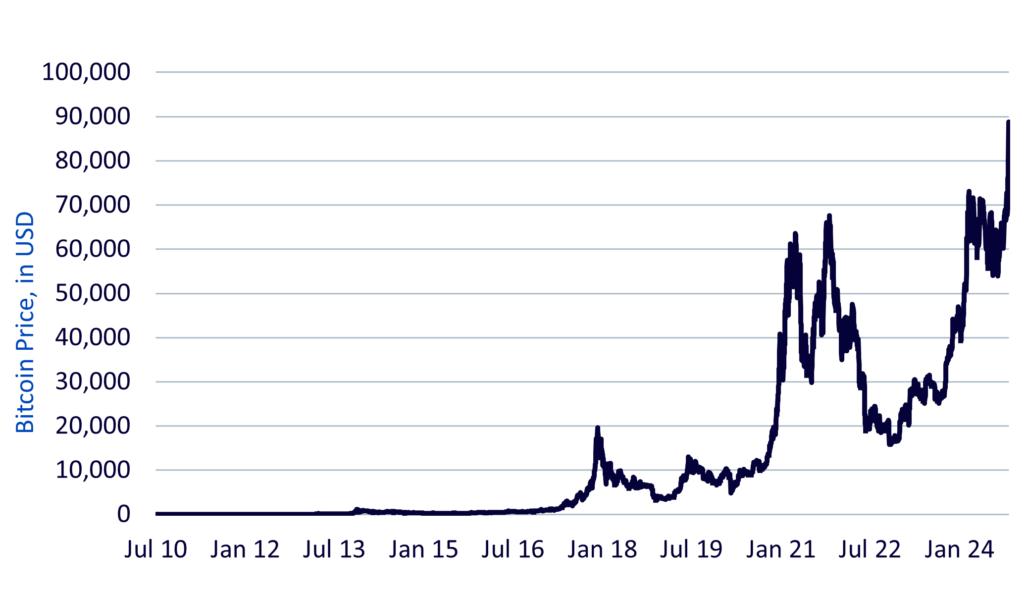
Year to date, 2024 has been a remarkable year for bitcoin:
- The launch of spot bitcoin exchange-traded funds (ETFs) in the United States resulted in record inflows of over $24 billion1 into those products.
- Bitcoin's price reached its all-time high of near $90k2 in November 2024.
Figure 1: Bitcoin price in USD
Source: Glassnode, WisdomTree. 12 November 2024. You cannot invest directly in an index. Historical performance is not an indication of future performance and any investment may go down in value.
However, professional investors’ sentiment does not reflect this. According to our 2024 Professional Investor Survey, 41% of respondents became more bearish towards cryptocurrencies since the approval of spot bitcoin ETFs in the US3.
Do these investors think that the cryptocurrency market has reached its all-time high and that it is all downhill from here?
Long and successful track record
By now, bitcoin has a track record of over 15 years. Looking at the past 10 calendar years4, bitcoin was:
- The best-performing asset in seven of those years.
- The worst-performing asset in three of those years.
It is interesting to note that bitcoin achieved the best performance in years around its halvings. Specifically:
- The second halving was in 2016, and bitcoin was the best-performing asset in 2015, 2016, 2017.
- The third halving was in 2020, and bitcoin was the best-performing asset in 2019, 2020, 2021.
- The fourth halving was in 2024, and bitcoin was the best-performing asset in 2023. It is too early to know whether it will be the best-performing asset in 2024 and 2025.
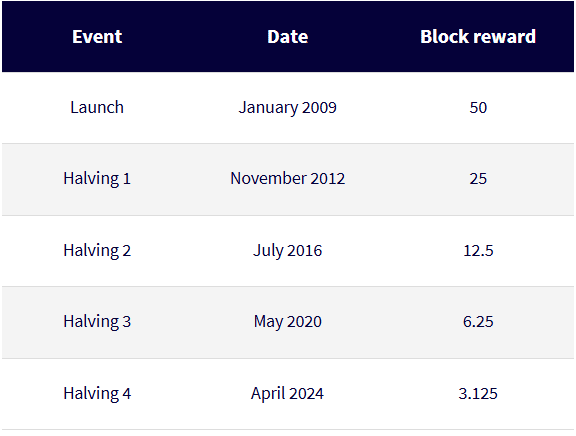
By way of reminder, bitcoin halving events take place once every four years. The last one was in April 2024, when the newly issued bitcoin supply was reduced from 6.25 to 3.125 per mined block. These halving events will continue until the maximum bitcoin supply of 21 million is reached, and this is expected to happen in 21405.
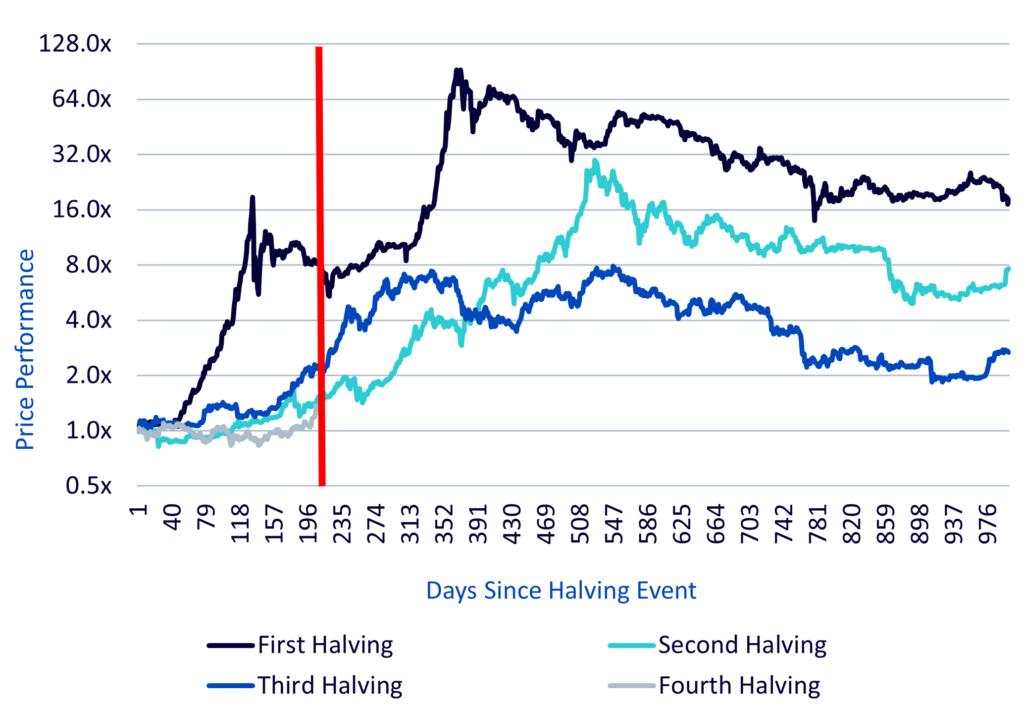
Each halving event reduces the bitcoin supply. If bitcoin demand remains the same or grows, each halving event is expected to impact the price of bitcoin positively.
Figure 2: Bitcoin price performance post-halving events
Source: Glassnode, WisdomTree. 12 November 2024. You cannot invest directly in an index. Historical performance is not an indication of future performance, and any investment may go down in value.
Now, over 200 days have passed since the fourth bitcoin halving event. As shown in Figure 2 (above), while significant price changes after the halving events are not always immediate, bitcoin price action after the most recent halving event is slightly trailing behind what we have seen for the first three. Does this justify the bearish sentiment that many professional investors are showing? Not necessarily.
Figure 3: Bitcoin block rewards
Source: WisdomTree. October 2024.
Per Figure 3 (above), each new bitcoin halving event has impacted bitcoin supply less. Specifically, bitcoin supply per mined block was reduced by:
- 25 bitcoins after the first halving event
- 12.5 bitcoins after the second halving event
- 6.25 bitcoins after the third halving event
- 3.125 bitcoins after the fourth (i.e. the last) halving event
To avoid any doubt, the bitcoin supply reduction is the difference between the block reward that bitcoin miners receive before the halving event and the block reward that they receive after the halving event.
For context, bitcoin closed just under $64k on 20 April 2024 (which was the fourth halving date), and the current price is just over $86k6 at the time of writing.
Major cryptocurrencies tend to follow bitcoin
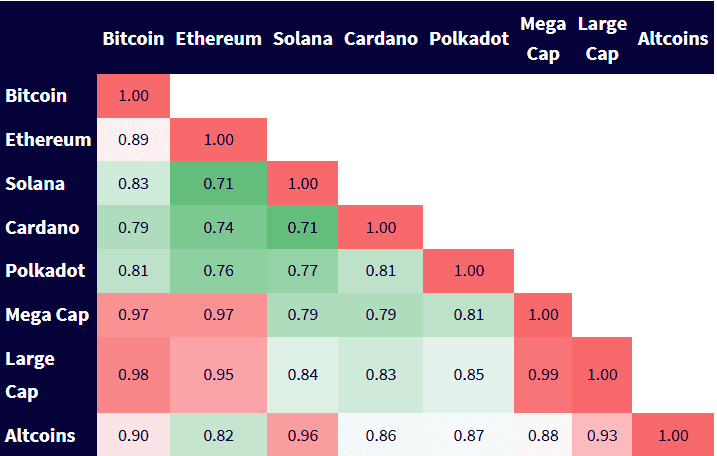
While correlations between bitcoin and most traditional assets are around or below 20%7, bitcoin’s correlations with other cryptocurrencies are much more significant.
Figure 4: Correlations between bitcoin and other major cryptocurrencies
Source: WisdomTree. 30 September 2024. Calculated using three-month daily USD returns and are annualised. Mega Cap = WisdomTree CF Crypto Mega Cap Equal Weight Index. Large Cap = WisdomTree CF Crypto Market Index. Altcoins = WisdomTree CF Crypto Altcoins Index. Historical performance is not an indication of future performance, and any investment may go down in value.
Per Figure 4 (above), correlations between bitcoin and other major cryptocurrencies are around or above 80%8. Since bitcoin is a cryptocurrency mega cap name that represents more than 50%9 of total crypto market cap and as it is highly correlated with other cryptocurrencies, once bitcoin’s price starts reflecting the fourth halving event, it is expected to bring the whole cryptocurrency market up.
Conclusion
In summary, 2024 has been a remarkable year for Bitcoin. Soon after spot bitcoin ETFs were launched in the United States, bitcoin achieved record price highs and experienced record inflows. Soon after, bitcoin also experienced a fourth halving event, reducing its supply from 6.25 to 3.125 bitcoins per mined block.
Bitcoin price change is lagging what we have seen post earlier halving events. This is because the fourth halving event has had the smallest impact on the bitcoin supply.
1 Bloomberg. 31 October 2024.
2 Glassnode. 12 November 2024.
3 WisdomTree, Censuswide. Pan-Europe Professional Investor Survey Research, a Survey of 817 professional investors across Europe, conducted June-July 2024.
4 Bloomberg, WisdomTree. From 31 December 2013 to 31 December 2023. In USD.
5 Ig.com. July 2024. Forecasts are not an indication of future performance, and any investments are subject to risks and uncertainties.
6 Messari. 13 November 2024.
7 Bloomberg, WisdomTree. From 31 December 2013 to 30 September 2024. In USD. Based on weekly returns.
8 WisdomTree. 30 September 2024. Calculated using 3-month daily USD returns and are annualised.
9 Messari. 29 October 2024.
Important Risks Related to this Article
Crypto assets, such as bitcoin and ether, are complex, generally exhibit extreme price volatility and unpredictability, and should be viewed as highly speculative assets. Crypto assets are frequently referred to as crypto “currencies,” but they typically operate without central authority or banks, are not backed by any government or issuing entity (i.e., no right of recourse), have no government or insurance protections, are not legal tender and have limited or no usability as compared to fiat currencies. Federal, state or foreign governments may restrict the use, transfer, exchange and value of crypto assets, and regulation in the U.S. and worldwide is still developing. Crypto asset exchanges and/or settlement facilities may stop operating, permanently shut down or experience issues due to security breaches, fraud, insolvency, market manipulation, market surveillance, KYC/AML (know your customer/anti-money laundering) procedures, non-compliance with applicable rules and regulations, technical glitches, hackers, malware or other reasons, which could negatively impact the price of any cryptocurrency traded on such exchanges or reliant on a settlement facility or otherwise may prevent access or use of the crypto asset. Crypto assets can experience unique events, such as forks or airdrops, which can impact the value and functionality of the crypto asset. Crypto asset transactions are generally irreversible, which means that a crypto asset may be unrecoverable in instances where: (i) it is sent to an incorrect address, (ii) the incorrect amount is sent, or (iii) transactions are made fraudulently from an account. A crypto asset may decline in popularity, acceptance or use, thereby impairing its price, and the price of a crypto asset may also be impacted by the transactions of a small number of holders of such crypto asset. Crypto assets may be difficult to value and valuations, even for the same crypto asset, may differ significantly by pricing source or otherwise be suspect due to market fragmentation, illiquidity, volatility and the potential for manipulation. Crypto assets generally rely on blockchain technology and blockchain technology is a relatively new and untested technology which operates as a distributed ledger. Blockchain systems could be subject to internet connectivity disruptions, consensus failures or cybersecurity attacks, and the date or time that you initiate a transaction may be different then when it is recorded on the blockchain. Access to a given blockchain requires an individualized key, which, if compromised, could result in loss due to theft, destruction or inaccessibility. In addition, different crypto assets exhibit different characteristics, use cases and risk profiles. Information provided by WisdomTree regarding digital assets, crypto assets or blockchain networks should not be considered or relied upon as investment or other advice, as a recommendation from WisdomTree, including regarding the use or suitability of any particular digital asset, crypto asset, blockchain network or any particular strategy.
Categories
Perspectives in Onchain Finance
View all

About the contributor

Dovile Silenskyte
Director, Digital Assets Research
Dovile Silenskyte is a director of digital assets research at WisdomTree. Before joining WisdomTree in May 2024, Dovile worked as an index equity product strategist at BlackRock. Currently, she is responsible for conducting analyses for in-house digital assets publications and assisting the sales team with client queries about products and markets. Dovile holds an MSc in Finance from Texas A&M University – Commerce, and she is also a chartered financial analyst (CFA).
Thought Leaders

Alice Liu
Senior Associate, Cryptocurrency Investments, WisdomTree Europe

Andrew Okrongly, CFA
Director, Model Portfolios

Blake Heimann
Associate Director, Quantitative Research

Christopher Gannatti, CFA
Global Head of Research

Chris Ryder
Head of WisdomTree Transfers

Dovile Silenskyte
Director, Digital Assets Research

Jason Guthrie
Director of Capital Markets, WisdomTree Europe

Jeff Weniger, CFA
Head of Equity Strategy

Jeremy J. Siegel
WisdomTree Senior Economist

Jeremy Schwartz, CFA
Global Chief Investment Officer

Kevin Flanagan
Head of Investment and Fixed Income Strategy

Mobeen Tahir
Director, Macroeconomics and Thematic Research

Nitesh Shah
Head of Commodities and Macroeconomic Research, WisdomTree Europe

Pierre Debru
Head of Research, Europe

Rick Harper
Chief Investment Officer, Fixed Income and Model Portfolios

Rohan Ranadive
Chief Risk Officer, WisdomTree Digital Assets

Samuel Rines
Macro Strategist, Model Portfolios

Vinh Tran
Associate Director, Business Development, Digital Assets

Will Peck
Head of WisdomTree Onchain

WisdomTree Onchain
Contributor
Alice Liu
Senior Associate, Cryptocurrency Investments, WisdomTree Europe
Andrew Okrongly, CFA
Director, Model Portfolios
Blake Heimann
Associate Director, Quantitative Research
Christopher Gannatti, CFA
Global Head of Research
Chris Ryder
Head of WisdomTree Transfers
Dovile Silenskyte
Director, Digital Assets Research
Jason Guthrie
Director of Capital Markets, WisdomTree Europe
Jeff Weniger, CFA
Head of Equity Strategy
Jeremy J. Siegel
WisdomTree Senior Economist
Jeremy Schwartz, CFA
Global Chief Investment Officer
Kevin Flanagan
Head of Investment and Fixed Income Strategy
Mobeen Tahir
Director, Macroeconomics and Thematic Research
Nitesh Shah
Head of Commodities and Macroeconomic Research, WisdomTree Europe
Pierre Debru
Head of Research, Europe
Rick Harper
Chief Investment Officer, Fixed Income and Model Portfolios
Rohan Ranadive
Chief Risk Officer, WisdomTree Digital Assets
Samuel Rines
Macro Strategist, Model Portfolios
Vinh Tran
Associate Director, Business Development, Digital Assets
Will Peck
Head of WisdomTree Onchain
WisdomTree Onchain
Contributor