


Understanding Bitcoin's Volatility
Bitcoin is renowned for its extreme volatility, with price movements that have given rise to the now-famous term "HODL"—an acronym for "Hold On for Dear Life"—reflecting how many investors endure its dramatic ups and downs while maintaining a long-term perspective. From dramatic surges to steep declines, these fluctuations often make headlines and influence investor sentiment. In the past decade, Bitcoin has been declared 'dead' over 400 times, only to rise again – why does it keep fluctuating so dramatically?1Let's look into the fundamentals behind Bitcoin’s Lazarus effect.
What is Bitcoin Volatility?
Bitcoin's volatility refers to the frequent and sometimes dramatic price swings that occur in response to factors such as market demand, regulatory changes, and technological developments. Measured as the degree of price variation over a given period, Bitcoin's volatility can be tracked through tools like the Bitcoin Volatility Index, which shows that Bitcoin’s price changes are often more intense compared to traditional assets like gold or the U.S. dollar.2
Short-Term vs. Long-Term Volatility
Short-Term Drivers of Bitcoin Volatility:
Bitcoin's price can be significantly influenced by short-term factors such as news events, macroeconomic indicators, and market sentiment. For instance, geopolitical tensions, regulatory changes, or significant technological developments can trigger rapid price movements. In mid-2021, when China banned Bitcoin mining, the market value of bitcoin plummeted 11%.3Similarly, Bitcoin ETPs have sparked market optimism, leading to notable price increases. On the other hand, rising global inflation concerns have also contributed to Bitcoin's appeal as a potential inflation hedge, which continues to be a topic of debate, particularly with a relatively short track record, and can drive volatility as investors flock to or from the asset. While short-term volatility can be triggered by immediate events, long-term volatility is driven by deeper supply-and-demand fundamentals.
Long-Term Volatility:
Over the longer term, Bitcoin's volatility is rooted in its unique supply dynamics. Unlike traditional commodities or goods, Bitcoin's supply is fixed and inelastic. This means that regardless of price changes, the supply of Bitcoin remains constant and, in fact, according to the code, will continue to incrementally increase until the year 2140 when all coins will be mined and in circulation.4 Consequently, any changes in demand directly impact its price, leading to greater volatility. To put it simply, because Bitcoin's supply is relatively constant or increasing at a slow rate, its price fluctuates based on market demand. Which brings us to our next point:
The Fixed Supply Factor
Bitcoin's value proposition includes its fixed supply, capped at 21 million coins. This scarcity is a fundamental aspect of its appeal as a digital asset. However, it also contributes to its volatility. In traditional markets, when demand for a commodity like oil increases, suppliers can produce more, stabilizing the price. With Bitcoin, no such supply adjustment is possible, so any demand fluctuation directly influences its price.
Volatility as a Value Proposition
Bitcoin's fixed supply is a double-edged sword. While it creates value due to scarcity, it also leads to greater price volatility. As Bitcoin educator Parker Lewis notes, "Bitcoin is valuable because it has a fixed supply and it is also volatile for the same reason."5 This intrinsic characteristic underscores that Bitcoin's volatility is tied to its fundamental value proposition.
Emerging Asset Class
Bitcoin, with its approximate $1.22 Trillion market cap as of 10/01/2024, is considered an emerging asset class. The journey from a nascent asset to a more established one involves periods of high volatility, much like gold experienced after the U.S. abandoned the gold standard in 1971.6 As more investors understand and adopt Bitcoin, its volatility may decline, reflecting a more mature asset class.
Historical Context
Comparing Bitcoin to gold's price discovery process in the 1970s provides valuable insights into the nature of volatile asset classes. When the U.S. abandoned the gold standard in 1971, gold’s price surged from around $35 per ounce to nearly $850 by 1980, marking a rise of over 2,300%.7 During this period, gold experienced volatility, averaging around 1.2% per year.8
Bitcoin has followed a similarly volatile path as it undergoes price discovery. However, Bitcoin’s volatility can be much higher, with annual fluctuations often exceeding 80%, especially during significant market events.9 This difference is attributed to Bitcoin's emerging status as an asset class and its decentralized, global nature, which introduces greater variability in market sentiment and liquidity.
Notably, comparisons between Bitcoin and gold are common in the investment world. Bitcoin’s exponential rise mirrors gold’s trajectory in the 1970s, suggesting that both assets have endured significant volatility during their transitions.10 Over time, as Bitcoin matures and to the extent it continues to gain wider recognition, its volatility may decrease, much like gold’s did after its early price surges.
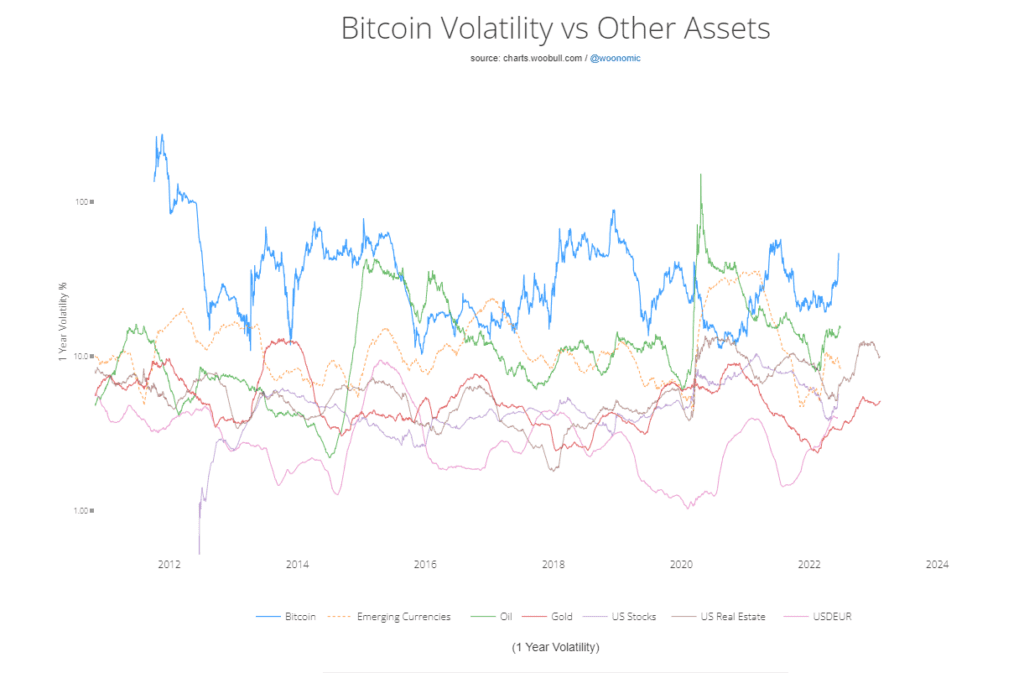
To further highlight this comparison, the following chart provides a visual representation of Bitcoin's volatility against other assets like gold, equities, and currencies. Put simply, Bitcoin’s volatility is markedly higher, reflecting both its emerging nature as an asset class and the rapid market shifts that can occur due to changes in demand, regulatory developments, and macroeconomic factors.
Closing Thoughts
Bitcoin's volatility is a byproduct of its fixed supply and its status as a developing asset class. While price fluctuations can be unsettling, Bitcoin can arguably be considered a unique store of value in an increasingly uncertain global economy, albeit with additional risk factors when compared to a store of value such as gold. For long-term investors, it’s essential to recognize that volatility isn't inherently negative—when framed within the context of its attributes that create the potential for long-term value preservation (e.g., scarcity and growing adoption), it becomes a key feature of Bitcoin's growing appeal.
As the market matures and adoption expands, Bitcoin's volatility may decrease, aligning more closely with that of traditional assets like gold. However, it’s precisely this volatility that underscores Bitcoin’s potential and its appeal as a potential hedge against economic instability. As Bitcoin continues to evolve, its path forward may mirror gold's stabilization after its early volatile phase, potentially paving the way for Bitcoin to solidify its role as a reliable and established asset class.
Important Information:
Bitcoin is highly speculative and involves a high degree of risk, including the potential for loss of the entire investment. An investment in involves significant risks (including the potential for quick, large losses) and may not be suitable for all investors. Investors should carefully consider whether their financial condition permits investment in bitcoin and should be willing to accept more risk than may be involved with other investments.
Extreme volatility of trading prices that many digital assets, including bitcoin, have experienced in recent periods and may continue to experience, could have a material adverse effect on the value bitcoin. The value of bitcoin is dependent on the acceptance of digital assets, such as bitcoin, which represent a new and rapidly evolving industry. Digital assets such as bitcoin were only introduced within the past two decades, and the medium-to-long term value of bitcoin is subject to a number of factors relating to the capabilities and development of blockchain technologies and to the fundamental investment characteristics of digital assets. Regulatory changes or actions may affect the value of bitcoin or restrict the use of bitcoin, mining activity or the operation of the Bitcoin Network or the Digital Asset Markets in a manner that adversely affects the value bitcoin. Digital Asset Platforms may experience fraud, business failures, security failures or operational problems, which may adversely affect the value of bitcoin.
Sources:
1 "Bitcoin Obituaries." Bitcoin Deaths, www.bitcoindeaths.com/. Accessed 25 Sept. 2024.
2 "Bitcoin Volatility Index." Bitbo, bitbo.io/volatility/. Accessed 25 Sept. 2024.
3 Robertson, Harry. "Bitcoin Tumbles 11% after China Steps up Crackdown on Crypto Mining and Financial Operations." Business Insider, 21 June 2021, 9:34 a.m. EDT, www.markets.businessinsider.com/currencies/news/bitcoin-price-btc-china-mining-crackdown-sichuan-cryptocurrencies-ether-2021-6-1030538480. Accessed 25 Sept. 2024.
4Bitcoin Mining: What Happens After All Bitcoin Are Mined?" River, www.river.com/learn/what-will-happen-after-all-bitcoin-mined/#:~:text=By%20the%20year%202140%2C%20all,transaction%20fees%20paid%20by%20users. Accessed 25 Sept. 2024.
5Lewis, Parker. "Bitcoin Is Not Too Volatile." CaseBitcoin, 9 Aug. 2019, casebitcoin.com/bitcoin-is-not-too-volatile. Accessed 25 Sept. 2024.
6 Redman, Jamie. "As the Fed Turns 109 Years Old, the US Dollar's Purchasing Power Eroded by More Than 96% Since It Was Created." Bitcoin News, 25 Dec. 2022, news.bitcoin.com/as-the-fed-turns-109-years-old-the-us-dollars-purchasing-power-eroded-by-more-than-96-since-it-was-created/. Accessed 25 Sept. 2024.
7Timmer, Jurrien. “Could Bitcoin Follow Gold’s 1970s Parabolic Rally? Fidelity Macro Strategist Compares BTC to Precious Metal.” The Daily Hodl, 29 July 2021, www.dailyhodl.com/2021/07/29/could-bitcoin-follow-golds-1970s-parabolic-rally-fidelity-macro-strategist-compares-btc-to-precious-metal/. Accessed 25 Sept. 2024.
8 World Gold Council. "Gold Price Volatility." World Gold Council, www.gold.org/goldhub/data/gold-price-volatility. Accessed 25 Sept. 2024.
9 World Gold Council. "Gold and Major Asset Volatilities." World Gold Council, 20 Sept. 2024, www.gold.org/goldhub/data/gold-price-volatility. Accessed 25 Sept. 2024.
10 1970's Gold vs. Bitcoin Today.” Sandstone Asset Management, 13 Nov. 2017, www.sandstoneam.com/insights/1970-gold-vs-bitcoin. Accessed 25 Sept. 2024.
Perspectives in Onchain Finance
View all

About the contributor

Kelly Reddington
Marketing and Research Analyst
Kelly Reddington is a Marketer and Research Analyst at WisdomTree, specializing in digital assets and the evolving financial infrastructure. He plays a key role in product marketing, executive communications, and content strategy for WisdomTree's digital assets initiatives, helping articulate the firm's vision for the future of tokenization and onchain finance. Prior to joining WisdomTree, Kelly built a career at the intersection of cybersecurity, marketing, and blockchain technology. He holds a degree in Business Administration and Marketing from the University at Buffalo. With a passion for crypto, DeFi, and emerging financial technologies, Kelly brings a unique perspective to how these innovations are communicated and understood by both institutional and retail audiences.
Thought Leaders

Alice Liu
Senior Associate, Cryptocurrency Investments, WisdomTree Europe

Andrew Okrongly, CFA
Director, Model Portfolios

Blake Heimann
Associate Director, Quantitative Research

Christopher Gannatti, CFA
Global Head of Research

Chris Ryder
Head of WisdomTree Transfers

Dovile Silenskyte
Director, Digital Assets Research

Jason Guthrie
Director of Capital Markets, WisdomTree Europe

Jeff Weniger, CFA
Head of Equity Strategy

Jeremy J. Siegel
WisdomTree Senior Economist

Jeremy Schwartz, CFA
Global Chief Investment Officer

Kevin Flanagan
Head of Investment and Fixed Income Strategy

Mobeen Tahir
Director, Macroeconomics and Thematic Research

Nitesh Shah
Head of Commodities and Macroeconomic Research, WisdomTree Europe

Pierre Debru
Head of Research, Europe

Rick Harper
Chief Investment Officer, Fixed Income and Model Portfolios

Rohan Ranadive
Chief Risk Officer, WisdomTree Digital Assets

Samuel Rines
Macro Strategist, Model Portfolios

Vinh Tran
Associate Director, Business Development, Digital Assets

Will Peck
Head of WisdomTree Onchain

WisdomTree Onchain
Contributor
Alice Liu
Senior Associate, Cryptocurrency Investments, WisdomTree Europe
Andrew Okrongly, CFA
Director, Model Portfolios
Blake Heimann
Associate Director, Quantitative Research
Christopher Gannatti, CFA
Global Head of Research
Chris Ryder
Head of WisdomTree Transfers
Dovile Silenskyte
Director, Digital Assets Research
Jason Guthrie
Director of Capital Markets, WisdomTree Europe
Jeff Weniger, CFA
Head of Equity Strategy
Jeremy J. Siegel
WisdomTree Senior Economist
Jeremy Schwartz, CFA
Global Chief Investment Officer
Kevin Flanagan
Head of Investment and Fixed Income Strategy
Mobeen Tahir
Director, Macroeconomics and Thematic Research
Nitesh Shah
Head of Commodities and Macroeconomic Research, WisdomTree Europe
Pierre Debru
Head of Research, Europe
Rick Harper
Chief Investment Officer, Fixed Income and Model Portfolios
Rohan Ranadive
Chief Risk Officer, WisdomTree Digital Assets
Samuel Rines
Macro Strategist, Model Portfolios
Vinh Tran
Associate Director, Business Development, Digital Assets
Will Peck
Head of WisdomTree Onchain
WisdomTree Onchain
Contributor