


Dovile Silenskyte
Director, Digital Assets Research
Key Takeaways
- In 2025, global crypto adoption is accelerating beyond Western markets, with countries such as Nigeria and Brazil leading retail-driven, real-world use cases amid inflation and underbanked populations.
- The UAE and South Korea are emerging as regulatory powerhouses, crafting clear frameworks that attract institutions and legitimise crypto as a mainstream financial tool.
- For crypto investors, this shift highlights that future crypto growth and innovation are increasingly rooted in dynamic, non-Western economies.
As crypto markets reawaken in 2025, the story goes far beyond crypto price charts. The real shift is geopolitical. While headlines obsess over the United States (US) spot bitcoin exchange-traded funds (ETFs) and Europe’s Markets in Crypto Assets (MiCA) framework, a different race is heating up—a global sprint for digital asset dominance.
These five countries are not just embracing crypto; they are operationalising it. Infrastructure, regulation, and usage are converging to make them strategic hubs.
Nigeria: retail-led, mobile-first, and unstoppable
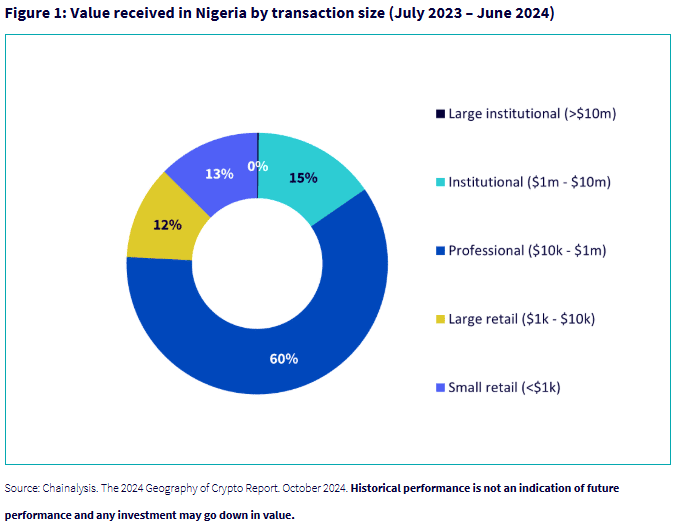
Forget Wall Street, crypto’s monetary utility is unfolding in Lagos. Nigeria leads global adoption rankings1 due to a perfect storm: a young, mobile-native population, inflationary pressure, and underdeveloped financial infrastructure.
- Peer-to-peer stablecoin use (especially USDT on Tron) is booming.
- Despite past hostility from the Central Bank, users have built parallel rails.
- The eNaira central bank digital currency (CBDC) pilot has floundered, reaffirming a strong grassroots preference for decentralised alternatives.
Nigeria is ground zero for crypto’s role as a monetary lifeline.
United States: institutional infrastructure on steroids
Regulation may be chaotic, but capital speaks louder.
- The 2024 approval of spot bitcoin ETFs unleashed over $40 billion in AUM inflows2 into these products.
- Major asset managers are building vertically integrated crypto stacks—tokenised treasuries, stablecoin rails, and more.
- New Hampshire became the first state to approve crypto reserve law that allows the investment of up to 5% of public funds in a digital asset that has at least $500 billion in market capitalisation3.
The US remains the epicentre of crypto financialisation—messy, but unmatched in institutional muscle.
United Arab Emirates: the global regulatory sandbox
Dubai is not waiting for the West, it is architecting crypto’s regulatory future.
- Virtual Assets Regulatory Authority (VARA) has built a clear, business-friendly licensing regime.
- Binance, OKX, Bybit and others have made the UAE a regional command centre.
- Blockchain is being embedded across trade finance and real estate via national digital economy initiatives.
The UAE is positioning itself as the Singapore of crypto—agile, open, and geopolitically savvy.
Brazil: Latin America’s on-ramp to the crypto economy
Brazil is transforming from a regional leader into a foundational layer for Latin America’s crypto future.
- PIX, the central bank’s instant payment system, blends seamlessly with stablecoin flows.
- Exchanges such as Mercado Bitcoin are scaling under a clear, tax-incentivised regime.
- The digital real (DREX) and tokenised public debt instruments are in development.
Brazil is proof that progressive regulation plus fintech innovation equals real-world adoption.
South Korea: retail mania meets regulatory discipline
No other country matches South Korea’s blend of retail appetite and regulatory rigour.
- Crypto penetration is among the world’s highest—daily volumes on local exchanges often rival equities.
- The government is implementing comprehensive crypto rules, including real-name trading, taxation, and licensing.
- The Financial Services Commission (FSC) is also designing oversight frameworks for security tokens and decentralised finance (DeFi).
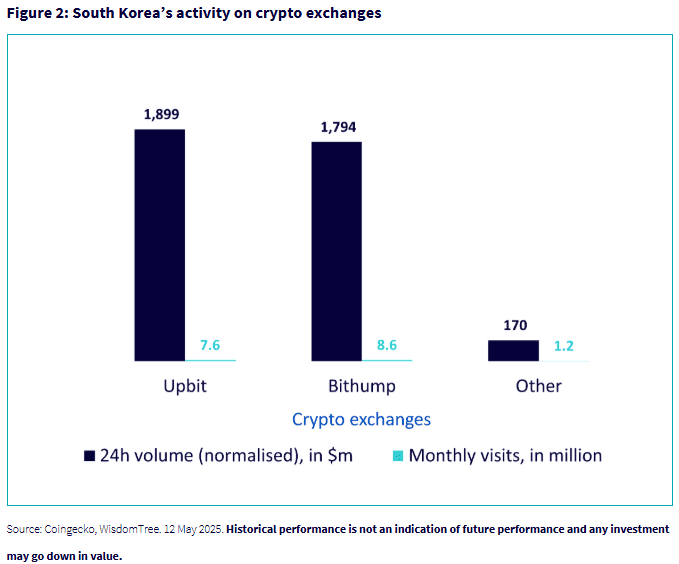
South Korea is a fully-formed, liquid, and increasingly regulated crypto market—a critical node in Asia’s digital asset network.
Conclusion: why this matters for crypto exchange-traded product (ETP) investors
The geography of crypto adoption is shifting and with it, the investment playbook. These five countries are not just pioneering innovation, they are laying the foundation for scalable, real-world digital asset use. For crypto ETP investors, that matters. A lot.
Here is what to watch:
- Geographic diversification is strategic. Exposure to bitcoin or Ether is no longer just about the underlying asset, it is about which economies are enabling the infrastructure behind them. Different countries mean different use cases, liquidity channels, and regulatory trajectories.
- Regulation is the catalyst. UAE and Brazil show how clear frameworks unlock institutional interest. ETP issuers aligned with these forward-looking jurisdictions will lead in product design, scalability, and distribution.
- The next wave is global. The US kicked off the institutionalisation trend, but the next leg of ETP evolution will come from Seoul, Dubai, São Paulo, and Lagos, where adoption is grassroots, compliant, and fast-moving.
The future of crypto ETPs will not be built solely in New York or London. It will be co-authored by markets that are embracing innovation.
1 Source: Chainalysis. The 2024 Geography of Crypto Report. October 2024.
2 Source: Bloomberg, WisdomTree. 06 May 2025.
3 Source: CoinDesk. 06 May 2025.
Important Risks Related to this Article
Crypto assets, such as bitcoin and ether, are complex, generally exhibit extreme price volatility and unpredictability, and should be viewed as highly speculative assets. Crypto assets are frequently referred to as crypto “currencies,” but they typically operate without central authority or banks, are not backed by any government or issuing entity (i.e., no right of recourse), have no government or insurance protections, are not legal tender and have limited or no usability as compared to fiat currencies. Federal, state or foreign governments may restrict the use, transfer, exchange and value of crypto assets, and regulation in the U.S. and worldwide is still developing. Crypto asset exchanges and/or settlement facilities may stop operating, permanently shut down or experience issues due to security breaches, fraud, insolvency, market manipulation, market surveillance, KYC/AML (know your customer/anti-money laundering) procedures, non-compliance with applicable rules and regulations, technical glitches, hackers, malware or other reasons, which could negatively impact the price of any cryptocurrency traded on such exchanges or reliant on a settlement facility or otherwise may prevent access or use of the crypto asset. Crypto assets can experience unique events, such as forks or airdrops, which can impact the value and functionality of the crypto asset. Crypto asset transactions are generally irreversible, which means that a crypto asset may be unrecoverable in instances where: (i) it is sent to an incorrect address, (ii) the incorrect amount is sent, or (iii) transactions are made fraudulently from an account. A crypto asset may decline in popularity, acceptance or use, thereby impairing its price, and the price of a crypto asset may also be impacted by the transactions of a small number of holders of such crypto asset. Crypto assets may be difficult to value and valuations, even for the same crypto asset, may differ significantly by pricing source or otherwise be suspect due to market fragmentation, illiquidity, volatility and the potential for manipulation. Crypto assets generally rely on blockchain technology and blockchain technology is a relatively new and untested technology which operates as a distributed ledger. Blockchain systems could be subject to internet connectivity disruptions, consensus failures or cybersecurity attacks, and the date or time that you initiate a transaction may be different then when it is recorded on the blockchain. Access to a given blockchain requires an individualized key, which, if compromised, could result in loss due to theft, destruction or inaccessibility. In addition, different crypto assets exhibit different characteristics, use cases and risk profiles. Information provided by WisdomTree regarding digital assets, crypto assets or blockchain networks should not be considered or relied upon as investment or other advice, as a recommendation from WisdomTree, including regarding the use or suitability of any particular digital asset, crypto asset, blockchain network or any particular strategy.
Categories
Perspectives in Onchain Finance
View all

About the contributor

Dovile Silenskyte
Director, Digital Assets Research
Dovile Silenskyte is a director of digital assets research at WisdomTree. Before joining WisdomTree in May 2024, Dovile worked as an index equity product strategist at BlackRock. Currently, she is responsible for conducting analyses for in-house digital assets publications and assisting the sales team with client queries about products and markets. Dovile holds an MSc in Finance from Texas A&M University – Commerce, and she is also a chartered financial analyst (CFA).
Thought Leaders

Alice Liu
Senior Associate, Cryptocurrency Investments, WisdomTree Europe

Andrew Okrongly, CFA
Director, Model Portfolios

Blake Heimann
Associate Director, Quantitative Research

Christopher Gannatti, CFA
Global Head of Research

Chris Ryder
Head of WisdomTree Transfers

Dovile Silenskyte
Director, Digital Assets Research

Jason Guthrie
Director of Capital Markets, WisdomTree Europe

Jeff Weniger, CFA
Head of Equity Strategy

Jeremy J. Siegel
WisdomTree Senior Economist

Jeremy Schwartz, CFA
Global Chief Investment Officer

Kevin Flanagan
Head of Investment and Fixed Income Strategy

Mobeen Tahir
Director, Macroeconomics and Thematic Research

Nitesh Shah
Head of Commodities and Macroeconomic Research, WisdomTree Europe

Pierre Debru
Head of Research, Europe

Rick Harper
Chief Investment Officer, Fixed Income and Model Portfolios

Rohan Ranadive
Chief Risk Officer, WisdomTree Digital Assets

Samuel Rines
Macro Strategist, Model Portfolios

Vinh Tran
Associate Director, Business Development, Digital Assets

Will Peck
Head of WisdomTree Onchain

WisdomTree Onchain
Contributor
Alice Liu
Senior Associate, Cryptocurrency Investments, WisdomTree Europe
Andrew Okrongly, CFA
Director, Model Portfolios
Blake Heimann
Associate Director, Quantitative Research
Christopher Gannatti, CFA
Global Head of Research
Chris Ryder
Head of WisdomTree Transfers
Dovile Silenskyte
Director, Digital Assets Research
Jason Guthrie
Director of Capital Markets, WisdomTree Europe
Jeff Weniger, CFA
Head of Equity Strategy
Jeremy J. Siegel
WisdomTree Senior Economist
Jeremy Schwartz, CFA
Global Chief Investment Officer
Kevin Flanagan
Head of Investment and Fixed Income Strategy
Mobeen Tahir
Director, Macroeconomics and Thematic Research
Nitesh Shah
Head of Commodities and Macroeconomic Research, WisdomTree Europe
Pierre Debru
Head of Research, Europe
Rick Harper
Chief Investment Officer, Fixed Income and Model Portfolios
Rohan Ranadive
Chief Risk Officer, WisdomTree Digital Assets
Samuel Rines
Macro Strategist, Model Portfolios
Vinh Tran
Associate Director, Business Development, Digital Assets
Will Peck
Head of WisdomTree Onchain
WisdomTree Onchain
Contributor