

What’s ‘Under the Hood’ of Your Core Bond Position?
Published May 13, 2026

Head of Investment and Fixed Income Strategy
Key Takeaways
- With Treasury securities now comprising roughly 47% of the Bloomberg U.S. Aggregate Bond Index ("the Agg")—up from 22% in 2002—core bond investors may be taking on too much concentration in U.S. government debt than they realize.
- Persistent fiscal deficits nearing $2 trillion and potential increases in Treasury coupon issuance in FY2027 could push the Agg’s Treasury weighting above 50%, further reshaping the risk and yield profile of traditional core fixed income allocations.
- Investors seeking a more balanced core bond exposure may consider the WisdomTree Yield Enhanced U.S. Aggregate Bond Fund (AGGY), which uses a rules-based approach to reduce Treasury concentration while maintaining familiar investment-grade risk characteristics and enhancing yield potential.
Typically, an investor’s traditional bond portfolio begins with a cornerstone, or core holding of some sort. From either a strategic or tactical perspective, a core fixed income position provides the investor with some ballast to help anchor any other strategies that may be included. However, the term ‘core’ gets thrown around a lot, and when you look ‘under the hood’, you may be surprised with what you discover on how this position could actually be allocated.
For many fixed income investors, their bond portfolio utilizes the Agg as their core holding. The Agg has been utilized as the benchmark for the U.S. bond market for 40 years and is a market-cap based index. In other words, in the market cap-based approach, the more debt an entity has outstanding, the higher relative weighting it receives in the index.
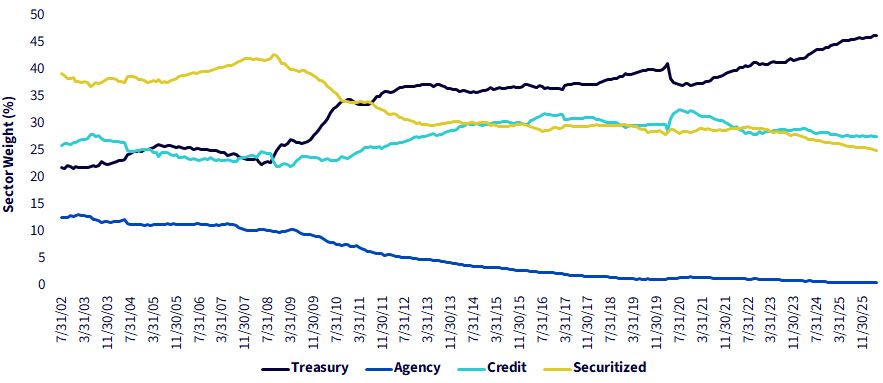
With the U.S. budget deficit standing at close to $1.8 trillion and projected to increase to just under $2.0 trillion for fiscal year 2026, the amount of Treasury marketable public debt outstanding has, and more importantly, will continue to rise if the deficit does not reverse course in coming years. As a result, the Treasury weighting in the Agg has continued to move higher and higher and currently stands at about 47%. Translation: almost one-half of the Agg consists of Treasuries.
Figure 1: Agg Sector Weightings
Source: WisdomTree, as of 5/8/2026. You cannot invest directly in an index.
Let’s compare that to the weightings for the Agg over the last twenty to twenty-five years. The enclosed graph underscores how the four major sectors have evolved over this timeframe. As I highlighted earlier, the Treasury weighting has surged to roughly 47% from 22% in 2002. On the other side of the ledger, the weighting for Federal Agency securities has declined from roughly 13% down to its current reading of below 1%. Securitized credit was the top weighting back in 2002 at just under 40% but has now dropped down to 25%. Rounding out the slate, investment grade corporates have remained relatively steady, straddling the 25% threshold.
With budget deficits expected to remain elevated, outstanding Treasury supply will also remain high and could very well increase. Thus, the Agg’s weighting for Treasuries could arguably pierce the 50% mark looking ahead. In fact, while Treasury recently signaled no changes/increases to coupon auction sizes “for at least the next several quarters”, the minutes for the Treasury Borrowing Advisory Committee (TBAC) did reveal “that increases in coupon issuance could be warranted in FY2027 and discussed potential changes to the forward guidance for Treasury to consider.”
Potential Solution
So, how can a bond investor invest in core fixed income without such an overweight to Treasuries? The answer: the WisdomTree Yield Enhanced U.S. Aggregate Bond Fund (AGGY). AGGY is designed to amend the counter intuitive nature of market cap-based strategies, by applying a rules-based approach that reweights the subcomponents of the Agg, while broadly maintaining familiar risk characteristics. As a result, this investment grade solution seeks to enhance yield while achieving the goal of anchoring one’s bond portfolio with a core holding.
Important Risks Related to this Article
There are risks associated with investing, including possible loss of principal. Fixed income investments are subject to interest rate risk; their value will normally decline as interest rates rise. Fixed income investments are also subject to credit risk, the risk that the issuer of a bond will fail to pay interest and principal in a timely manner, or that negative perceptions of the issuer’s ability to make such payments will cause the price of that bond to decline. Investing in mortgage- and asset-backed securities involves interest rate, credit, valuation, extension and liquidity risks and the risk that payments on the underlying assets are delayed, prepaid, subordinated or defaulted on. Due to the investment strategy of the Fund, it may make higher capital gain distributions than other ETFs. The Fund invests in the securities included in, or representative of, its Index regardless of their investment merit. The Fund does not attempt to outperform its Index. Please read the Fund’s prospectus for specific details regarding the Fund’s risk profile.
Categories
About the contributor

Head of Investment and Fixed Income Strategy
Kevin serves as the Head of Investment and Fixed Income Strategy. In this role, he writes macro and fixed income-related content and works closely with the sales, research and marketing teams. In addition, Kevin conducts client-facing webinars and meetings, providing expertise on WisdomTree’s existing and future bond ETFs. Prior to joining WisdomTree, Kevin spent 30 years at Morgan Stanley, where he was Managing Director and Chief Fixed Income Strategist for Wealth Management. He was responsible for tactical and strategic recommendations and created asset allocation models for fixed income securities. He was a contributor to the Morgan Stanley Wealth Management Global Investment Committee, primary author of Morgan Stanley Wealth Management’s monthly and weekly fixed income publications, and collaborated with the firm’s Research and Consulting Group Divisions to build ETF and fund manager asset allocation models. Kevin has an MBA from Pace University’s Lubin Graduate School of Business, and a B.S. in Finance from Fairfield University.