


Gold and Silvers’ Most Volatile Day
Published February 3, 2026

Key Takeaways
- On January 30, 2026, gold and silver experienced their most extreme intraday volatility on record, with silver plunging 26% in a single day, underscoring a regime shift in precious metals that challenges traditional risk and valuation models.
- Despite the dramatic price swings driven by geopolitical anxiety and shifting Federal Reserve leadership expectations, futures positioning and ETP flows show little evidence of an institutional speculative bubble, suggesting volatility was amplified by retail or OTC market activity instead.
- The sharp drawdown may have cleared speculative excess, potentially creating a more attractive entry point for long-term strategic investors seeking gold and silver exposure amid structural tailwinds such as geopolitical fragmentation, fiscal dominance concerns, and a broadening global buyer base.
An Unprecedented Spike in Intraday Volatility
Friday, January 30, 2026, will likely go down in history as the most volatile day for both gold and silver. When measured by the difference between intraday highs and lows (as a percentage of the intraday high), January 30, 2026, clearly stands out (Figure 1).
Admittedly, we do not have reliable intraday price data prior to the early 1990s, meaning the Hunt Brothers episode1 cannot be included in our analysis of intraday volatility. That said, the end-of-day–to–end-of-day decline in silver of 26% on Friday was far larger than any comparable daily price decline observed during the 1980s.
Figure 1: Intraday Moves in Gold and Silver
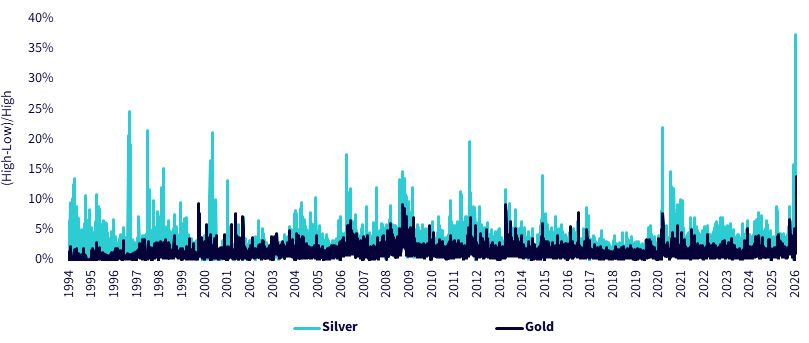
Sources: Bloomberg, WisdomTree, Daily data, for the period January 1994 to January 2026. Past performance is not indicative of future results.
Tarnish, Reputation, and Market Psychology
Gold is chemically inert. Silver, on the other hand, is famous for its reaction with compounds in the air, which manifests as a black layer on the metal. In financial markets, gold has traditionally enjoyed a similarly "untarnished" reputation as an antidote to general market volatility.
Silver's reputation, by contrast, was famously tarnished during the Hunt Brothers saga. Friday's events have raised concerns that gold itself may have been "tarnished" by its close association with its sister metal.
Extreme Price Swings in a Matter of Hours
Heading into last week, both gold and silver had already been moving rapidly. Gold reached an intraday high of USD 5,595 per ounce on 29 January 2026, only to retreat below USD 5,200 per ounce later the same day. By 30 January, prices had declined below USD 5,000 per ounce intraday.
These are price swings that would typically be expected over the course of a year, not within a single trading day.
A Structural Break in Precious Metals
We have previously argued that both gold and silver appear to be undergoing a structural break. Heightened geopolitical tensions, concerns around fiscal dominance, and growing unease over central-bank independence have all acted as catalysts.
These forces are being compounded by a broadening buyer base for gold, including Chinese insurance companies, Indian pension funds, and the rapid growth of digital and tokenized forms of gold exposure. Together, these dynamics have pushed precious-metal prices into territory that traditional valuation and volatility models, which have served investors well for decades, increasingly struggle to capture.
Why Did Volatility Surge So Suddenly?
Market anxiety intensified following President Trump's attempt to acquire Greenland, reigniting geopolitical risk premia. Gold's role as a defensive asset gained renewed traction as a result. While no immediate tariffs or use of force were announced, markets remain sensitive to the risk that tensions could re-emerge.
Another source of uncertainty was the future leadership of the Federal Reserve, and whether the next Chair would be perceived as politically independent. The nomination of Kevin Walsh appears to have eased some of these concerns, removing a degree of political risk and taking momentum out of gold and silver prices, contributing to the sharp reversals observed.
Futures Markets do not Signal a Speculative Frenzy
If this narrative were the sole driver, we would have expected elevated activity on gold and silver futures exchanges. However, this has not been the case.
Looking at net speculative positioning on the Commodity Exchange (COMEX), neither gold (Figure 2) nor silver (Figure 3) shows evidence of extreme positioning. Silver, in particular, appears relatively bearish.
Figure 2: Net Speculative Positioning in Gold Futures
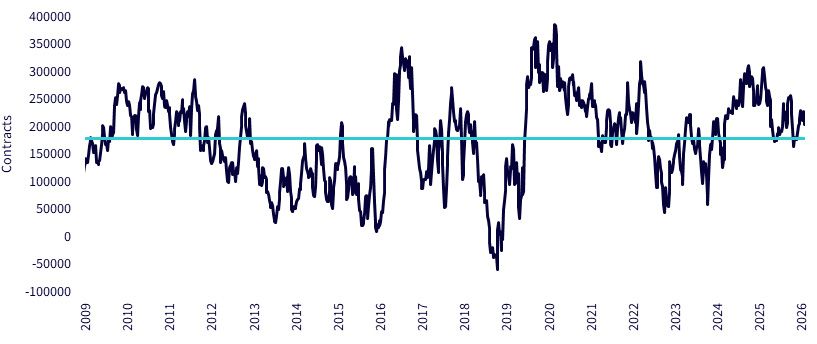
Figure 3: Net Speculative Positioning in Silver Futures
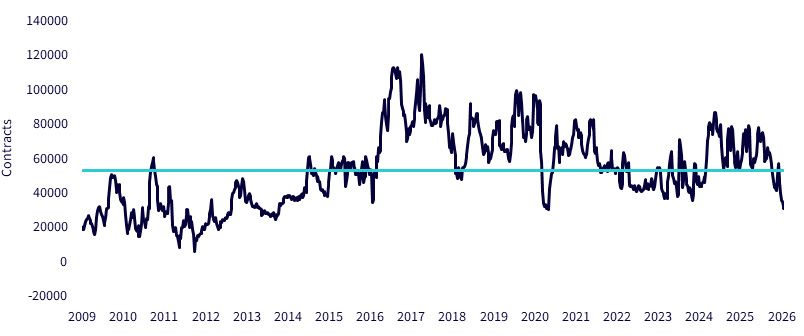
Source: WisdomTree, Bloomberg. ETP data: January 2009 – January 2026. Past performance is not indicative of future results.
Exchange-Traded Products Tell a Similar Story
We have seen a pickup in gold exchange-traded product (ETP) buying in recent weeks (latest data to 23 January, World Gold Council), but not on the scale observed in 2024.
Based on Bloomberg data, which is less complete and less clean than data from the World Gold Council (WGC) for gold, we believe silver ETPs experienced large net outflows in North America and Europe, offset only by modest inflows in India and other regions.
Figure 4: Gold ETF Flows by Region
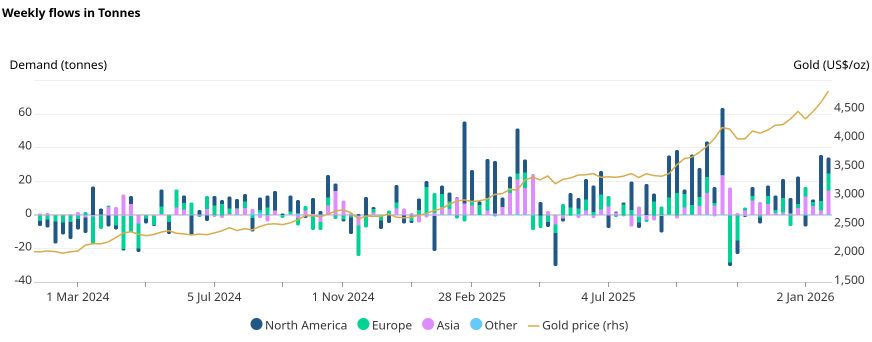
Source: Bloomberg, Company Filings, ICE Benchmark Administration and World Gold Council, as of January 23, 2026. Past performance is not indicative of future results.
Volatility Likely Driven Outside Traditional Channels
Taken together, the traditional institutional channels of futures markets and exchange-traded products do not point to a speculative frenzy. This suggests that retail investors or over-the-counter (OTC) markets may have seen elevated buying, and subsequent selling, over the past month. Activity in these channels may have amplified volatility.
The fact that China has taken measures to dampen silver trading suggests policymakers were responding to a perceived problem2.
Clearing the Speculative Froth
We believe the sharp drawdown on Friday is likely to discourage the speculative end of buying.
Shortly after publishing our gold outlook, we were surprised by how rapidly prices continued to rise and pass our year-end forecasts. Friday's drawdown takes prices firmly below our year-end forecasts now. While further bouts of volatility cannot be ruled out, Friday's market moves may have flushed out a significant portion of speculative froth, potentially creating space for long-term strategic buyers to re-allocate.
1 The Hunt Brothers saga describes the late-1970s attempt by Nelson Bunker Hunt and William Herbert Hunt to corner the silver market, which drove prices to nearly USD 50 per ounce in 1980 before regulatory intervention caused a sharp collapse.
2 China introduced stricter export controls on silver effective January 1, 2026:
- Strategic export licensing: Only state-approved companies meeting high production and financial criteria are allowed to export silver, effectively excluding many small and mid-sized exporters from the market.
- Export licensing regime replaces old quotas, tightening global supply. Analysts say this will squeeze international availability and push prices higher.
Domestic trading venues in China have tightened risk control measures for gold and silver contracts:
Shanghai Gold Exchange and Shanghai Futures Exchange adjusted key parameters on gold and silver futures, such as:
- Increasing margin requirements
- Changing daily price limits (price bands) to reduce volatility.
Categories

About the contributor

Nitesh Shah
Head of Commodities and Macroeconomic Research, WisdomTree Europe
@NiteshShahWTNitesh Shah is a seasoned financial professional with over 24 years of experience in research and investment strategy. As Head of Commodities & Macroeconomic Research at WisdomTree Europe, he leads market analysis and insights across asset classes, with a focus on commodities and exchange-traded products. Previously, he held roles at Moody’s, HSBC Investment Bank, The Pension Protection Fund, and Decision Economics, building expertise in market analysis and strategy. Nitesh earned a master’s degree in International Economics and Finance from Brandeis University and a bachelor's in Economics from the London School of Economics. His insights are frequently featured in financial media, and he is a sought-after speaker at industry events. He also hosts the ‘Commodity Exchange’ podcast, where he discusses trends shaping global markets. Passionate about guiding investors, Nitesh provides actionable insights to help them navigate complex financial landscapes.