


What If: The Other Side of the Trade
Published October 22, 2025

Kevin Flanagan
Head of Investment and Fixed Income Strategy
Key Takeaways
- Following September’s rate cut, markets are pricing in further Federal Reserve easing, driven by perceived labor market weakness.
- 2024’s labor data shows that downward payroll revisions misled markets before a late-year rebound…could 2025 follow a similar trajectory?
- If the labor market is nearing a bottom and job creation surprises to the upside, investors may need to rethink the consensus Fed path.
Up to now, the Federal Reserve and the bond market have been operating under the assumption that the employment setting has been cooling in a somewhat visible fashion. In fact, recent comments from Powell & Co. underscore how the employment aspect of their dual mandate is where the greater risk may lie. No doubt this was the reason behind September’s rate cut and the expectation of another easing move at this month’s FOMC meeting, and even potentially at the December policy making gathering.
That got me thinking. Back in my days on the fixed income trading floor, we would always consider the “other side of the trade.” In this case, it would be what if the labor market already reached its low point and that some better readings could be looming on the horizon?
U.S. Total Nonfarm Payrolls
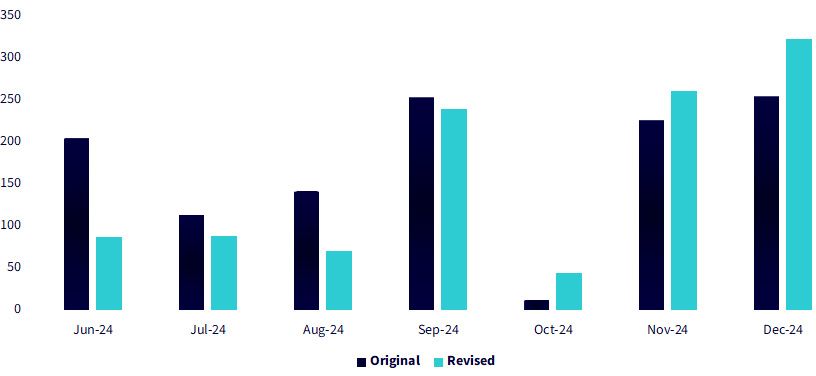
Source: Bureau of Labor Statistics, as of 10/17/25.
What struck me most were the parallels between what the jobs numbers did last year, as compared to this year’s experience. The downward revisions we saw in summer’s nonfarm payrolls changed the entire perception of labor market conditions, from solid to visible cooling. After a quick glance at the enclosed chart, you might be saying to yourself, this was the 2025 experience, NOT what occurred a year ago. But this chart is for 2024!
As you can see, some noteworthy downward revisions also occurred during the June–August 2024 period. Over this three-month period, the level of new job creation was scaled back by 216,000, which is not too far removed from the 258,000 downward revisions that changed everything this year. As you may recall, last year’s revisions ultimately led to the beginning of the rate cut cycle, and fast-forward to the 2025 experience, the resumption of easing moves at last month’s FOMC meeting.
However, check out what happened in Q4 of last year (the October readings can be discarded due to the negative impacts of both Hurricanes Helene and Milton). Indeed, not only did the November and December payrolls bounce back in a noticeable way, but they were then revised upward.
Conclusion
For the record, I’m not saying that we are going to see the same end result for the final two months of this calendar year. In fact, one could argue that the November 2024 nonfarm payroll number may have been somewhat inflated by the fact that the aforementioned hurricanes were over. However, the “student body right” narrative for the Fed and the bond market is, without a doubt, centered on a weakening employment setting, leading to Fed Funds Futures pricing in three rate cuts for 2026. Hence, what if some version of last year’s payroll phenomenon occurs this year? Now that’s what is called the other side of the trade, for sure.
Categories
About the contributor

Kevin Flanagan
Head of Investment and Fixed Income Strategy
Kevin serves as the Head of Investment and Fixed Income Strategy. In this role, he writes macro and fixed income-related content and works closely with the sales, research and marketing teams. In addition, Kevin conducts client-facing webinars and meetings, providing expertise on WisdomTree’s existing and future bond ETFs. Prior to joining WisdomTree, Kevin spent 30 years at Morgan Stanley, where he was Managing Director and Chief Fixed Income Strategist for Wealth Management. He was responsible for tactical and strategic recommendations and created asset allocation models for fixed income securities. He was a contributor to the Morgan Stanley Wealth Management Global Investment Committee, primary author of Morgan Stanley Wealth Management’s monthly and weekly fixed income publications, and collaborated with the firm’s Research and Consulting Group Divisions to build ETF and fund manager asset allocation models. Kevin has an MBA from Pace University’s Lubin Graduate School of Business, and a B.S. in Finance from Fairfield University.