


Beyond the 60/40: Building a Smarter International Core Allocation
Published September 8, 2025

Christopher Gannatti, CFA
Global Head of Research
Key Takeaways
- In mid-2025, international equities surged ahead of U.S. markets by nearly 11%, while trading at a steep 34.6% valuation discount, highlighting a rare moment of both momentum and value opportunity abroad.
- NTSI delivered stronger downside protection and competitive long-term returns versus pure equity or traditional 60/40 blends, showcasing the advantages of its embedded Treasury overlay during volatile market regimes.
- Ranked in the top decile of Morningstar’s revamped Global Moderately Aggressive Allocation category, NTSI has outperformed a majority of its peers, cementing its role as a smarter global core allocation solution.
One of the foundational challenges in asset allocation is the trade-off between long-term return potential and short-term drawdown risk. For decades, the 60/40 portfolio served as a pragmatic answer, a middle path between equity growth and bond ballast. But as macroeconomic regimes shifted and correlations between stocks and bonds evolved, that framework began to feel more like a blunt instrument than a precision tool.1 At WisdomTree, the Efficient Core concept was built from the ground up to rethink this balance. Instead of combining full allocations to equities and bonds, Efficient Core strategies embed the diversification power of Treasuries directly into the equity sleeve through the use of a Treasury futures overlay. This preserves the return profile of equities while subtly reshaping the risk profile, less like chopping up a portfolio and more like engineering a more capital-efficient chassis.
The key intuition is simple but powerful: over time, intermediate U.S. Treasuries tend to exhibit a negative or low correlation to equity markets, especially during periods of stress.2 Embedding that diversifier into the core of an equity exposure can reduce volatility and improve risk-adjusted returns without asking investors to give up equity beta or alter their broader allocation goals. And because the strategy is delivered through a single exchange-traded fund (ETF), investors gain access to both sides, equity exposure and fixed income diversification, within a highly transparent, tax-aware and liquid structure. The result isn't just a different mix of assets. In our opinion, it's a more efficient use of capital, freeing up room elsewhere in the portfolio to take on complementary exposures, whether that's alternatives, real assets or high-conviction strategies with potential to generate alpha.
This framework isn't just theoretical. It's already being applied across geographies, including international developed markets. That's where the WisdomTree International Efficient Core Fund (NTSI) comes into focus. Many investors are under-weight in international equities, not because they doubt the case, but because the volatility and drawdown behavior of markets benchmarked to the widely followed MSCI EAFE Index have historically made them harder to hold through full cycles. By applying the Efficient Core lens, 90% international equity exposure (500 large market capitalization stocks) paired with a 60% overlay of U.S. Treasury futures, NTSI is a solution that maintains international equity participation while delivering a potentially more tempered volatility experience.
The Catalyst to Look at International EquitiesRelative to U.S. Equities
After years of underperformance and persistent valuation discounts, international equities are suddenly back in the spotlight. Investors in mid-2025 are increasingly revisiting global allocations for two compelling reasons: first, international stocks continue to trade at a steep valuation gap relative to U.S. equities, with a forward P/E discount exceeding 34.6%, far below the long-term median (as seen in figure 1a); second, performance momentum has shifted this year, with non-U.S. markets outperforming the U.S. by almost 11% year-to-date (as seen in figure 1b). This rare combination of structural undervaluation and emerging performance leadership is prompting a critical question: Is this the start of a durable rotation or just a countertrend rally in a long-running U.S. equity dominance cycle?
Figure 1a: The Great Valuation Divergence: U.S. vs. ex-U.S. Equities as of Mid-2025
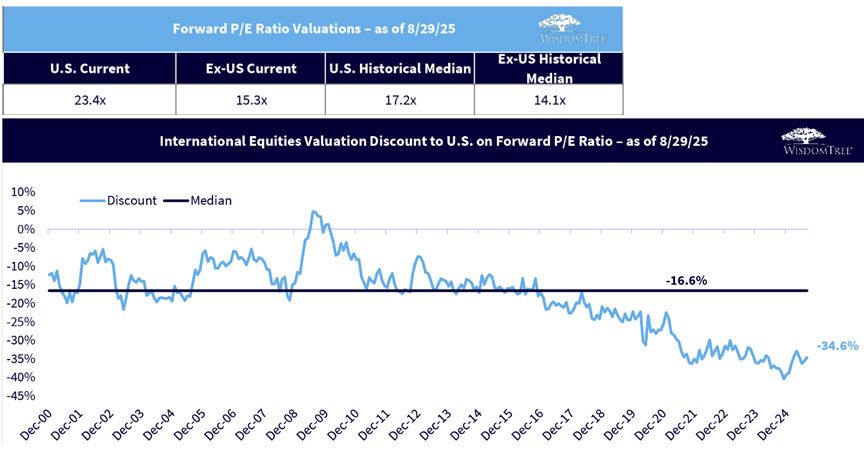
Sources: WisdomTree, MSCI and S&P. Data begins 12/29/00 to coincide with the inception of the MSCI ACWI ex USA Index. U.S. equities are measured by the S&P 500 Index. Ex-U.S. is measured by the MSCI ACWI ex USA Index. You cannot invest directly in an index. Past performance is not indicative of future returns.
Figure 1b: Is This the Start of Global Equity Performance Rotation or Just a Breather?
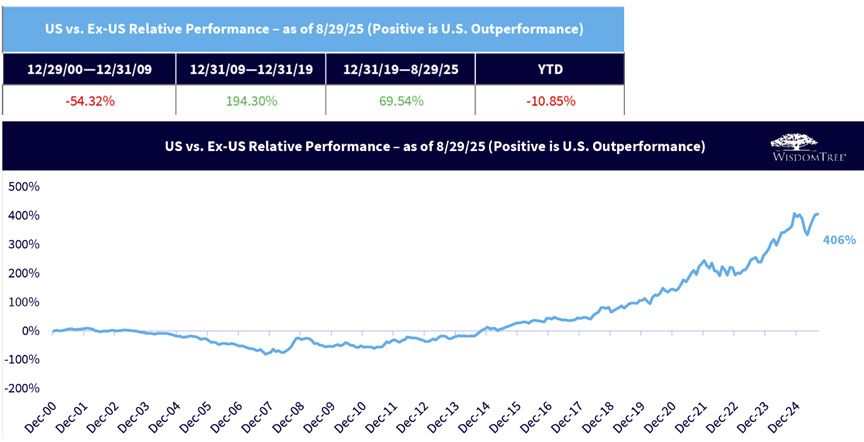
Sources: WisdomTree, MSCI and S&P. Data begins 12/29/00 to coincide with the inception of the MSCI ACWI ex USA Index. U.S. equities are measured by the S&P 500 Index. Ex-U.S. is measured by the MSCI ACWI ex USA Index. You cannot invest directly in an index. Past performance is not indicative of future returns.
In short, this creates the backdrop that makes NTSI more interesting.
Evaluating the Performance of Multi-Asset Strategies
However, evaluating performance introduces a nuanced challenge. Traditional equity benchmarks such as the MSCI EAFE Index, while widely used for international exposure, fall short in capturing the dual-asset nature of NTSI. Because EAFE is 100% equities, it does not account for the fixed income component that plays a crucial role in NTSI's risk-return profile. To address this, we constructed a blended exposure using allocations to both the iShares MSCI EAFE ETF (EFA) and the iShares U.S. Core Aggregate Bond ETF (AGG). This composite provides an important 60/40 international equity to U.S. fixed income reference point.
Why this SPECIFIC blend?
- iShares MSCI EAFE ETF (EFA): This is the largest ETF, by assets under management, that is tracking the total return performance, before fees, of the MSCI EAFE Index. The MSCI EAFE Index is a closely followed benchmark among U.S. investors who are seeking to look at how developed international equities are doing.
- iShares U.S. Core Aggregate Bond ETF (AGG): This is the largest ETF, by assets under management, that is tracking the total return performance, before fees, of the Bloomberg U.S. Aggregate Bond Index. For U.S. investors looking at the returns of investment-grade, U.S. fixed income, this is the most widely followed index.
Figure 2: Standardized Return
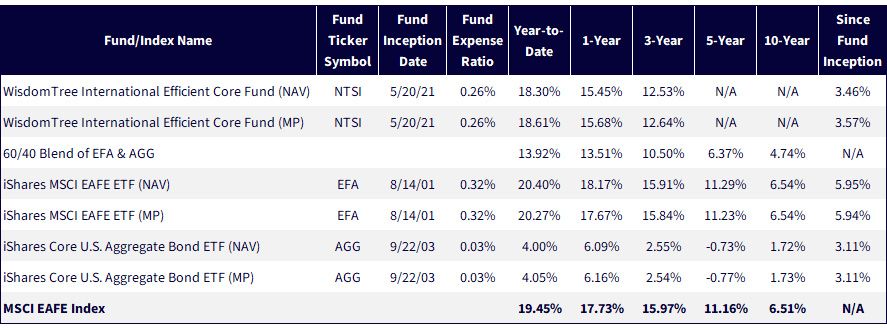
Sources: Morningstar, FactSet and WisdomTree, specifically data is from the PATH Fund Comparison Tool, accessed as of 7/30/25, but showing returns for the period ended 6/30/25. NAV denotes total return performance at net asset value. MP denotes market price performance. The performance data quoted represents past performance and is not indicative of future results. Investment return and principal value of an investment will fluctuate so that an investor's shares, when redeemed, may be worth more or less than their original cost. Current performance may be lower or higher than the performance data quoted. For the most recent month-end and standardized performances, click the respective ticker: NTSI, EFA, AGG.
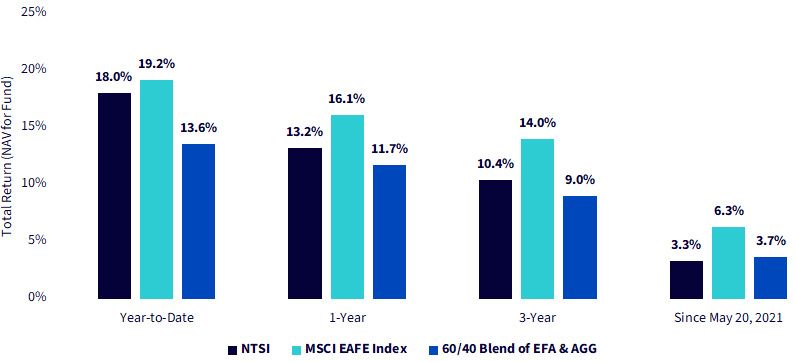
In figure 3, we see:
- Near-Term Strength in Equities: In the year-to-date and one-year periods, the MSCI EAFE Index outperforms both NTSI and the 60/40 EFA/AGG blend, reflecting the strength of pure equity beta in recent market conditions, particularly in developed international markets.
- Since Inception Trade-off: Since NTSI's inception in May 2021, performance is very similar to the 60/40 blend.
Figure 3: Efficient Core Exposure in a World of Inefficient Comparisons
What Is the Global Moderately Aggressive Allocation Category?
In 2025, Morningstar transformed the way global allocation strategies are classified, replacing the old, inconsistent "World Allocation" bucket with five risk-calibrated categories based on equity-like volatility.3 The Global Moderately Aggressive Allocation group now serves as a clear benchmark for strategies targeting long-term volatility equivalent to a 70%–85% global equity portfolio. These funds are no longer loosely diversified vehicles; they're structured, globally diversified and risk-banded systems requiring exposure across multiple asset classes and geographies, with U.S. assets capped at 75%.4 Most portfolios land at roughly three-quarters equity, making them ideal for long-horizon investors seeking disciplined global participation with embedded risk controls. Crucially, the value lies not in tactical positioning, but in the clarity of the strategic architecture: defined volatility targets, enforced global mandates and better-aligned benchmarks now enable allocators to evaluate these strategies with sharper precision, on terms like downside capture and capital efficiency, bringing rigor and comparability to what was once a murky segment.
In figure 4, we see:
- Competing with the Big Leagues: Within the full Global Moderately Aggressive Allocation category, dominated by nearly 200 mostly actively managed mutual funds, NTSI ranks in the top decile year-to-date—beating 96% of peers—and in the top third over one year. This shows it can compete head-to-head with complex, often more expensive, multi-asset strategies.
- Dominating the Small, More Limited ETF Subset: Among ETFs in the same peer group, NTSI isn't just competitive, it's dominant. It ranks #1 across some periods, beating 100% of its ETF peers year-to-date and over one year, underscoring its leadership in a space where index-based and rules-based strategies are gaining traction, but product breadth remains limited.
Figure 4: Standing Out in Two Worlds: NTSI vs. Active Funds and the ETF Peer Set
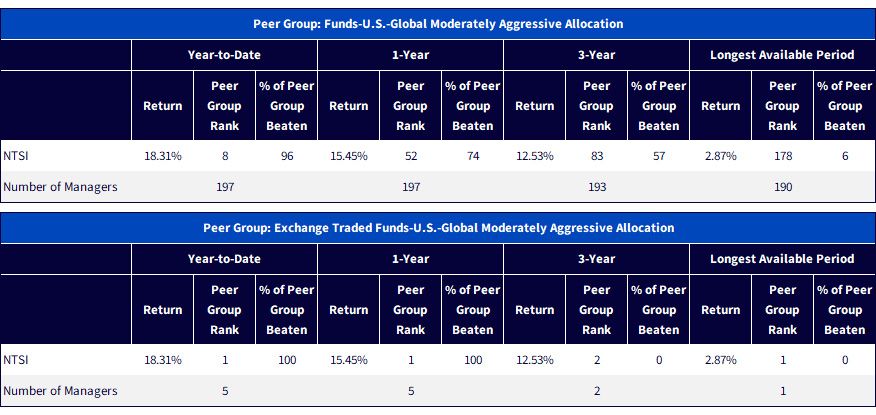
Source: Morningstar Direct. The longest available period is from 6/1/21 to 6/30/25, based on 6/1/22 being the closest next month start relative to NTSI's inception on 5/20/22. Morningstar, Inc., 2025. All rights reserved. The information contained herein: (1) is proprietary to Morningstar and/or its content providers; (2) may not be copied or distributed; and (3) is not warranted to be accurate, complete or timely. Neither Morningstar nor its content providers is responsible for any damages or losses arising from any use of this information. Past performance, rankings and ratings are no guarantee of future results. The % of Peer Group Beaten is the fund's total-return percentile rank compared to all funds within the same Morningstar Category and is subject to change each month. Regarding ranking of funds, 1 = Best. Past performance is not indicative of future results.
Conclusion: A Smarter Core for Global Exposure
NTSI is helping to redefine what a global core allocation can be, combining equity-like return potential with structural balance across regions and asset classes. In a category long cluttered with inconsistent strategies, NTSI stands out for its clarity, discipline and results. It competes head-to-head with traditional mutual funds and leads among ETFs, offering a thoughtfully constructed portfolio that doesn't rely on heavy U.S. tilts or tactical guesswork. For investors seeking long-term global growth in a cleaner, more transparent format, NTSI offers not just diversification but direction.
Figure 5: Additional Information
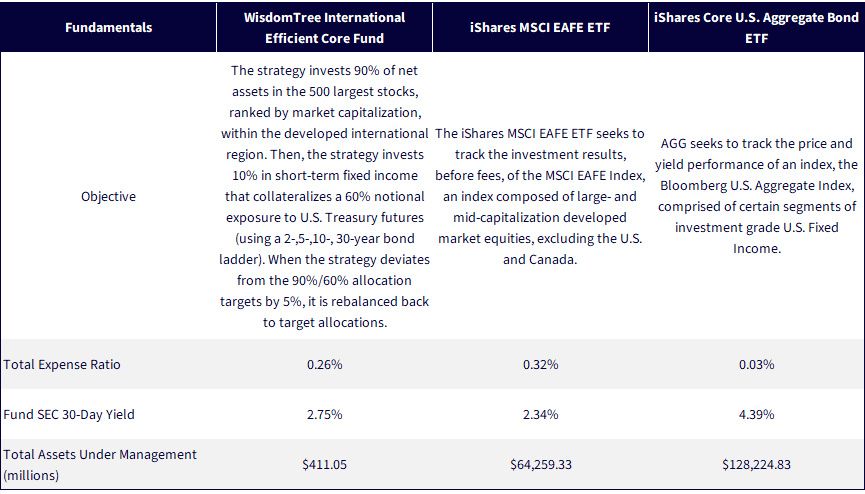
Sources: WisdomTree and iShares. Assets under management, as of 7/29/25.
1 Source: L. Swinkels, R. Molenaar, E. Sénéchal and Z. Wang, "New research into the stockbond correlation shows when they correlate – and when they don't" (Robeco Insights), Robeco, April 2024.
2 Source: "Correlation anxiety and the reality of diversification," SEI, 2024.
3 Source: "Morningstar category changes – April 30 2025" [FAQ document], Morningstar, 4/30/25.
4 Source: "Morningstar category changes – April 30 2025" [FAQ document], Morningstar, 4/30/25.
Important Risks Related to this Article
NTSI: There are risks associated with investing, including the possible loss of principal. Investments in non-U.S. securities involve political, regulatory and economic risks that may not be present in U.S. securities. For example, foreign securities may be subject to risk of loss due to foreign currency fluctuations, political or economic instability, or geographic events that adversely impact issuers of foreign securities. While the Fund is actively managed, the Fund’s investment process is expected to be heavily dependent on quantitative models, and the models may not perform as intended. Equity securities, such as common stocks, are subject to market, economic and business risks that may cause their prices to fluctuate. The Fund invests in derivatives to gain exposure to U.S. Treasuries. The return on a derivative instrument may not correlate with the return of its underlying reference asset. The Fund’s use of derivatives will give rise to leverage, and derivatives can be volatile and may be less liquid than other securities. As a result, the value of an investment in the Fund may change quickly and without warning, and you may lose money. Interest rate risk is the risk that fixed income securities and financial instruments related to fixed income securities will decline in value because of an increase in interest rates and changes to other factors, such as perception of an issuer’s creditworthiness. Diversification does not eliminate the risk of experiencing investment losses. Please read the Fund’s prospectus for specific details regarding the Fund’s risk profile.
EFA: International investing involves risks, including risks related to foreign currency, limited liquidity, less government regulation and the possibility of substantial volatility due to adverse political, economic or other developments. These risks often are heightened for investments in emerging/ developing markets or in concentrations of single countries.
Diversification may not protect against market risk or loss of principal. Shares of ETFs are bought and sold at market price (not NAV) and are not individually redeemed from the fund. Any applicable brokerage commissions will reduce returns.
AGG: Fixed income risks include interest-rate and credit risk. Typically, when interest rates rise, there is a corresponding decline in bond values. Credit risk refers to the possibility that the bond issuer will not be able to make principal and interest payments.
Diversification may not protect against market risk or loss of principal. Shares of ETFs are bought and sold at market price (not NAV) and are not individually redeemed from the fund. Any applicable brokerage commissions will reduce returns.
Categories

About the contributor

Christopher Gannatti, CFA
Global Head of Research
Christopher Gannatti began at WisdomTree as a Research Analyst in December 2010, working directly with Jeremy Schwartz, CFA®, Director of Research. In January of 2014, he was promoted to Associate Director of Research where he was responsible to lead different groups of analysts and strategists within the broader Research team at WisdomTree. In February of 2018, Christopher was promoted to Head of Research, Europe, where he was based out of WisdomTree’s London office and was responsible for the full WisdomTree research effort within the European market, as well as supporting the UCITs platform globally. In November 2021, Christopher was promoted to Global Head of Research, now responsible for numerous communications on investment strategy globally, particularly in the thematic equity space. Christopher came to WisdomTree from Lord Abbett, where he worked for four and a half years as a Regional Consultant. He received his MBA in Quantitative Finance, Accounting, and Economics from NYU’s Stern School of Business in 2010, and he received his bachelor’s degree from Colgate University in Economics in 2006. Christopher is a holder of the Chartered Financial Analyst Designation.