
SHAG
Yield Enhanced U.S. Short-Term Aggregate Bond Fund

Published August 4, 2025

Head of Investment and Fixed Income Strategy
The busy week for the markets last week culminated in the July Employment Situation report. With the jobs data coming after the July FOMC meeting, investors were greeted with a dynamic that is somewhat unusual. With the July jobs data now in, the markets are faced with a visibly different labor market backdrop than what existed at 8:29 Friday morning prior to the release, i.e., much softer than previously thought over the last three months (see below).
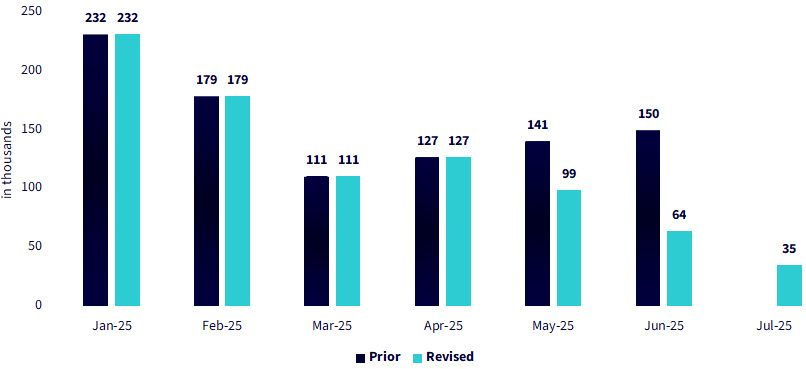
Source: Bureau of Labor Statistics, as of 8/1/25.
Here are some takeaways:
Against this shifting labor market, and potential Fed monetary policy backdrop, how should fixed income investors position their bond portfolio? If the Fed does shift into “rate-cut” mode, the front-end of the yield curve, or short-duration strategies, would be expected to outperform. I suggest investors consider either the WisdomTree Yield Enhanced U.S. Short-Term Aggregate Bond Fund (SHAG) or, for a Treasuries-only solution, the WisdomTree 1-3 Year Laddered Treasury Fund (USSH) from our fixed income suite.
There are risks associated with investing, including possible loss of principal. Please read the Fund's prospectus for specific details regarding the Fund's risk profile.
SHAG: Fixed income investments are subject to interest rate risk; their value will normally decline as interest rates rise. Fixed income investments are also subject to credit risk, the risk that the issuer of a bond will fail to pay interest and principal in a timely manner, or that negative perceptions of the issuer’s ability to make such payments will cause the price of that bond to decline. Investing in mortgage- and asset-backed securities involves interest rate, credit, valuation, extension and liquidity risks and the risk that payments on the underlying assets are delayed, prepaid, subordinated or defaulted on. Due to the investment strategy of the Fund, it may make higher capital gain distributions than other ETFs.
USSH: Because the Fund is new, it has no performance history. U.S. Treasury obligations may provide relatively lower returns than those of other securities. Changes to the financial condition or credit rating of the U.S. government may cause the value to decline. Fixed income securities are subject to interest rate, credit, inflation, and reinvestment risks. Generally, as interest rates rise, the value of fixed-income securities falls. Please read the Fund's prospectus for specific details regarding the Fund's risk profile.

Head of Investment and Fixed Income Strategy
Kevin serves as the Head of Investment and Fixed Income Strategy. In this role, he writes macro and fixed income-related content and works closely with the sales, research and marketing teams. In addition, Kevin conducts client-facing webinars and meetings, providing expertise on WisdomTree’s existing and future bond ETFs. Prior to joining WisdomTree, Kevin spent 30 years at Morgan Stanley, where he was Managing Director and Chief Fixed Income Strategist for Wealth Management. He was responsible for tactical and strategic recommendations and created asset allocation models for fixed income securities. He was a contributor to the Morgan Stanley Wealth Management Global Investment Committee, primary author of Morgan Stanley Wealth Management’s monthly and weekly fixed income publications, and collaborated with the firm’s Research and Consulting Group Divisions to build ETF and fund manager asset allocation models. Kevin has an MBA from Pace University’s Lubin Graduate School of Business, and a B.S. in Finance from Fairfield University.


