
AGGY
Yield Enhanced U.S. Aggregate Bond Fund

Published July 17, 2025

Senior Associate, Capital Markets
Equity exposure alone doesn't build a resilient portfolio. In the final part of our ETF series, we explore how fixed income ETFs—across core, credit, floating rate and alternative sectors—can strengthen portfolios with liquidity, income diversification and structural efficiency.
A well-rounded portfolio isn't built on equities alone. Fixed income ETFs provide stability, predictable cash flow and diversification when stock markets stumble. Given ETFs trade intraday, dozens (or thousands) of bonds can be bundled in one ticker, and using the ETF wrapper's tax-efficient creation/redemption process, fixed income ETFs have become the modern way to own bonds—without the hassle of trading individual notes or paying typical bond fund markups.
WisdomTree Yield Enhanced U.S. Aggregate Bond Fund (AGGY) tracks a modified version of the Bloomberg U.S. Aggregate (AGG) that tilts toward higher-yielding issues while keeping familiar sector weights. Think of it as the portfolio's ballast: broad, investment-grade exposure that historically cushions equity drawdowns yet offers more income than the vanilla AGG.
For investors who worry about rising rates, WisdomTree Yield Enhanced U.S. Short-Term Aggregate Bond Fund (SHAG) trims duration to roughly two years while still holding a diversified mix of government, corporate and securitized bonds—reducing price sensitivity if yields climb.
When the Federal Reserve is tightening, a low duration sleeve such as WisdomTree Floating Rate Treasury Fund (USFR) becomes valuable. It owns U.S. Treasury notes whose coupons reset weekly with three-month t-bill yields, so income rises in lockstep with policy rates while interest rate risk stays minimal. That makes USFR a popular parking place for liquidity or as the "dry powder" component of a tactical bond barbell.
Core Treasuries defend—but corporate credit can enhance returns. WisdomTree U.S. Corporate Bond Fund (QIG)1 weights issuers by fundamental strength (free cash flow, growth and low leverage) rather than debt outstanding, seeking a better risk-reward mix than traditional cap-weighted credit indexes. It gives portfolios an income uptick while staying in the investment-grade universe.
Adding currency and regional diversification can further smooth portfolio volatility. WisdomTree Emerging Markets Local Debt Fund (ELD) actively allocates among local-currency government and corporate bonds across 15–25 EM countries, balancing yield opportunities with risk management. Because returns reflect both coupon income and shifting foreign exchange values, ELD often behaves differently from U.S. rate-sensitive bonds—useful when domestic and international cycles diverge.
Traditional core bonds may not deliver enough yield for some objectives. WisdomTree Alternative Income Fund (HYIN) tracks a rules-based index of non-traditional credit—business-development-company debt, CLOs, mortgage REIT securities and more—assets historically difficult to access in a daily liquidity vehicle. Adding a small slice can lift portfolio income and diversify away from plain-vanilla rate risk, though investors should size positions to reflect the sector's higher volatility.
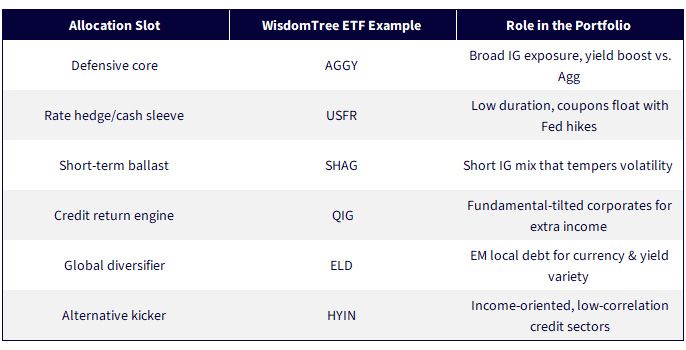
For definitions of terms in the table above, please visit the glossary.
Blending these ETFs can create a bond portfolio that (1) anchors overall risk, (2) keeps pace with shifting rate regimes, and (3) taps into differentiated sources of income—all without straying outside WisdomTree's family of transparent, tax-efficient wrappers. The result: a fixed income allocation that does more than just "sit there"—it works actively and intelligently alongside your equity positions to pursue steadier, more resilient total returns.
From wrapper mechanics to strategy selection and now fixed income implementation, this series has unpacked how ETFs function at every level of portfolio construction. With the right tools, investors can build portfolios that are not only efficient, but also purpose-built for today's complex market environment.
1 Prior to 07/08/24 the fund’s ticker symbol was WFIG. The fund’s name, objective and strategy were not affected at that time
There are risks associated with investing, including possible loss of principal. Please read the Fund’s prospectus for specific details regarding the Fund’s risk profile.
AGGY/SHAG: Fixed income investments are subject to interest rate risk; their value will normally decline as interest rates rise. Fixed income investments are also subject to credit risk, the risk that the issuer of a bond will fail to pay interest and principal in a timely manner, or that negative perceptions of the issuer’s ability to make such payments will cause the price of that bond to decline. Investing in mortgage- and asset-backed securities involves interest rate, credit, valuation, extension and liquidity risks and the risk that payments on the underlying assets are delayed, prepaid, subordinated or defaulted on. Due to the investment strategy of the Fund, it may make higher capital gain distributions than other ETFs.
USFR: Securities with floating rates can be less sensitive to interest rate changes than securities with fixed interest rates, but may decline in value. Fixed income securities will normally decline in value as interest rates rise. The value of an investment in the Fund may change quickly and without warning in response to issuer or counterparty defaults and changes in the credit ratings of the Fund’s portfolio investments. Due to the investment strategy of this Fund it may make higher capital gain distributions than other ETFs.
QIG: Fixed income investments are subject to interest rate risk; their value will normally decline as interest rates rise. Fixed income investments are also subject to credit risk, the risk that the issuer of a bond will fail to pay interest and principal in a timely manner or that negative perceptions of the issuer’s ability to make such payments will cause the price of that bond to decline. While the Fund attempts to limit credit and counterparty exposure, the value of an investment in the Fund may change quickly and without warning in response to issuer or counterparty defaults and changes in the credit ratings of the Fund’s portfolio investments.
ELD: Foreign investing involves special risks, such as risk of loss from currency fluctuation or political or economic uncertainty. Investments in emerging, offshore or frontier markets are generally less liquid and less efficient than investments in developed markets and are subject to additional risks, such as risks of adverse governmental regulation and intervention or political developments. Derivative investments can be volatile and these investments may be less liquid than other securities, and more sensitive to the effects of varied economic conditions.
Fixed income investments are subject to interest rate risk; their value will normally decline as interest rates rise. In addition, when interest rates fall income may decline. Fixed income investments are also subject to credit risk, the risk that the issuer of a bond will fail to pay interest and principal in a timely manner, or that negative perceptions of the issuer’s ability to make such payments will cause the price of that bond to decline. Unlike typical exchange-traded funds, there is no index that the Fund attempts to track or replicate. Thus, the ability of the Fund to achieve its objective will depend on the effectiveness of the portfolio manager. Due to the investment strategy of this Fund it may make higher capital gain distributions than other ETFs.
HYIN: The Fund invests in alternative credit sectors through investments in underlying closed-end investment companies (“CEFs”), including those that have elected to be regulated as business development companies (“BDCs”), and real estate investment trusts (“REITs”). The value of a CEF can decrease due to movements in the overall financial markets. BDCs generally invest in less mature private companies, which involve greater risk than well-established, publicly traded companies and are subject to high failure rates among the companies in which they invest. By investing in REITs, the Fund is exposed to the risks of owning real estate, such as decreases in real estate values, overbuilding, increased competition and other risks related to local or general economic conditions. The Fund invests in the securities included in, or representative of, its Index regardless of their investment merit, and the Fund does not attempt to outperform its Index or take defensive positions in declining markets.


