


Municipals: Relative Value in U.S. Fixed Income
Published June 11, 2025

Kevin Flanagan
Head of Investment and Fixed Income Strategy
Key Takeaways
- While uncertainty will continue to hover over the bond market, the “good news” is that fixed income yields have returned to normal levels.
- Due to underperformance and attractive tax equivalent yields, municipal bonds offer investors a relative value opportunity in U.S. fixed income.
- WisdomTree’s newly launched municipal funds, WTMU and WTMY, offer tax-equivalent yields that outpace most investment-grade fixed income options, positioning them as attractive solutions for income-seeking investors.
While uncertainty will continue to hover over the money and bond markets in the months ahead, the good news is that investors have been given a scenario where yield levels have returned to "normal" levels. This development has provided a "new" landscape to consider when putting money to work in the U.S. fixed arena. In my opinion, one sector that currently offers relative value is the municipal (muni) bond market.
Relative Value Ratio
Typically, when analyzing the muni market, one key gauge that is focused on is known as the "relative value ratio." This ratio is simply the percentage of the yield offered on a muni security as compared to a U.S. Treasury (UST) security, with the UST 10-Year being the traditional comparison. The general rule of thumb is that the higher this percentage is, the cheaper and better relative value munis will be. Remember, this is before taxes are taken into consideration…more on that aspect down below.
Muni Relative Value Ratios
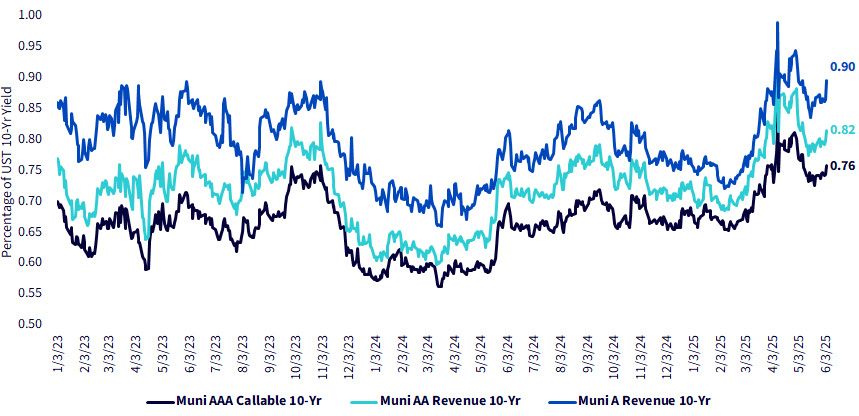
Source: Bloomberg, as of 6/5/25.
The graph above outlines relative ratios over the last nearly 2 ½ years for the three key sectors of the muni market: AAA Callable, AA Revenue and A Revenue. As you can see, the ratios have been on the rise here in 2025, i.e., munis have underperformed the UST 10-Year. In terms of the ratios themselves, each one is about 10 percentage points above its average respective readings during this period.
In fact, as of this writing, municipals are the only major U.S. fixed income sector that has produced a negative return (-1.1%) thus far this year. Three things come to mind for the reason behind this underperformance: increased supply, seasonal selling during tax season and concerns about whether the "big, beautiful bill" would change the federal tax-exempt status of munis. The first two reasons tend to sort themselves out each year, but more importantly, the House-passed version kept this tax-exempt status intact, and it is highly likely the final version of the "bb" bill will as well.
Tax-Equivalent Yield (TEY)
That brings us to the tax-equivalent yield aspect of munis. The TEY enables investors to compare the yield on taxable and tax-exempt securities and represents the yield an investment in taxable bonds would have to earn in order to match, after federal income taxes, the yield available on an investment in tax-exempt municipal bonds.
WisdomTree recently launched two municipal Funds, the WisdomTree Core Laddered Municipal Fund (WTMU) and the WisdomTree High Income Laddered Municipal Fund (WTMY), in conjunction with industry experts Insight Investment. As their titles specify, these two Funds utilize the time-tested laddered approach to fixed income investing and are active solutions.
The TEY for a fund is based on the fund's SEC 30-day yield and uses the highest marginal federal income tax rate. State income and alternative minimum taxes are excluded from the calculation.
Tax-Equivalent Municipal SEC Yields vs. U.S. Fixed Income
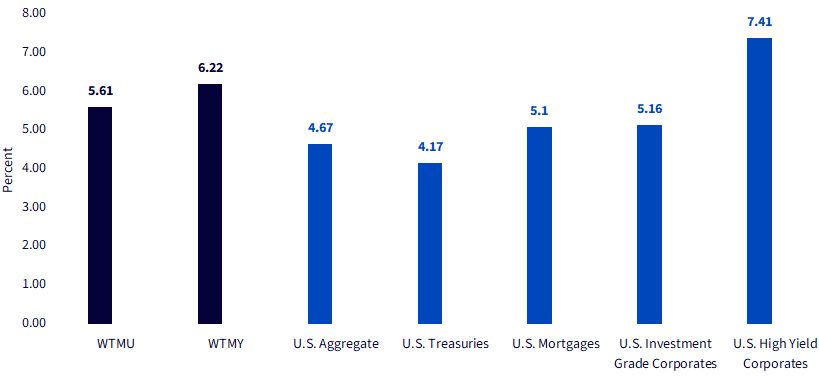
Source: Bloomberg, as of 6/5/25. The performance data quoted represents past performance. Past performance is not indicative of future results. Investment return and principal value of an investment will fluctuate so that an investor's shares, when redeemed, may be worth more or less than their original cost. Current performance may be lower or higher than the performance data quoted. For the most recent month-end and standardized performances, click the relevant ticker: WTMY, WTMU.
The chart above clearly illustrates how the TEYs for both WTMU and WTMY are visibly above the U.S. investment-grade fixed income universe. An investor would need to move strictly into all high-yield corporates in order to find a higher-yielding instrument.
Conclusion
In my opinion, the municipal market appears to be telling investors that, besides the traditional tax-advantaged solution, munis could also be considered for broader fixed income portfolios.
Important Risks Related to this Article
There are risks associated with investing, including the possible loss of principal. Municipal securities carry various risks, including credit, interest rate, prepayment and valuation risks. Issuers may face financial difficulties that impact their ability to meet payment obligations. The value of these securities can fluctuate due to changes in revenue sources, local economic and political conditions and industry-specific downturns (e.g., education, health care, transportation, utilities). Additionally, tax-exempt income from municipal securities could become taxable due to regulatory changes or issuer noncompliance, potentially reducing their value. Fixed income investments are subject to interest rate risk; their value will normally decline as interest rates rise. Higher-yield securities or “junk” bonds have lower credit ratings and involve a greater risk to principal. Fixed income investments are also subject to credit risk, the risk that the issuer of a bond will fail to pay interest and principal in a timely manner or that negative perceptions of the issuer’s ability to make such payments will cause the price of that bond to decline. While the Fund attempts to limit credit and counterparty exposure, the value of an investment in the Fund may change quickly and without warning in response to issuer or counterparty defaults and changes in the credit ratings of the Fund’s portfolio investments. Please read the Fund’s prospectus for specific details regarding the Fund’s risk profile.
Categories
About the contributor

Kevin Flanagan
Head of Investment and Fixed Income Strategy
Kevin serves as the Head of Investment and Fixed Income Strategy. In this role, he writes macro and fixed income-related content and works closely with the sales, research and marketing teams. In addition, Kevin conducts client-facing webinars and meetings, providing expertise on WisdomTree’s existing and future bond ETFs. Prior to joining WisdomTree, Kevin spent 30 years at Morgan Stanley, where he was Managing Director and Chief Fixed Income Strategist for Wealth Management. He was responsible for tactical and strategic recommendations and created asset allocation models for fixed income securities. He was a contributor to the Morgan Stanley Wealth Management Global Investment Committee, primary author of Morgan Stanley Wealth Management’s monthly and weekly fixed income publications, and collaborated with the firm’s Research and Consulting Group Divisions to build ETF and fund manager asset allocation models. Kevin has an MBA from Pace University’s Lubin Graduate School of Business, and a B.S. in Finance from Fairfield University.