


Riding the Tailwinds: EM Local Debt
Published April 24, 2025

Behnood Noei, CFA
Director, Fixed Income
Key Takeaways
- As U.S. dollar weakness and policy uncertainty persist, emerging market local currencies and bonds are gaining traction, offering investors a timely opportunity to benefit from relative strength and high yields.
- Despite global macro risks, EM local debt, especially in countries like Mexico, Colombia and Indonesia, stands out for its strong fundamentals, favorable valuations and policy flexibility.
- The WisdomTree Emerging Markets Local Debt Fund (ELD) has outperformed its benchmark and is strategically positioned with yield-enhancing tilts and active risk management to capture near-term and structural opportunities.
A Window of Opportunity for EM FX and Local Bonds
The recent sell-off in the U.S. dollar has opened a compelling window for emerging market (EM) local currencies and debt. As policy uncertainty and weakening U.S. growth projections weigh on the dollar, EM currencies have strengthened, and we believe this dynamic is likely to persist. Amid this environment, the WisdomTree Emerging Markets Local Debt Fund (ELD) offers an attractive way for investors to capture this opportunity through actively managed exposure to high-yielding local currency EM sovereign bonds.
Why EM Local Debt Now?
- Constructive Backdrop Despite Global Uncertainty
The fading narrative of U.S. exceptionalism and a policy-driven slowdown are creating space for EM outperformance. While EM FX may remain sensitive to tariff-related risk-off moves, local rates offer differentiation and carry.
- Relative Valuations and Strong Fundamentals
While EM spreads may face short-term headwinds from tariff escalation, local debt in high-carry and improving fundamentals markets still provides upside. Mexican bonds are one of the more attractive local bond stories out there due to the monetary policy room and defensive FX positioning.
How ELD Is Positioned to Outperform
ELD has outpaced its benchmark—the J.P. Morgan GBI-EM Global Diversified Index—both YTD and over the long term, as demonstrated in Figure 1.
Figure 1: Performance
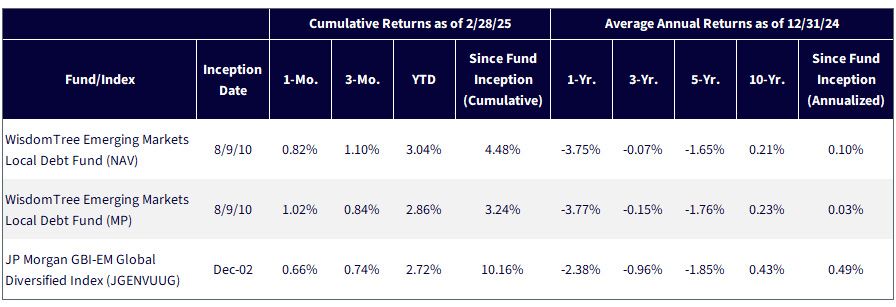
Sources: WisdomTree, Bloomberg, J.P. Morgan. You cannot invest directly in an index. GBI-EM GD: J.P. Morgan Government Bond Index – Emerging Markets (GBI-EM) Global Diversified. Past performance is not indicative of future results. Investment return and principal value of an investment will fluctuate so that an investor's shares, when redeemed, may be worth more or less than their original cost. Current performance may be lower or higher than the performance data quoted. For the most recent month-end and standardized performances and to download the respective Fund prospectuses, click here.
On March 12, 2025, the Fund's Strategy Committee assessed the currency and debt exposures of the Fund as part of its structured investment process. The key changes made in order to position the Fund strategically to take advantage of the current environment include:
- Tactical Tilts with Risk Management:
The Fund upgraded Colombia and Chile due to improving fundamentals while downgrading Brazil on valuation and policy risk concerns. Notably, ELD continues to over-weight Mexico and Indonesia, which are both supported by relative strength in macro metrics.
- Cautious Currency Positioning:
ELD actively reduces exposure to currencies that are more vulnerable to U.S. trade policy shocks. This includes under-weights in countries with high beta to tariffs, helping manage volatility should trade tensions escalate.
As seen in Figure 2, compared to the GBI-EM Global Diversified Index, the Fund's target allocation is over-weight Colombia (+3.86%) and Chile (+2.59%) and under-weight China (-5.57%) and Czech Republic (-2.94%).
Figure 2: Country Allocations
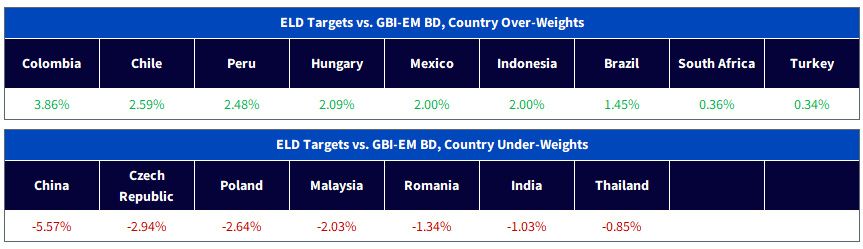
Sources: WisdomTree, Bloomberg, J.P. Morgan, data as of 3/9/25. Subject to change.
Post rebalance, ELD is generating approximately 111 basis points more yield than its benchmark, with slightly longer duration (0.15 years), as seen in figure 3.
Figure 3: Yield & Duration
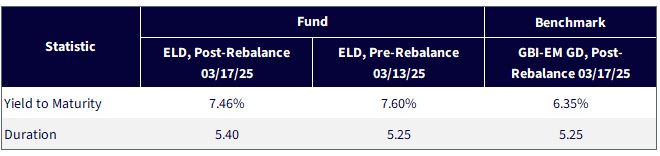
Sources: WisdomTree, Bloomberg, J.P. Morgan, data as of 3/13/25 and 3/17/25. As of 4/17/25, ELD's SEC 30-day yield = 6.35%, and expense ratio = 0.55%. Past performance is not indicative of future results. Investment return and principal value of an investment will fluctuate so that an investor's shares, when redeemed, may be worth more or less than their original cost. Current performance may be lower or higher than the performance data quoted. For the most recent month-end and standardized performances and to download the respective Fund prospectuses, click here.
Conclusion: A Compelling Case for Active Exposure
In an environment where global policy is in flux and risk premiums remain highly reactive, ELD offers a differentiated approach to capturing the structural and tactical opportunities in EM local debt. With a proven track record, active risk management and fundamental research, ELD stands well-positioned to ride the tailwinds of a weaker dollar and emerging market resilience. For investors seeking income and diversification, ELD remains a compelling tool in the EM fixed income toolkit.
Important Risks Related to this Article
There are risks associated with investing, including the possible loss of principal. Foreign investing involves special risks, such as risk of loss from currency fluctuation or political or economic uncertainty. Investments in emerging, offshore or frontier markets are generally less liquid and less efficient than investments in developed markets and are subject to additional risks, such as risks of adverse governmental regulation and intervention or political developments. Derivative investments can be volatile, and these investments may be less liquid than other securities and more sensitive to the effects of varied economic conditions.
Fixed income investments are subject to interest rate risk; their value will normally decline as interest rates rise. In addition, when interest rates fall income may decline. Fixed income investments are also subject to credit risk, the risk that the issuer of a bond will fail to pay interest and principal in a timely manner or that negative perceptions of the issuer’s ability to make such payments will cause the price of that bond to decline. Unlike typical exchange-traded funds, there is no index that the Fund attempts to track or replicate. Thus, the ability of the Fund to achieve its objective will depend on the effectiveness of the portfolio manager. Due to the investment strategy of this Fund, it may make higher capital gain distributions than other ETFs.
Please read the Fund’s prospectus for specific details regarding the Fund’s risk profile.
Categories
Related articles
About the contributor

Behnood Noei, CFA
Director, Fixed Income
Behnood Noei serves as Director of Fixed Income at WisdomTree Asset Management, where he develops the firm’s suite of fixed income and currency exchange-traded funds and enhances existing investment processes. Behnood has 11 years investment experience in portfolio management and quantitative research. Prior to joining WisdomTree in 2022, Behnood was a portfolio manager and developer of some of the fixed income ETFs at J.P.Morgan Asset Management, where he was directly responsible for managing more than 7 Fixed Income ETFs and multiple SMAs with more than $13Billion in assets. He graduated from The Ohio State University with Master of Science degree in Finance and is a CFA charter holder.