
DDWM
Dynamic International Equity Fund

Published April 7, 2025

Director of Modern Alpha
This piece is an update to the blog post, "The Value of Dynamic Currency Hedging."
While the focus on currency hedging has mostly been on the economic and policy uncertainty of countries outside the U.S., the uncertainty of U.S. policy is now making the direction of the dollar hard to assess. Are tariffs strengthening the dollar, as other countries try to devalue to reduce the impact, or weakening the dollar, as investors allocate away from U.S. equity amid volatility? We show that bottom-up currency hedging could be useful as well.
Bottom-up currency hedging could be useful to reduce risk in portfolios. At WisdomTree, we provide systematic and dynamic hedging through our WisdomTree Dynamic Currency Hedged International Equity Fund (DDWM), WisdomTree Dynamic Currency Hedged International SmallCap Equity Fund (DDLS) and WisdomTree International Multifactor Fund (DWMF) for developed markets. We also provide dynamic currency hedging with the WisdomTree Emerging Markets Multifactor Fund (EMMF).
Dynamic currency hedging has delivered substantial benefits, offering a viable alternative to a fully hedged approach. For investors reluctant to commit to 100% hedging, dynamic strategies can help mitigate currency risks while preserving flexibility.
For investors who are hedging currency bets and putting a 50% currency hedge, we show below how our dynamic currency hedging is doing better, even though the average hedge ratio is also close to 50% for the dynamic model.
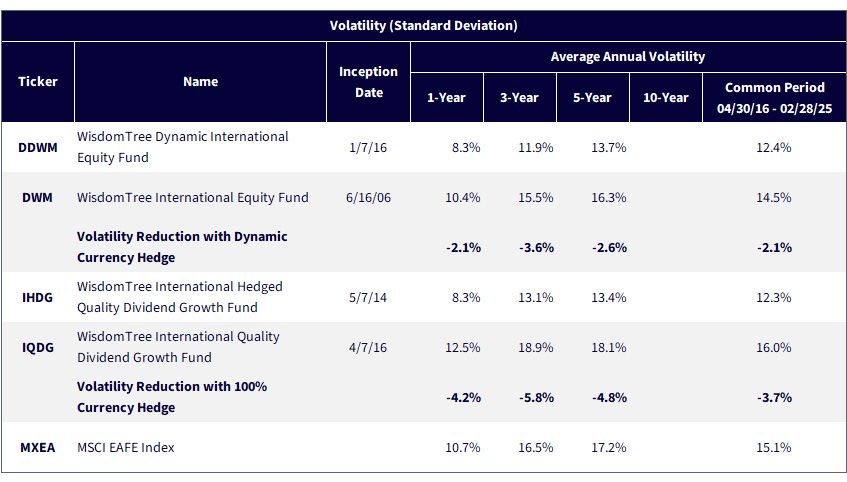
Sources: WisdomTree, FactSet, as of 3/28/25. You cannot directly invest in an index. Currency hedge value add is the difference between fund performances. Past performance is not indicative of future results. Investment return and principal value of an investment will fluctuate so that an investor's shares, when redeemed, may be worth more or less than their original cost. Current performance may be lower or higher than the performance data quoted. For the most recent month-end and standardized performances, click the respective ticker: DDWM, DWM, IHDG, IQDG.
For volatility reduction, a dynamic currency hedge has been shown to reduce portfolio risk consistently and significantly.
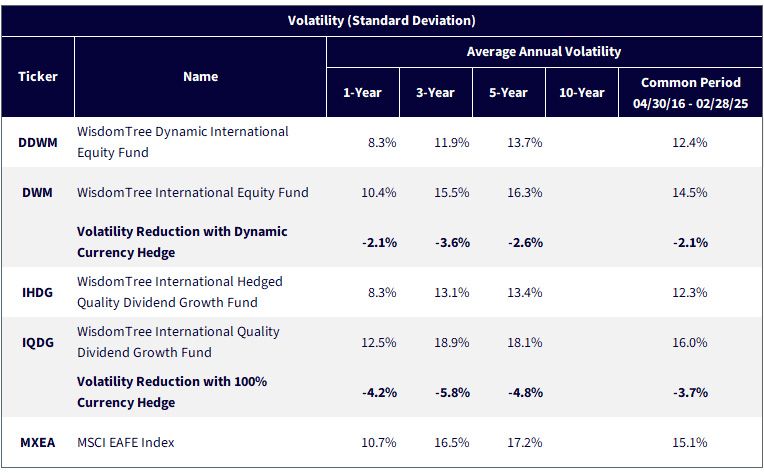
Sources: WisdomTree, FactSet, as of 2/28/25. Volatility reduction = the difference in volatility between two funds. You cannot directly invest in an index.
Since 2023, we've refined our factor-based currency model, placing greater emphasis on momentum. This adjustment has made our dynamic hedging approach more responsive to shifts in the dollar's movement. For instance, our hedge ratio for April 2025 is 22.4%, reflecting this enhanced sensitivity.
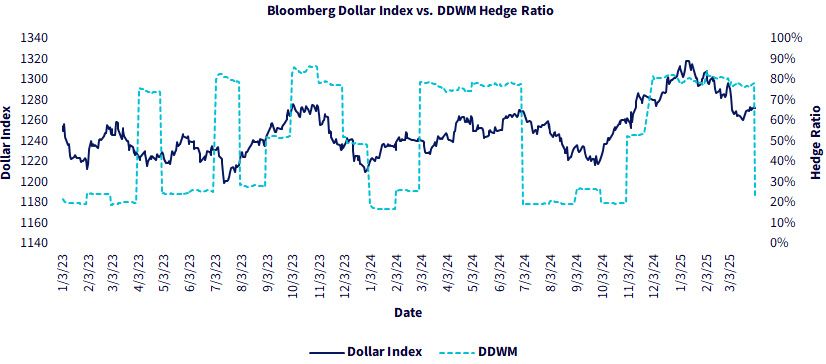
Sources: WisdomTree, Bloomberg, as of 4/1/25. For definitions of terms in the chart above, please visit the glossary. You cannot directly invest in an index.
For emerging markets, the higher momentum factor weights had made the hedge ratio more responsive as well, moving to 50% hedged already during March 2025 and continuing to be around 50% hedged for April 2025.
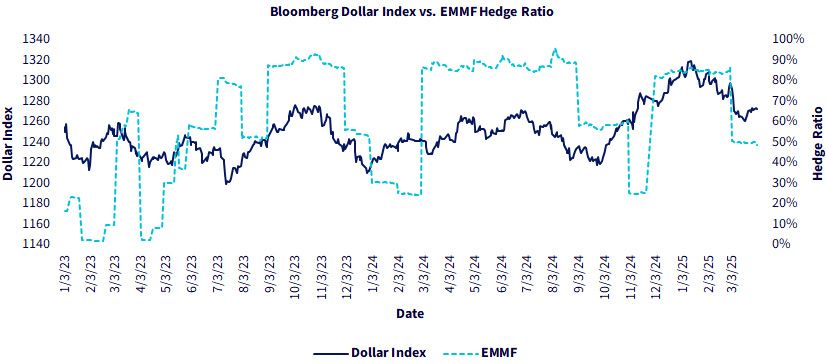
Sources: WisdomTree, Bloomberg, as of 4/1/25. For definitions of terms in the chart above, please visit the glossary. You cannot directly invest in an index.
Almost daily, geopolitical developments—whether related to tariffs, regional conflicts or macroeconomic shifts both in the U.S. and outside the U.S.—underscore the significant role currency risk plays in international investing. Investors can benefit from reduced volatility and enhanced risk management when incorporating more thoughtful approaches to the currency exposure inherent to their international investments.
There are risks associated with investing, including the possible loss of principal. Foreign investing involves special risks, such as risk of loss from currency fluctuation or political or economic uncertainty. The Funds invest in derivatives in seeking to obtain a dynamic currency hedge exposure. Derivative investments can be volatile, and these investments may be less liquid than other securities and more sensitive to the effects of varied economic conditions. Derivatives used by the Funds may not perform as intended. A Fund that has exposure to one or more sectors may be more vulnerable to any single economic or regulatory development. This may result in greater share price volatility. The composition of the Index underlying the Funds is heavily dependent on quantitative models and data from one or more third parties, and the Index may not perform as intended. The Funds invest in the securities included in, or representative of, its Index regardless of their investment merit, and the Funds does not attempt to outperform its Index or take defensive positions in declining markets. Please read the Funds' prospectus for specific details regarding the Funds' risk profile.

Director of Modern Alpha
Liqian Ren, Ph.D., joined WisdomTree as Director of Modern Alpha in 2018. She leads WisdomTree’s quantitative investment capabilities and serves as a thought leader for WisdomTree’s Modern Alpha® approach. Liqian was previously at Vanguard, where she worked for 12 years, most recently as a portfolio manager in the Quantitative Equity Group managing Vanguard’s active funds and conducting research on factor strategies. Prior to joining Vanguard, she was an associate economist at the Federal Reserve Bank of Chicago. Liqian received her bachelor’s degree in Computer Science from Peking University in Beijing, her master’s in Economics from Indiana University—Purdue University Indianapolis, and her MBA and Ph.D. in Economics from the University of Chicago Booth School of Business. Liqian co-hosts a podcast on China and Asian markets with Jeremy Schwartz, WisdomTree’s Global Head of Research, and she is a co-host on the Wharton Business Radio program Behind the Markets on SiriusXM 132.

