
WisdomTree
india_new.jpg

India: Short-Term Slowdown, Long-Term Strength

Published March 14, 2025

Ayush Babel
Ayush Babel

Director, Quantitative Research

Jeremy Schwartz, CFA

Global Chief Investment Officer

Key Takeaways

  • India’s corporate earnings and stock market performance have faced short-term pressure, with the MSCI India Index down more than 21% from its peak, and foreign investors withdrawing over four out of five recent months, from October 2024 to February 2025, amid global uncertainty.
  • Despite this slowdown, India’s GDP is projected to grow at 6.6% in 2025, supported by strong domestic demand, resilient foreign direct investment (FDI) inflows and government-led infrastructure investments.
  • With a young, expanding workforce, structural economic reforms and rising global trade partnerships, India remains one of the most attractive long-term investment opportunities among emerging markets.

Over the past year, India has experienced a slowdown in corporate earnings growth and stock market performance, reflecting global economic headwinds, reduced government spending and softer demand across key sectors. The MSCI India Index had a muted performance over the past year, dropping 5%1 (most of which came from the depreciation of the Indian rupee versus the U.S. dollar) and declining more than 21%1 from its peak in September 2024. Corporate earnings have also grown at a more moderate pace compared to previous years. However, despite these near-term challenges, India remains one of the most compelling long-term investment opportunities globally, driven by structural reforms, strong demographics and continued economic expansion.

The Recent Slowdown: What's Happening?

Muted Corporate Earnings Growth

  • The Nifty 50 companies reported a 5% profit growth in the October–December 2024 quarter, marking the third consecutive quarter of single-digit increases.
  • This represents a slowdown from the 14% annualized earnings growth seen in 2023.
  • Sectors such as banking, IT and consumer goods have faced margin pressures due to rising costs and subdued demand.

Stock Market Underperformance

  • The Nifty 50 has fallen by approximately 17% (USD returns) from its peak, reflecting investor caution amid slowing earnings growth.
  • Foreign institutional investors (FIIs) have withdrawn more than $10 billion from Indian equities in early 2025,1 citing concerns over valuation and global uncertainty.
  • Market volatility has increased as global economic conditions remain uncertain, affecting capital inflows into emerging markets like India.

Economic Growth Remains Resilient

  • Despite the corporate earnings slowdown, India's GDP is projected to grow 6.6% in 2025, one of the highest rates among major economies.
  • Domestic demand remains strong, bolstered by India's expanding middle class and urbanization trends.
  • Government infrastructure spending remains robust, although fiscal tightening has led to a temporary slowdown in some public sector investments.

Why India's Long-Term Investment Story Remains Strong

Structural Economic Growth

  • India is projected to become the world's third-largest economy by 2027, surpassing Japan and Germany.
  • The IMF expects India's GDP to exceed $5 trillion by 2026, reinforcing its position as a key driver of global economic growth.
  • India remains one of the fastest-growing large economies despite short-term earnings pressures.

Resilient Foreign Direct Investment (FDI) and Trade Agreements

  • FDI inflows increased by 26% to $42.1 billion in the first half of FY 2024–2025, signaling continued confidence from global investors.
  • The country has surpassed $1 trillion in cumulative FDI inflows since April 2000, reinforcing its attractiveness as a business hub.
  • The $100 billion trade agreement with the European Free Trade Association (EFTA) is expected to further boost foreign investments, while the FTA with the United Kingdom is in its final stages. There have also been several Memoranda of Understanding (MOUs) with other major economies, including the United States and Japan.

Demographic and Consumption Strength

  • India's median age is just 28 years, providing a dynamic and expanding workforce that will drive consumption and economic growth for decades.
  • The middle class is expected to grow to 800 million by 2030, significantly increasing demand for housing, financial services, health care and consumer goods.
  • Urbanization trends continue, fuelling demand for infrastructure, technology and services.

Government Reforms and Growth Policies

  • India's government has enacted business-friendly reforms, including:
    • A lower corporate tax rate (22%), making it one of the most competitive in Asia.
    • Incentives for foreign investment, including simplified regulations and ease-of-doing-business reforms.
    • Massive infrastructure spending exceeding $1.4 trillion by 2025, for smart cities, highways and digital connectivity.
  • A lower corporate tax rate (22%), making it one of the most competitive in Asia.
  • Incentives for foreign investment, including simplified regulations and ease-of-doing-business reforms.
  • Massive infrastructure spending exceeding $1.4 trillion by 2025, for smart cities, highways and digital connectivity.
  • The "China Plus One" strategy is benefiting India as global supply chains diversify away from China. India has the world's second-largest English-speaking population, which further strengthens its appeal, enabling smoother integration into global supply chains, especially in tech, services and manufacturing.

Sectoral Growth Opportunities

  • Technology & Digital Economy: India's digital economy is projected to surpass $1 trillion by 2030, supported by fintech, AI and cloud services.
  • Manufacturing & Infrastructure: India's Production Linked Incentive (PLI) scheme is attracting billions in FDI, particularly in electronics and semiconductors.
  • Renewable Energy: The government is targeting 500 GW of renewable energy capacity by 2030, creating new investment opportunities in solar, wind and electric vehicles.

Forward-Looking Earnings Projections: Recovery Expected

Despite recent earnings pressures, analysts remain optimistic about India's corporate earnings growth over the next few years:

  • Nifty 50 earnings are projected to grow by 14.7% for the financial year ending March 2026, driven by a recovery in domestic demand and global stabilization.
  • Sectors such as manufacturing, renewable energy and consumer goods are expected to outperform in 2025–2026, as inflation pressures ease and corporate margins expand.
  • Banking and financial services earnings are projected to rebound as credit growth recovers and loan delinquencies stabilize, supported by the proactive monetary policies and regulatory oversight of the Reserve Bank of India (RBI). The RBI's balanced approach to inflation control and economic growth has ensured adequate liquidity in the financial system, while its regulatory measures—such as improved asset quality recognition, capital adequacy norms and stress test frameworks—have strengthened the sector's resilience.
  • The RBI's push for financial inclusion and digital banking initiatives has expanded credit access, driving loan growth. With economic recovery gaining traction, better asset quality, lower credit costs and improving demand for credit are expected to support higher earnings for banks and financial institutions in the coming quarters.

Conclusion: A Temporary Slowdown but a Strong Long-Term Bet

While India has experienced a slowdown in corporate earnings and stock market performance over the past year, its long-term investment story remains intact. The country's strong economic fundamentals, resilient FDI inflows, growing consumer base and government-backed reforms make it a compelling destination for long-term investors.

As earnings growth recovers in the second half of 2025, India is poised to continue its rise as a global economic powerhouse, we believe offering one of the best investment opportunities among emerging markets. Short-term market volatility could be an opportunity for investors to enter India's powerful long-term trajectory.

WisdomTree offers differentiated exposure to India through the WisdomTree India Earnings Fund (EPI) and WisdomTree India Hedged Equity Fund (INDH). EPI provides a broad-based, earnings-weighted exposure to tackle the comparatively expensive Indian markets, while INDH provides exposure to large-cap Indian stocks while hedging the currency exposure, thereby delivering lower volatility alongside reduced currency risk.

It is notable that EPI has delivered strong outperformance over the common history of the Fund versus the iShares MSCI India ETF (INDA), which continues to be the largest ETF by AUM providing exposure to Indian markets. In the last five years to March 5, 2025, EPI delivered a strong 4.96% of annualized outperformance versus INDA, as seen in figure 1.
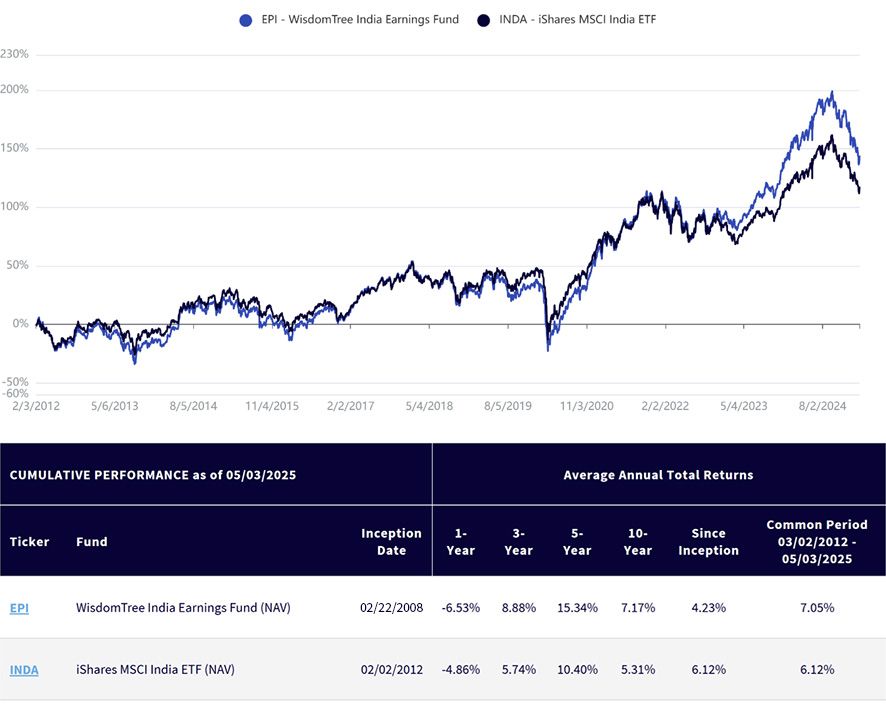
Figure 1: Performance of EPI vs. INDA

figure-1-1.jpg

Sources: WisdomTree, FactSet. Performance from 2/3/12 to 3/5/25—Cumulative Total Return. Current performance may be lower or higher than quoted. Investment returns and principal value of an investment may be worth more or less than their original cost. Past performance is not indicative of future results. Investment return and principal value of an investment will fluctuate so that an investor's shares, when redeemed, may be worth more or less than their original cost. Current performance may be lower or higher than the performance data quoted. For the most recent month-end and standardized performances, click EPI, or call 866.909.9473 for INDA.
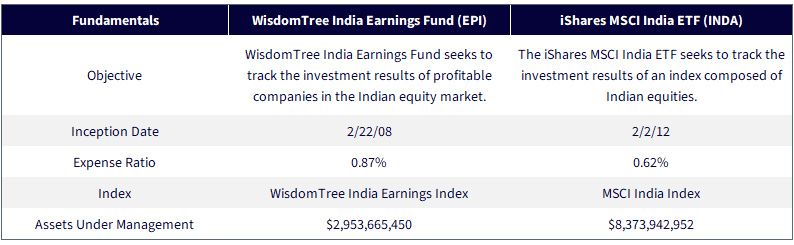
Figure 2: Important Information

figure-2.jpg

Sources: WisdomTree, iShares, as of 3/10/25. Current performance may be lower or higher than quoted. Investment returns and principal value of an investment may be worth more or less than their original cost. Past performance is not indicative of future results. Investment return and principal value of an investment will fluctuate so that an investor's shares, when redeemed, may be worth more or less than their original cost. Current performance may be lower or higher than the performance data quoted. For the most recent month-end and standardized performances, click EPI, or call 866.909.9473 for INDA.

1 Source: Bloomberg, up to 2/28/25.

Important Risks Related to this Article

EPI: There are risks associated with investing, including the possible loss of principal. Foreign investing involves special risks, such as risk of loss from currency fluctuation or political or economic uncertainty. This Fund focuses its investments in India, thereby increasing the impact of events and developments associated with the region, which can adversely affect performance. Investments in emerging, offshore or frontier markets such as India are generally less liquid and less efficient than investments in developed markets and are subject to additional risks, such as risks of adverse governmental regulation and intervention or political developments. As this Fund has a high concentration in some sectors, the Fund can be adversely affected by changes in those sectors. Due to the investment strategy of this Fund, it may make higher capital gain distributions than other ETFs. Please read the Fund’s prospectus for specific details regarding the Fund’s risk profile.

INDA: Carefully consider the Fund’s investment objectives, risk factors, and charges and expenses before investing. This and other information can be found in the Fund’s prospectus and, if available, summary prospectus, which may be obtained by calling 1-800-iShares (1-800-474-2737) or by visiting www.iShares.com or www.blackrock.com. Read the prospectus carefully before investing.

Investing involves risk, including the possible loss of principal.

International investing involves risks, including risks related to foreign currency, limited liquidity, less government regulation and the possibility of substantial volatility due to adverse political, economic, or other developments. These risks are often heightened for investments in emerging/developing markets or in concentrations of single countries.

Diversification may not protect against market risk or loss of principal. Shares of ETFs are bought and sold at market price (not NAV) and are not individually redeemed from the Fund. Any applicable brokerage commissions will reduce returns.

Related Products

About the contributors

Ayush Babel
Ayush Babel

Director, Quantitative Research

Ayush Babel is the Director of Quantitative Research in WisdomTree's multi-asset quantitative research and index teams. In this role, he focuses on developing innovative quantitative strategies across various asset classes while supporting WisdomTree's diverse range of products. His expertise spans factor exploration, portfolio construction and optimization, quantitative investment research, and product development.

With over a decade of experience in the financial services industry, Ayush has held investment research roles at J.P. Morgan and Franklin Templeton. At these institutions, he was responsible for developing and managing equity and fixed income smart beta products, as well as cross-asset risk premia solutions for global institutional and retail clients. His experience covers a broad spectrum of asset classes and investment styles.

Ayush holds a bachelor's in Engineering Physics and a master’s degree in Nanoscience from the Indian Institute of Technology, Bombay.

Jeremy Schwartz, CFA

Global Chief Investment Officer

Jeremy Schwartz has served as Global Chief Investment Officer since November 2021 and leads WisdomTree’s investment strategy team in the construction of WisdomTree’s equity Indexes, quantitative active strategies and multi-asset Model Portfolios. Jeremy joined WisdomTree in May 2005 as a Senior Analyst, adding Deputy Director of Research to his responsibilities in February 2007. He served as Director of Research from October 2008 to October 2018 and as Global Head of Research from November 2018 to November 2021. Before joining WisdomTree, he was a head research assistant for Professor Jeremy Siegel and, in 2022, became his co-author on the sixth edition of the book Stocks for the Long Run. Jeremy is also co-author of the Financial Analysts Journal paper “What Happened to the Original Stocks in the S&P 500?” He received his B.S. in economics from The Wharton School of the University of Pennsylvania and hosts the Behind the Markets podcast. Jeremy is a member of the CFA Society of Philadelphia.

GO PAPERLESS

Contact your broker to sign up for eDelivery of WisdomTree ETF documents.

Investors should carefully consider the investment objectives, risks, charges and expenses of the Funds before investing. U.S. investors only: To obtain a prospectus containing this and other important information, please call 866.909.9473, or click here to view or download a prospectus online. Read the prospectus carefully before you invest. There are risks involved with investing, including the possible loss of principal. Past performance does not guarantee future results.

You cannot invest directly in an index.

Foreign investing involves currency, political and economic risk. Funds focusing on a single country, sector and/or funds that emphasize investments in smaller companies may experience greater price volatility. Investments in emerging markets, real estate, currency, fixed income and alternative investments include additional risks. Due to the investment strategy of certain Funds, they may make higher capital gain distributions than other ETFs. Please see prospectus for discussion of risks.

WisdomTree Funds are distributed by Foreside Fund Services, LLC, in the U.S.

© 2026 WisdomTree, Inc. All Rights Reserved.