
WisdomTree
The Treasury Rally Ticket Needs to Be Validated - Icon Picture

Rate Cuts: That Was Then, This Is Now

Published February 12, 2025

Kevin Flanagan
Kevin Flanagan

Head of Investment and Fixed Income Strategy

Key Takeaways

  • The U.S. labor market remains robust, with the three-month moving average for payrolls surging to its highest level since March 2023, challenging expectations of near-term Federal Reserve (Fed) rate cuts.
  • Persistent labor strength, inflation uncertainty and policy risks could delay or limit monetary easing in 2025.
  • Given the likelihood of heightened bond market volatility, Treasury Floating Rate Notes (FRNs) offer a compelling fixed income solution, balancing income generation with reduced volatility.

The money and bond markets received their first look at the U.S. employment situation for 2025, and on the surface, the results were somewhat of a mixed bag. Given the importance the Fed has placed on both the inflation and labor market aspects of its dual mandate, it is prudent to “check under the hood” of the data to see if anything stands out. Well, after going through this exercise with the January jobs data, one discovers that the employment data may not have been a mixed bag after all, but rather another indication that the nation’s labor market remains solid, a key factor when trying to ascertain the outlook for any potential rate cuts.

Figure 1 below represents the three-month moving average for U.S. total nonfarm payrolls. Utilizing this means of analysis helps not only to “smooth out” any outsized increases or decreases but, more importantly, can provide guidance for underlying trends.
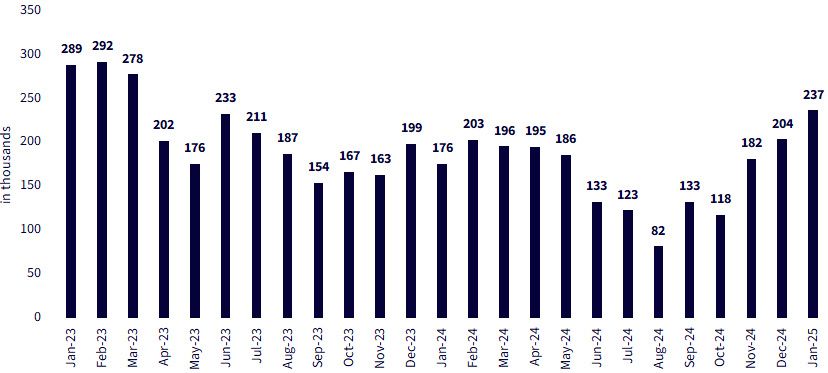
Figure 1: U.S. Total Nonfarm Payrolls, Three-Month Moving Average

figure-1.jpg

Source: Bureau of Labor Statistics, as of 2/7/25.

Here are some highlights of what Powell & Co. are looking at now as compared to when they began cutting rates in an aggressive way back in mid-September.

  • The three-month moving average increase for payrolls has been on a rather noteworthy ascending trend since November, with the current reading now at its highest level since March 2023
  • When the Fed cut rates by 50 basis points (bps) in mid-September, the policy maker was operating under the premise that the labor markets may be cooling too much, as the three-month moving average had fallen to +82k in August
  • The labor market narrative has done a “180” since that first rate cut, and now the current three-month number is at +237
  • Post jobs and CPI, Fed rate cut expectations now point toward only one rate cut for 2025.If the labor market backdrop remains solid, inflation stays “bumpy” and policy/tariff-related uncertainty continues, the hurdle for future easing is raised accordingly
  • The ascending trend in new job creation does not provide the underlying macro support for a continued rally in the Treasury 10-Year yield (it dropped nearly 40 bps from its January peak). In fact, heightened volatility and renewed pressure to the upside is the more likely scenario

Conclusion

The investment backdrop for fixed income highlights the value of Treasury Floating Rate Notes (FRNs) as the cornerstone of our active/passive barbell approach, where the emphasis is on income without the volatility.

Categories

Related Products

About the contributor

Kevin Flanagan
Kevin Flanagan

Head of Investment and Fixed Income Strategy

Kevin serves as the Head of Investment and Fixed Income Strategy. In this role, he writes macro and fixed income-related content and works closely with the sales, research and marketing teams. In addition, Kevin conducts client-facing webinars and meetings, providing expertise on WisdomTree’s existing and future bond ETFs. Prior to joining WisdomTree, Kevin spent 30 years at Morgan Stanley, where he was Managing Director and Chief Fixed Income Strategist for Wealth Management. He was responsible for tactical and strategic recommendations and created asset allocation models for fixed income securities. He was a contributor to the Morgan Stanley Wealth Management Global Investment Committee, primary author of Morgan Stanley Wealth Management’s monthly and weekly fixed income publications, and collaborated with the firm’s Research and Consulting Group Divisions to build ETF and fund manager asset allocation models. Kevin has an MBA from Pace University’s Lubin Graduate School of Business, and a B.S. in Finance from Fairfield University.

GO PAPERLESS

Contact your broker to sign up for eDelivery of WisdomTree ETF documents.

Investors should carefully consider the investment objectives, risks, charges and expenses of the Funds before investing. U.S. investors only: To obtain a prospectus containing this and other important information, please call 866.909.9473, or click here to view or download a prospectus online. Read the prospectus carefully before you invest. There are risks involved with investing, including the possible loss of principal. Past performance does not guarantee future results.

You cannot invest directly in an index.

Foreign investing involves currency, political and economic risk. Funds focusing on a single country, sector and/or funds that emphasize investments in smaller companies may experience greater price volatility. Investments in emerging markets, real estate, currency, fixed income and alternative investments include additional risks. Due to the investment strategy of certain Funds, they may make higher capital gain distributions than other ETFs. Please see prospectus for discussion of risks.

WisdomTree Funds are distributed by Foreside Fund Services, LLC, in the U.S.

© 2026 WisdomTree, Inc. All Rights Reserved.