
USFR
Floating Rate Treasury Fund

Published December 4, 2024

Head of Investment and Fixed Income Strategy
Listen to the accompanying episode of the Basis Points podcast:
With the U.S. interest rate landscape returning to a more historically normal setting over the last year or so, investors are now presented with a backdrop that hasn’t been witnessed in literally more than a decade. As a result, I believe the bond portfolio decision-making process could benefit from taking an active/passive approach from a solution standpoint. In my blog post last week, I highlighted an active core strategy for fixed income investors to consider. This week, I wanted to feature a more passive income solution that comes without the volatility investors have witnessed in the broader bond market over the last couple of years.
In my opinion, Treasury floating rate notes (FRNs) offer bond investors an approach that can be combined, or “barbelled,” with other fixed income solutions when building a portfolio. Treasury FRNs are backed by the full faith and credit of the U.S. government and are reset with the weekly UST 3-Month t-bill auction and an accompanying spread. The WisdomTree Floating Rate Treasury Fund (USFR) allows investors to invest in this asset class in a user-friendly ETF structure.
Why should investors consider Treasury FRNs (USFR)?
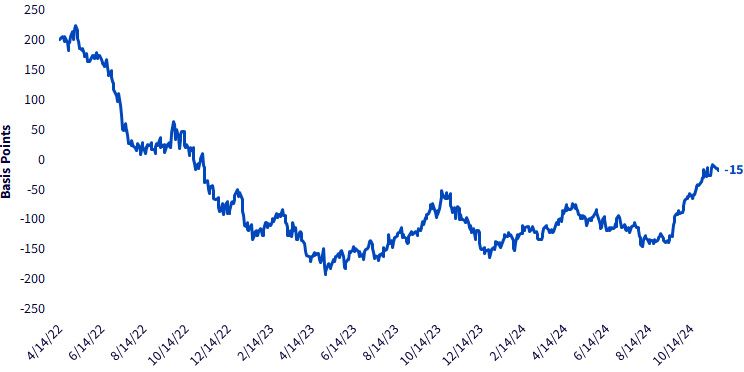
Source: Bloomberg, as of 11/22/24. For definitions of terms in the chart above, please visit the glossary.
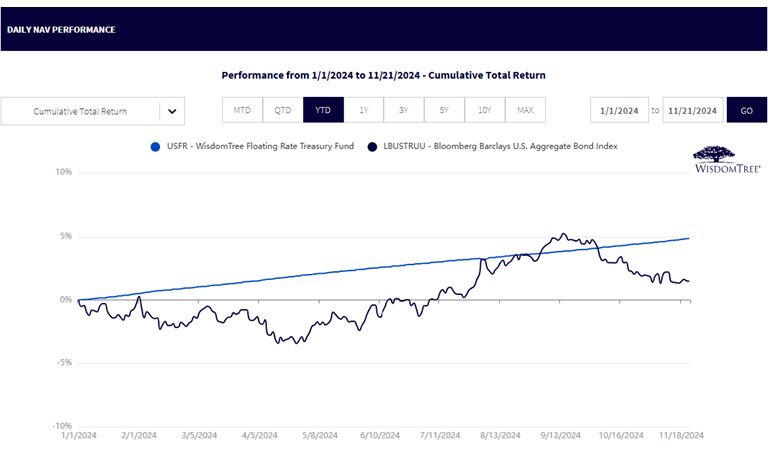
Source: WisdomTree, as of 11/22/24. For definitions of terms in the chart above, please visit the glossary. Past performance is not indicative of future results. Investment return and principal value of an investment will fluctuate so that an investor’s shares, when redeemed, may be worth more or less than their original cost. Current performance may be lower or higher than the performance data quoted. For the most recent month-end and standardized performance, click here.
As I mentioned in the opening, interest rates have now returned to a more normal historical setting. And, even with rate cuts, investors could still be presented with what is viewed as a “higher for longer” regime compared to what many market participants had been accustomed to during the 2010–2021 period.
There are risks associated with investing, including the possible loss of principal. Securities with floating rates can be less sensitive to interest rate changes than securities with fixed interest rates, but may decline in value. Fixed income securities will normally decline in value as interest rates rise. The value of an investment in the Fund may change quickly and without warning in response to issuer or counterparty defaults and changes in the credit ratings of the Fund’s portfolio investments. Due to the investment strategy of this Fund it may make higher capital gain distributions than other ETFs. Please read the Fund’s prospectus for specific details regarding the Fund’s risk profile.
Floating Rate Treasury Fund

Head of Investment and Fixed Income Strategy
Kevin serves as the Head of Investment and Fixed Income Strategy. In this role, he writes macro and fixed income-related content and works closely with the sales, research and marketing teams. In addition, Kevin conducts client-facing webinars and meetings, providing expertise on WisdomTree’s existing and future bond ETFs. Prior to joining WisdomTree, Kevin spent 30 years at Morgan Stanley, where he was Managing Director and Chief Fixed Income Strategist for Wealth Management. He was responsible for tactical and strategic recommendations and created asset allocation models for fixed income securities. He was a contributor to the Morgan Stanley Wealth Management Global Investment Committee, primary author of Morgan Stanley Wealth Management’s monthly and weekly fixed income publications, and collaborated with the firm’s Research and Consulting Group Divisions to build ETF and fund manager asset allocation models. Kevin has an MBA from Pace University’s Lubin Graduate School of Business, and a B.S. in Finance from Fairfield University.

