


The Treasury Rally Ticket Needs to Be Validated
Published August 14, 2024

Kevin Flanagan
Head of Investment and Fixed Income Strategy
Key Takeaways
- The recent U.S. Treasury yield rally is compared to a similar rally in Q4 2023, driven by expectations of a shift in Federal Reserve policy.
- Significant yield movements in UST 2-Year and 10-Year notes over the past two months are highlighted, where the UST 2- and 10-Year trading ranges have been moved lower.
- The need for validation of the recent rally is emphasized, questioning whether the UST 2-Year yield being significantly below the Fed Funds Rate is justified given current economic data.
Is this going to be another case of “déjà vu all over again”? Obviously, I’m referring to another incredible rally in the U.S. Treasury (UST) market, much like investors saw in Q4 of last year. As was the case then, it is still the case now: the Treasury rally needs to be validated.
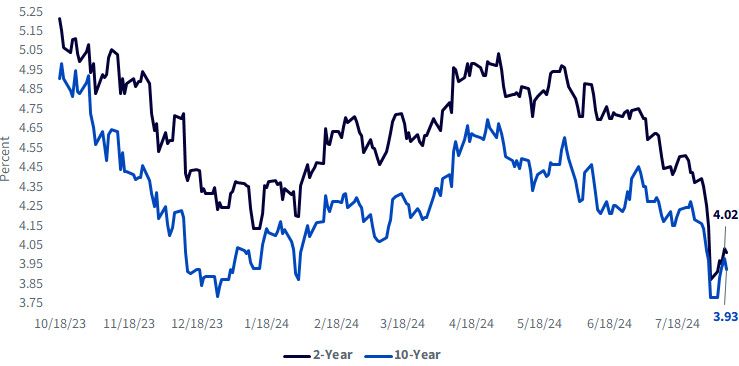
Let’s take a step back to that Q4 plunge in UST yields. The catalyst for that move was the notion of a pivot in Fed policy from rate hikes to rate cuts brought about by improving inflation data and potential softening in economic reports. In hindsight, we all know how that turned out: i.e., the rally was not validated, and as a result, UST yields reversed course in a visible fashion, reaching their 2024 peaks in late April.
U.S. Treasury Yields
Source: Bloomberg, as of 8/9/24.
Fast-forward to the present, where the decline in UST yields was eerily similar to the Q4 experience. For this blog post, I’m going to concentrate on the UST 2- and 10-Year yields. As I mentioned, technically, the 2024 peak readings for each of these maturities actually occurred in late April, but I wanted to highlight the yield movements that have transpired just a little over the last two months.
Taking the 2-Year first, from its late May level, the yield dropped at one point by an incredible 132 basis points (bps), bringing the reading to an intraday low of 3.65%. Of course, most of the headlines are reserved for the UST 10-Year note. In this case, the yield plunged 94 bps for an intraday posting of 3.67%. For the record, in Q4, the declines in yield for the 2- and 10-Year notes were 110 bps and 120 bps, respectively.
Interestingly, while the starting points in terms of yield levels for this most recent rally were a bit lower than the Q4 episode, the aforementioned low watermarks were visibly below those readings, especially for the UST 2-Year note. Indeed, the UST 2-Year nadir was nearly 50 bps less than the prior low point. Why is that noteworthy? Go back to my prior blog post where I discussed Treasury correlations to the Fed Funds target range, and as you may recall, the UST 2-Year yield is very positively correlated to overnight money. Thus, at its low point, the 2-Year was discounting a very aggressive rate-cutting policy from the Fed, considering the mid-point Fed Funds Rate is still at 5.375%.
This is where validation comes back into play. Did it make sense for the UST 2-Year yield to be an eye-opening 173 bps below the Fed Funds level? Given price action as last week progressed, the market’s answer was definitely in the negative, as the yield moved back above the 4% threshold. Yes, disinflation appears to still be intact, but the economic data does not—at this point anyway—point to an imminent recession/hard landing. In fact, the ISM Services gauge that was released last week came in better than expected and above the “50” line of demarcation between expansion and contraction. Perhaps more importantly, weekly jobless claims fell more than projected, completely reversing the prior week’s increase, which had helped to give rise to all those labor market concerns. There was similar yield movement for the UST 10-Year as well, as the rate here bounced 30 bps off its low watermark.
Conclusion
Market expectations now definitively expect a rate cut from the Fed in September, but upcoming labor market data will more than likely hold the key as to whether it will be a 25bp or 50bp easing move. While the UST 2 and 10-year trading ranges have been moved lower, if the data don't point the Fed in the UST market's direction, this most recent rally could once again not be completely validated.

About the contributor

Kevin Flanagan
Head of Investment and Fixed Income Strategy
Kevin serves as the Head of Investment and Fixed Income Strategy. In this role, he writes macro and fixed income-related content and works closely with the sales, research and marketing teams. In addition, Kevin conducts client-facing webinars and meetings, providing expertise on WisdomTree’s existing and future bond ETFs. Prior to joining WisdomTree, Kevin spent 30 years at Morgan Stanley, where he was Managing Director and Chief Fixed Income Strategist for Wealth Management. He was responsible for tactical and strategic recommendations and created asset allocation models for fixed income securities. He was a contributor to the Morgan Stanley Wealth Management Global Investment Committee, primary author of Morgan Stanley Wealth Management’s monthly and weekly fixed income publications, and collaborated with the firm’s Research and Consulting Group Divisions to build ETF and fund manager asset allocation models. Kevin has an MBA from Pace University’s Lubin Graduate School of Business, and a B.S. in Finance from Fairfield University.